Digester acidification: symptoms, causes and a step-by-step action plan
Acidification is the most common process failure. A table of symptoms and causes, a rescue procedure and the rules for restarting after a crisis.
Other language versions: polski.
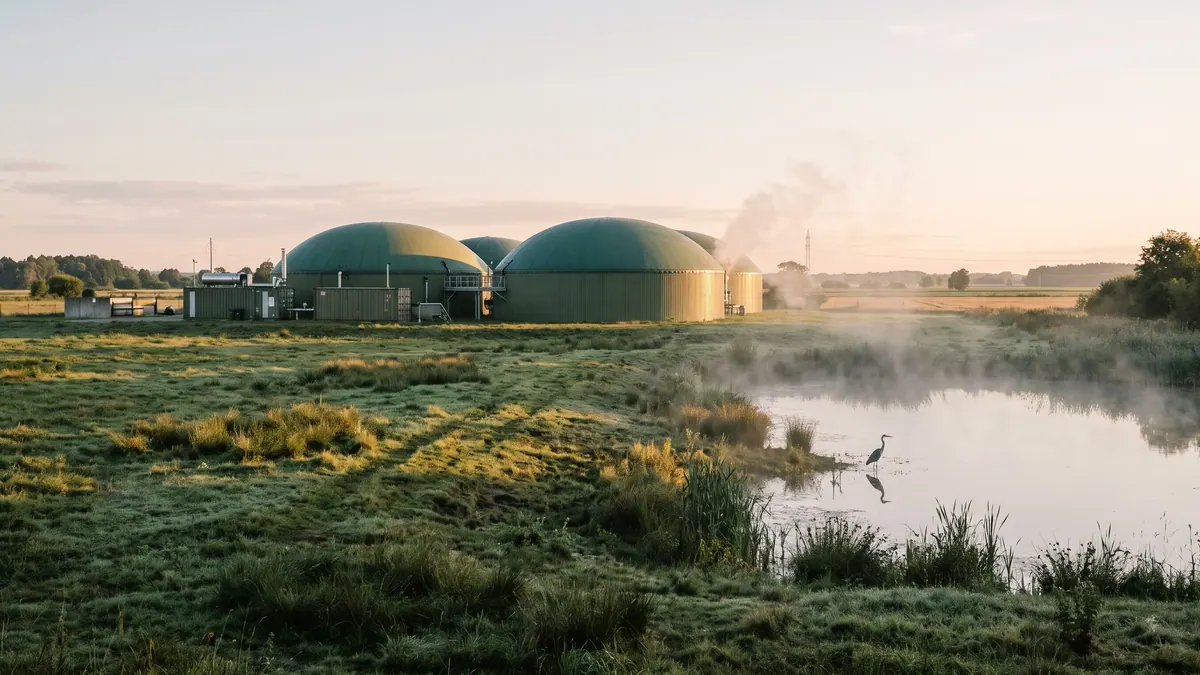
Digester acidification occurs when volatile fatty acids are formed faster than the methanogens consume them, and the buffer (alkalinity) is exhausted. It is recognised by a rising FOS/TAC and VFA concentration, a falling share of CH₄ in the biogas and only at the end — by a fall in pH. The fastest action is to suspend or reduce the feeding of easily degradable substrates and to verify temperature and mixing; only then is a deeper cause sought.
Symptoms and the order in which they appear
| Stage | Indicator | Observation |
|---|---|---|
| Early | propionate, propionate/acetate ratio | rising |
| Early | FOS/TAC | upward trend |
| Middle | CH₄ in the gas | falling, CO₂ rising |
| Middle | gas production | falling or fluctuating |
| Late | pH | falls below approx. 7.0–6.8 |
| Late | foam, smell of acids | foam, a sour or "vinegary" smell of the digestate |
The most common causes
- Overload — too rapid an increase in the feed rate, especially of easily degradable substrates (whey, kitchen waste, sugars, glycerol, silage with a lot of starch).
- Change in temperature — a failure of heating, cold substrate in a large portion.
- Mixing failure — dead zones, sediments, scum.
- Inhibitors — ammonia, H₂S, antibiotics, disinfectants, oxygen after entering the digester.
- Trace element deficiency — chronic VFA.
- Short HRT — washout of biomass.
- Insufficient alkalinity — plants without slurry.
Action procedure
- Confirm the diagnosis: pH, FOS/TAC, VFA, gas composition, temperature. Check the data from recent days (feed rates, failures).
- Reduce the load: suspend the feeding of the most easily degradable substrates; in severe cases suspend all feeding for 1–3 days. The process will "eat" the acids if the methanogens are alive.
- Restore conditions: repair mixing and heating, remove the cause of inhibition.
- Raise the buffer (if necessary): add slurry or digestate from another, stable digester; dose alkaline agents (lime, sodium bicarbonate) in an amount calculated from TAC — in small portions and with pH control. An excess of lime risks precipitation.
- Supplement trace elements if analysis or history indicates it.
- Resume feeding gradually: start with 20–30% of the previous feed rate, increase every few days, watching VFA and FOS/TAC.
- Document: what happened, what the values were, what actions were taken. This is the basis for prevention.
What to avoid
- Abrupt dilution with cold water (a drop in temperature).
- A quick return to the full feed rate after the first improvement in pH.
- Adding many agents at once — it is not known what worked.
- Introducing easily degradable rescue substrates "to raise the gas".
- Using gas with a low methane content in the CHP without control (a drop in quality, risk to the engine).
Prevention
- Increase the feed rate in small steps.
- Maintain a constant temperature and efficient mixing.
- Use a mix with a buffer (slurry) and supplement trace elements.
- Measure FOS/TAC and VFA regularly, not only in a crisis.
- Have an emergency plan: who decides, when and on what basis on a reduction of the feed rate; set alarm thresholds for the plant.
A well-documented crisis is the most valuable source of knowledge about the limits of your own plant; once it has been brought under control, it is worth updating the alarm thresholds and procedures.
Example scenario
A plant operates stably with FOS/TAC of approx. 0.3 and pH 7.6. On Monday the share of silage was increased by 15%, and on Wednesday a batch of whey was added. On Thursday FOS/TAC is 0.45, on Friday 0.58, CH₄ falls from 53% to 50%. The operator: (1) suspends the whey, (2) reduces the silage to the previous level, (3) on Saturday measures VFA — propionate 1.6 g/l, (4) adds a portion of cattle slurry from the neighbouring digester, (5) on Sunday sees FOS/TAC fall to 0.52, (6) in the following week increases the feed rate gradually. Thanks to the quick reaction, pH never fell below 7.2, and production returned to normal after about ten days.
The role of communication and procedures
The most common cause of a delayed reaction is the lack of clear responsibility: measurements are made by the laboratory, feeding is handled by another person, and decisions are made by the manager. A written procedure with thresholds (e.g. FOS/TAC above value X for two measurements = a reduction of the feed rate by Y%) removes doubts and shortens reaction time.
When to suspend feeding completely
A complete suspension of feeding for 1–3 days is justified when pH falls below approx. 7.0 and at the same time propionate rises and the share of CH₄ in the gas decreases rapidly. During this time mixing and heating must continue unchanged, and measurements should be repeated at least once a day. The feed rate is resumed only when FOS/TAC clearly falls and the gas composition improves. Too early a return to the feed rate usually ends in a relapse of acidification.
Sources
Questions and answers
Can acidification be recognised from pH alone?
Usually too late. The buffer masks the build-up of acids, so pH falls only at the end. Earlier, FOS/TAC and propionate rise, and the share of CH₄ in the gas falls.
Related articles