BMP testingAnalysis
BMP and biogas plant yield: why laboratory and full-scale results differ
Why does laboratory BMP usually exceed the actual yield of a plant? We break the difference down into factors: time, kinetics, losses, data errors and measurements. With a worked example.
Other language versions: polski.
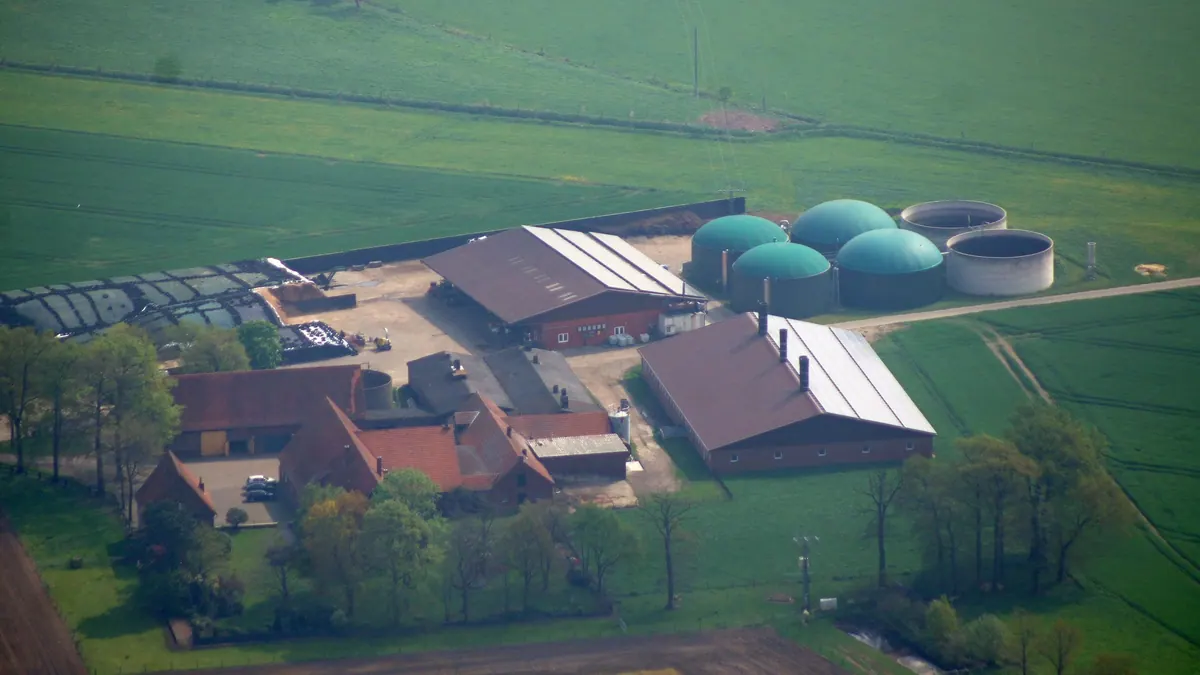

Methane yield at a biogas plant is usually lower than the sum calculated from the BMP of the substrates, because the laboratory test provides optimal conditions and time until production is exhausted, whereas the digester has a limited retention time, imperfect mixing and losses. On the other hand, part of the discrepancy is not biology but data errors: inaccurate weighing, variable TS and VS of substrates, and uncertainty in gas measurement. A reliable comparison requires a balance with explicit uncertainties.
Factors lowering yield at full scale
| Factor | Mechanism | Scale of impact |
|---|---|---|
| Retention time (HRT) | part of the slowly degradable fractions leaves the digester undegraded | depends on the substrate; greater for fibrous ones |
| Imperfect mixing | dead zones, short-circuiting | variable |
| Process conditions | temperature fluctuations, inhibitors, micronutrient deficiency | variable |
| Methane losses | releases, leaks, flare, digestate storage | a few to a dozen or so per cent in poorly run plants |
| Feed heterogeneity | batches of differing quality | random |
| Pretreatment or lack of it | full-scale size reduction differs from that in the test | variable |
Data-related factors
- TS and VS of substrates – variable over time; use of catalogue values instead of batch analyses.
- Dosed masses – weighing errors, unreported additions, changes in moisture.
- Gas measurement – flow meter calibration, humidity, temperature, standard conditions.
- Gas composition – the analyser requires calibration; an error of 1–2 percentage points of CH₄ translates directly into a methane error.
- Averaging period – a balance shorter than several HRT is distorted by changes in the digester contents.
Worked example
Assumptions (illustrative): over a month 600 t of silage (TS 33%, VS 95% of TS, BMP 340 NmL/g VS) and 1,200 t of slurry (TS 8%, VS 80% of TS, BMP 200 NmL/g VS) were fed. Measured methane: 92,000 m³.
- VS of silage: 600,000 kg × 0.33 × 0.95 ≈ 188,100 kg; CH₄ = 188,100 × 0.340 ≈ 63,950 m³,
- VS of slurry: 1,200,000 × 0.08 × 0.80 = 76,800 kg; CH₄ = 76,800 × 0.200 ≈ 15,360 m³,
- sum from BMP: ≈ 79,300 Nm³ (BMP is given in NmL/g VS, i.e. at standard conditions); measured 92,000 m³ (assuming conversion to the same standard conditions) → 116% of the BMP value.
A result above 100% is a signal that there is an error in the data or that substrates are missing (e.g. an unrecorded fat addition, an overstated gas measurement, underestimated VS). Had the measured value been 70,000 m³ (88% of BMP), the result would have been typical of a well-run plant. This shows that the balance should be treated as a plausibility check, not as proof of process performance alone.
Degree of degradation as a measure
The ratio of measured methane to that calculated from BMP is referred to as relative efficiency. A higher value means better use of the potential. Alongside this, the residual potential of the digestate is assessed (a BMP test of a sample from the outlet). If the residual potential is high and losses are small, the reserve lies in the process: HRT, mixing, pretreatment. If it is low and the balance does not close, look for data errors or losses.
How to improve the agreement of the balance
- Analyse the TS and VS of each delivery (or at least every few days for silage).
- Weigh everything that goes in (approved, calibrated scales).
- Calibrate the biogas flow meter and the CH₄ analyser.
- Harmonise standard conditions in documents.
- Close the balance over periods of at least several HRT.
- Add uncertainties: ±5% of masses, ±5% of VS, ±5% of gas gives a combined interval of over a dozen per cent.
Conclusions for the user of BMP results
BMP is a useful reference point for planning and for assessing substrates, but it is not a promise of yield. In design, correction factors based on experience are applied, and in settlements with a substrate supplier — data from one's own plant. It is also worth remembering that some substrates (fats, fibrous materials) show greater discrepancy than silages.
In 2017 Holliger, Fruteau de Laclos and Hack published an analysis comparing methane production calculated from the BMP of substrates with that measured on site in full-scale plants; the title of the paper summarises its conclusion — calculations from BMP agree well with measurements, provided that the data on substrates and production are reliable. Discrepancies should therefore first be explained by data quality and process conditions.
Checklist for comparing BMP with the plant
- Choose a period of at least several HRT without major failures.
- Collect the masses of substrates, TS and VS from analyses.
- Calculate the sum of CH₄ from BMP (Σ mass·TS·VS·BMP).
- Measure or read the actual methane from the gas meter and analyser.
- Estimate the uncertainty of each component.
- Calculate the ratio and its interval.
- If the result goes beyond about 100%, check the data first, then the process.
An exercise carried out once a quarter quickly shows whether the plant is operating stably relative to its own history.
The role of pretreatment
Size reduction, thermal hydrolysis or enzymatic additives affect mainly the rate and degree of degradation of difficult fractions. A BMP test of the sample before and after pretreatment, with the same protocol, is a reliable way to check the effect before buying the equipment.
Sources
- Holliger C. et al. (2016), Towards a standardization of biomethane potential tests, Water Sci. Technol. 74(11), 2515–2522
- Holliger C., Fruteau de Laclos H., Hack G. (2017), Methane Production of Full-Scale Anaerobic Digestion Plants Calculated from Substrate's Biomethane Potentials Compares Well with the One Measured On-Site, Front. Energy Res. 5, 12
- Weiland P. (2010), Biogas production: current state and perspectives
- IEA Bioenergy Task 37
Questions and answers
Can an installation have a higher yield than BMP?
The actual yield from a substrate rarely exceeds BMP. If the balance shows more, data errors are usually to blame: understated masses or VS, overstated gas measurement, unreported additional substrates.
Related articles