BMP testingGuide
How to calculate methane in the BMP test: standard calculations and findings from Hafner et al. (2020)
Calculation errors can change a BMP result by several to a dozen or so per cent. We discuss the corrections: dry gas, water vapour, headspace, solubility and gas mass.
Other language versions: polski.
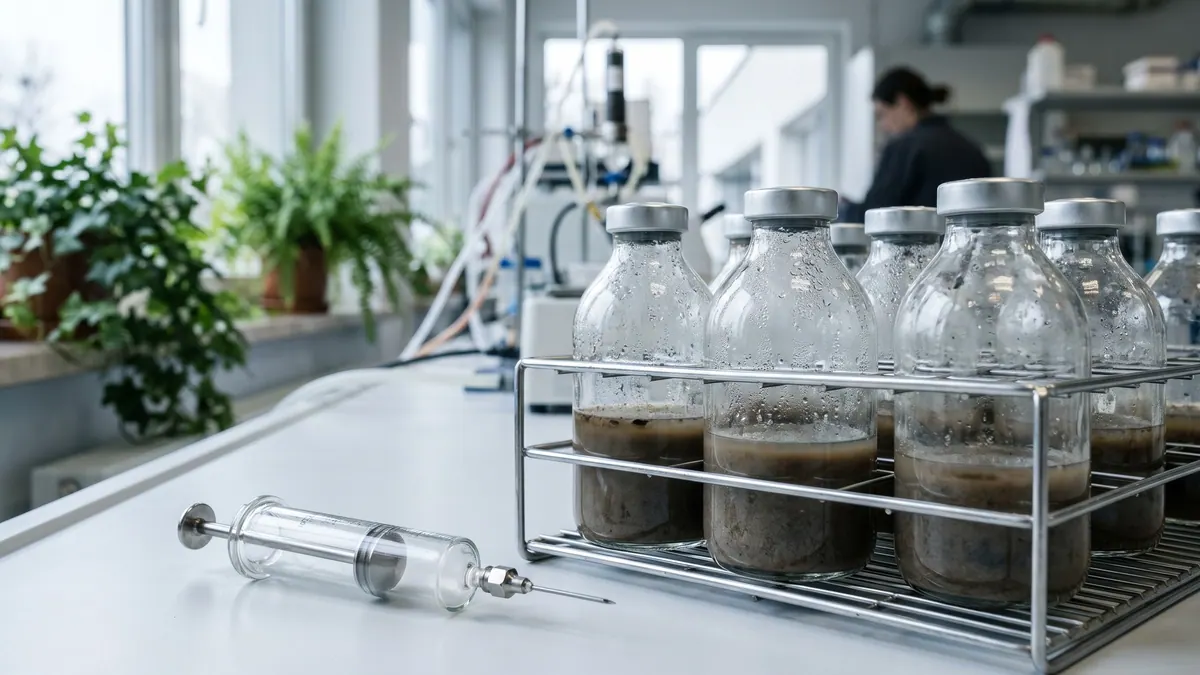
The result of a BMP test depends not only on biology but also on the way it is calculated. A correct calculation requires converting the methane volume to dry gas at standard conditions (0 °C, 1013 hPa), accounting for water vapour, for changes in headspace volume after gas release and, depending on the measurement method, for the solubility of CO₂ and CH₄ in the liquid. These principles are described in the open documents of the 200 series of the "Standard BMP Methods" collection (DBFZ), maintained by the group of authors of the BMP guidelines. The related inter-laboratory study (Hafner et al. 2020, Water 12(6), 1752) is not a calculation handbook: it indicates that errors in data processing and data entry were among the significant sources of scatter between laboratories, and that simplifications can produce differences of the order of several to a dozen or so per cent.
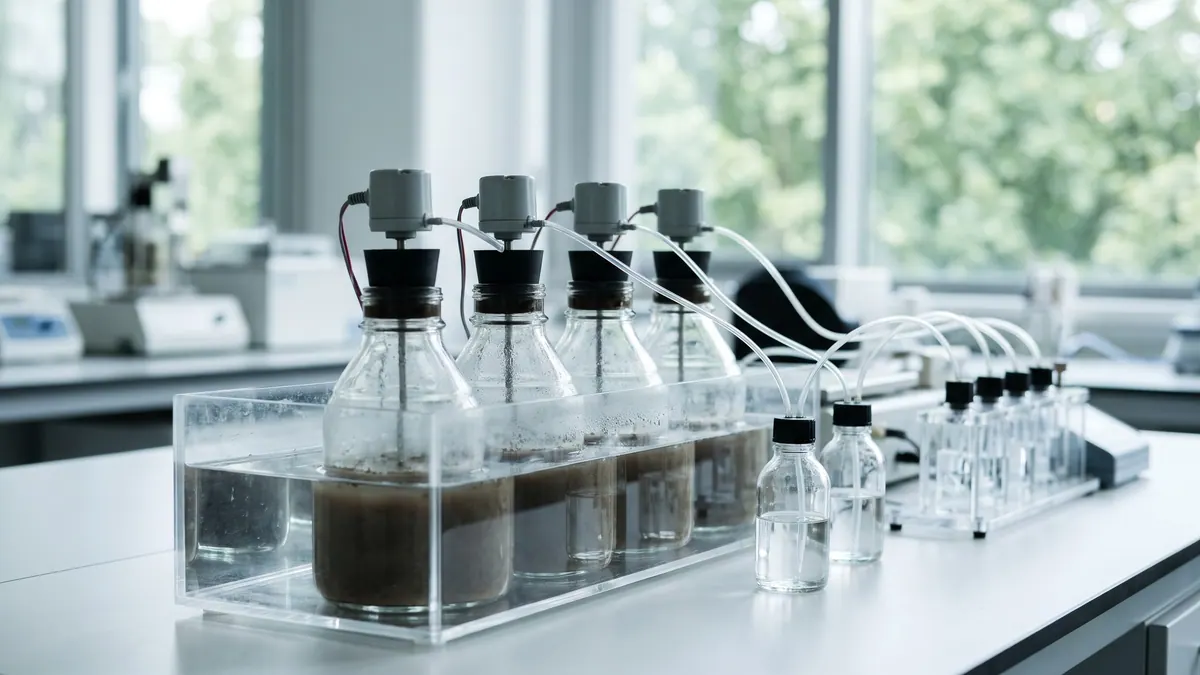
Three basic types of measurement
| Method | What we measure | Most important corrections |
|---|---|---|
| Manometric | pressure in the headspace of the bottle | conversion of pressure to moles of gas, water vapour, CO₂ solubility, composition from GC |
| Volumetric | volume of displaced liquid | temperature, water vapour, solubility, pressure |
| Gravimetric (gas mass) | loss of bottle mass after gas release | gas composition from GC, molar mass |
Conversion to standard conditions
From the ideal gas equation:
n = p·V / (R·T), where p is the partial pressure of the dry gas (after subtracting the water vapour pressure), V — the headspace volume, T — the temperature in kelvins.
Volume at standard conditions: V_N = n · 22.414 L/mol (for 0 °C, 1013.25 hPa).
Example (illustrative assumptions): headspace 300 mL (0.300 L), after 5 days the pressure rose by 400 hPa relative to the initial pressure, temperature 37 °C (310.15 K). Water vapour is already present at the start, so the pressure increase refers to dry gas. With R = 83.14 hPa·L/(mol·K): Δn = Δp·V/(R·T) = 400 × 0.300 / (83.14 × 310.15) ≈ 0.00465 mol. At standard conditions: 0.00465 × 22,414 mL/mol ≈ 104 NmL of gas. With a composition of 65% CH₄, the methane is about 68 NmL. If someone calculated the entire pressure without separating out the water vapour (about 6% of the total pressure at 37 °C), the result would be overstated. The sequence is always the same: Δp → Δn → V_N → CH₄ fraction from GC.
Common errors
- Omitting water vapour. At 37 °C water vapour accounts for about 6% of the total pressure; omitting it overstates the volume of dry gas.
- Wrong headspace volume. It is not equal to the nominal volume of the bottle; it depends on the volume of liquid. It must be measured or calculated accurately.
- Neglecting CO₂ solubility. At higher pH part of the CO₂ remains in the liquid as bicarbonate, which lowers the pressure; methane is much less soluble and the correction is usually small, but it matters for accurate comparisons.
- Not accounting for gas composition when releasing gas. Gas released after a measurement takes methane with it; it must be calculated from GC for each point.
- Using different standard conditions (0 °C vs 20 °C vs 25 °C) without declaring them.
- Inaccurate calibration of pressure sensors and GC.
Practical recommendations
- Carry out calculations in a spreadsheet or script consistent with the published method and verify it on reference data (e.g. the cellulose result).
- At each measurement record the pressure, temperature, volume of gas released and composition.
- Calculate cumulative methane production as the sum of increments, taking into account the methane removed.
- Report the result together with a description of the convention (dry gas, 0 °C, 1013 hPa).
Differences between methods
The study by Hafner et al. (2020), involving more than thirty laboratories, showed that with different measurement methods (including manometric, volumetric and gravimetric) very similar BMP values can be obtained, but manual manometric and volumetric methods showed a negative bias in the results. Errors in data processing and entry also played an important role, and a significant part of the scatter could not be attributed to any of the factors studied (probably it resulted from the individual practices of laboratories or technicians). That is why the harmonisation of measurements, calculations and validation is so important.
Spreadsheet checklist
- [ ] Standard conditions defined.
- [ ] Water vapour taken into account (as a function of temperature).
- [ ] Headspace volume determined for each bottle.
- [ ] CO₂ solubility considered within the uncertainty or explicitly.
- [ ] Released methane included in the total.
- [ ] Cellulose test consistent with the criterion.
Validating the calculation spreadsheet
Check the spreadsheet on reference data: assume a known pressure, volume and composition, calculate the result by hand and compare. Test extreme cases (low and high pressure, different incubation temperatures). After every change to the formulas, save a version of the spreadsheet. This simple discipline eliminates most systematic errors, which would otherwise only come to light in an inter-laboratory comparison.
Cumulative curves
Besides the final value, the whole cumulative production curve matters. Only it makes it possible to fit kinetic models and assess the lag phase. At each measurement point record how much gas was released and what its composition was, so that the curve is reproducible.
When differences matter
For a single determination, a difference of the order of a few per cent may seem small, but in settlements (e.g. with a substrate supplier) or in comparisons between series it becomes significant. Harmonising calculations is the cheapest way to reduce scatter; it requires only discipline and a well-checked spreadsheet.
Sources
- Hafner S.D., Fruteau de Laclos H., Koch K., Holliger C. (2020), Improving Inter-Laboratory Reproducibility in Measurement of Biochemical Methane Potential (BMP), Water 12(6), 1752
- Holliger C. et al. (2021), Towards a standardization of biomethane potential tests: a commentary, Water Sci. Technol. 83(1), 247–250