BMP testingGuide
BMP test protocol step by step: from sample to methane yield curve
The full path of a batch test: sample preparation, inoculum, filling, incubation, gas measurement, termination and calculations. With a checklist and typical mistakes.
Other language versions: polski.
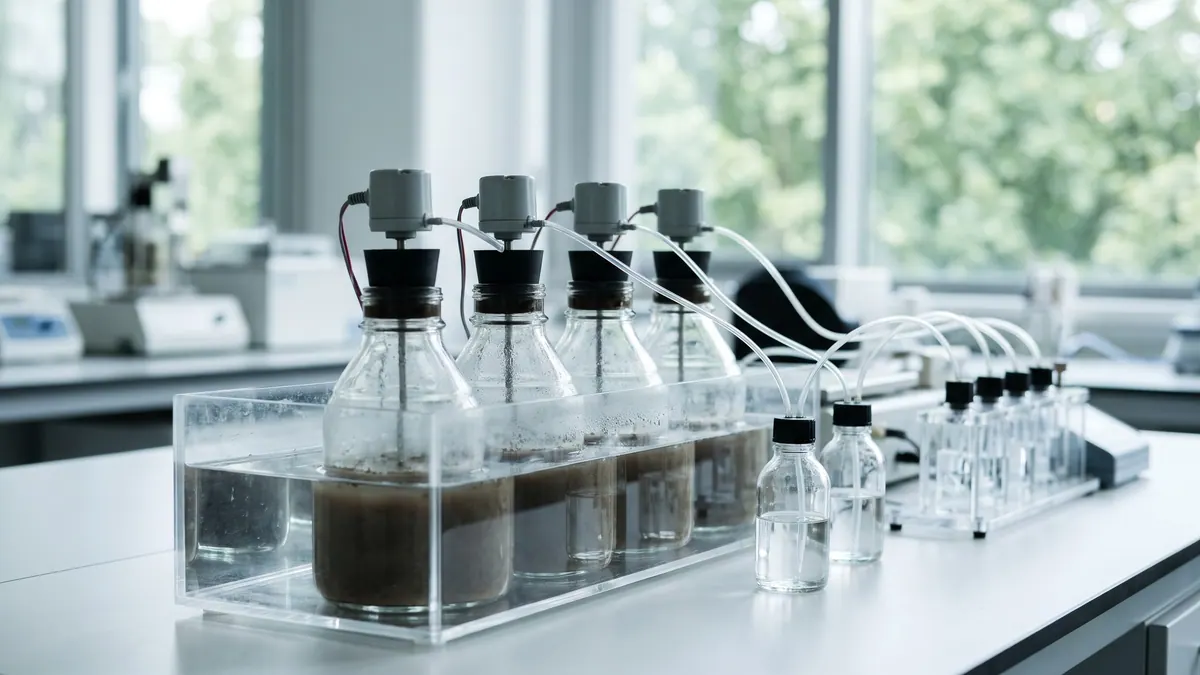
A BMP test is carried out in seven steps: determining the TS and VS of the sample, preparing and degassing the inoculum, calculating sample weights at a given I/S, filling and sealing the bottles, incubation at a constant temperature, measuring the volume and composition of the gas, and terminating the test and calculating BMP after subtracting the blank. Each stage affects the uncertainty of the final result, so the protocol should be written down and applied identically to all series.
1. Sample
- Take a representative sample (often several times larger than needed) and homogenise it; fibrous materials are ground to a size that allows reproducible sample weights to be taken (of the order of millimetres).
- Determine TS (drying at about 105 °C) and VS (ignition at about 550 °C) in at least two replicates. For ensiled substrates or those containing volatile compounds (alcohols, acids) drying at 105 °C underestimates TS and VS; corrections or determinations that take volatile compounds into account are then used.
- Store the sample in a way that limits changes (cooling, freezing), recording the conditions.
2. Inoculum
Inoculum from a working installation or a laboratory reactor is degassed (a few days at the test temperature) in order to lower endogenous production. Its TS, VS, pH and alkalinity are determined, often also VFA and ammonium nitrogen. Details are in the article on inoculum.
3. Sample weights and I/S
The mass of substrate is chosen so that the inoculum-to-substrate ratio (I/S, on a VS basis) complies with the guidelines (see the separate article); in doing so remember that the total volume of liquid and the free space above the liquid must hold the gas and allow measurement.
4. Filling
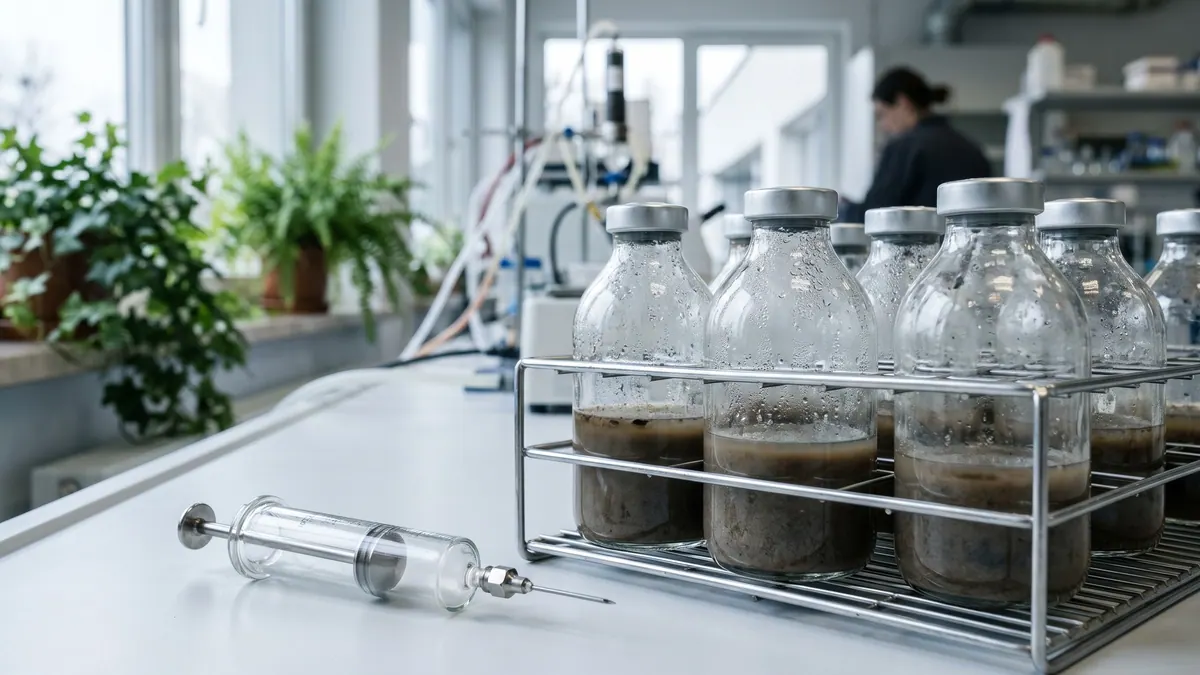
- Weigh the inoculum and substrate into the bottles (usually glass, with a volume of several hundred mL).
- Top up with water or medium to a constant volume.
- Correct the pH if the procedure requires it.
- Flush the headspace with an inert gas (N₂ or N₂/CO₂) to remove oxygen.
- Close the bottles tightly (septum stoppers, caps).
- Prepare: test samples in triplicate, blanks (inoculum only), a positive control (cellulose), and optionally a test with a reference substrate.
5. Incubation
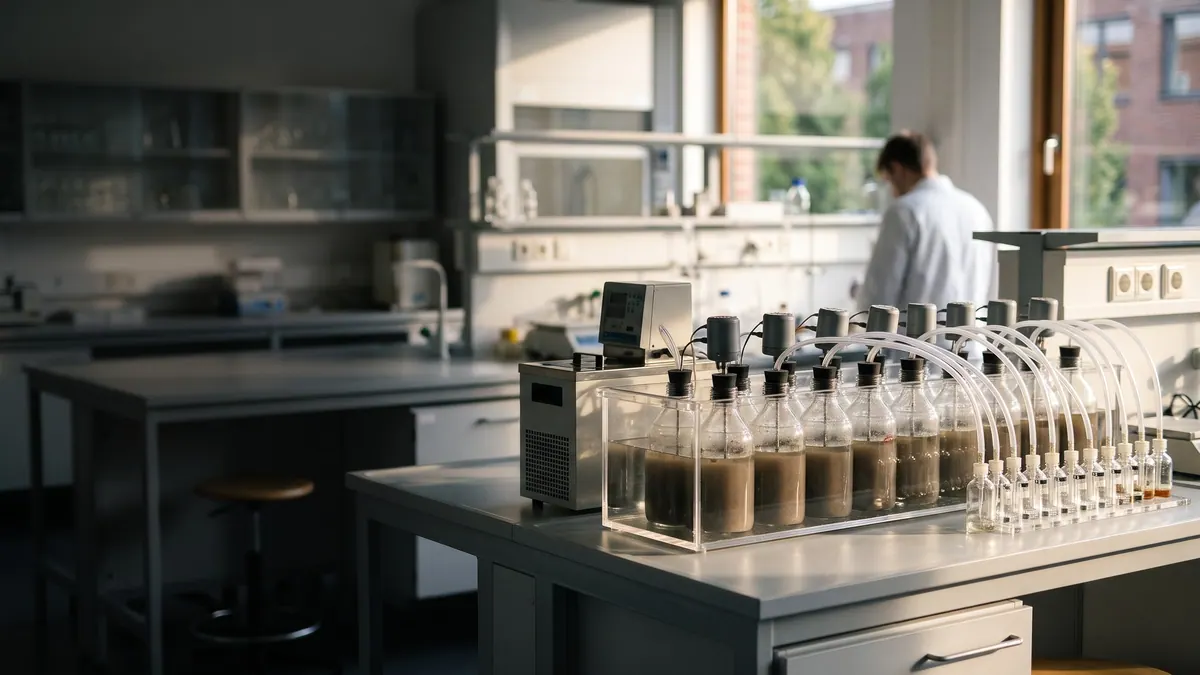
A constant temperature (mesophilic, e.g. 35–38 °C, or thermophilic, about 52–55 °C), gentle manual or mechanical mixing, stable conditions. Temperature fluctuations and lack of mixing increase scatter.
6. Gas measurement
| Method | Principle | Notes |
|---|---|---|
| Manometric | measurement of pressure in the headspace | requires venting and correction for CO₂ solubility |
| Volumetric | measuring out gas by displacement of liquid | simple, sensitive to leaks and solubility |
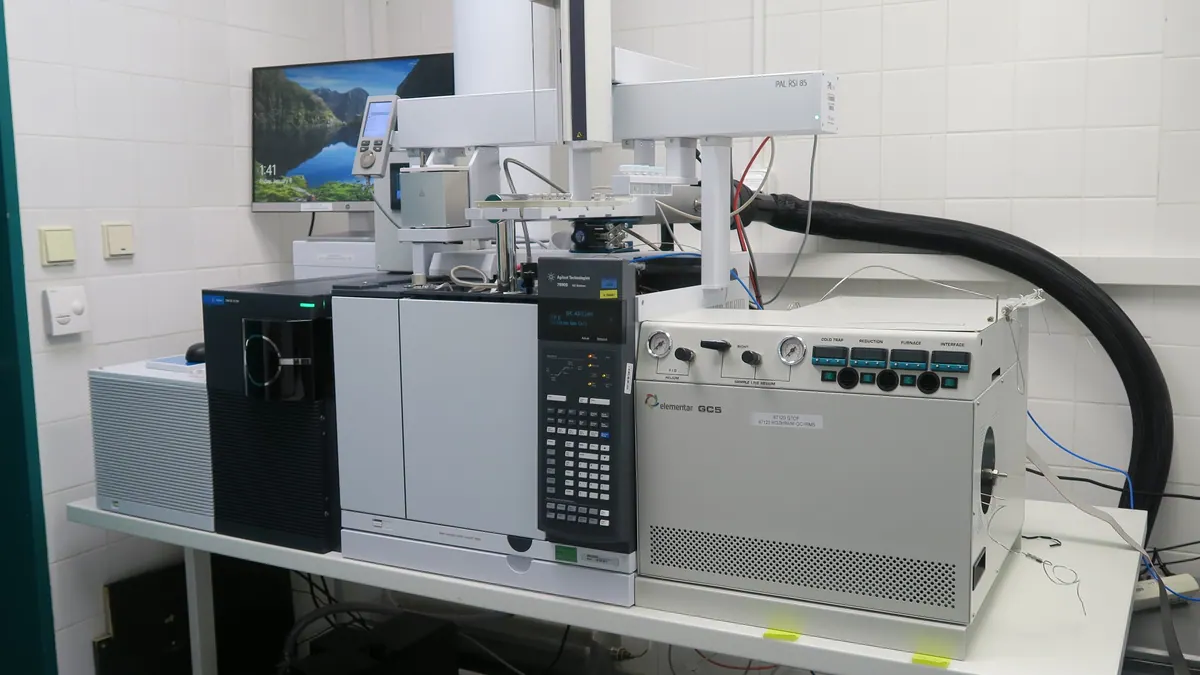
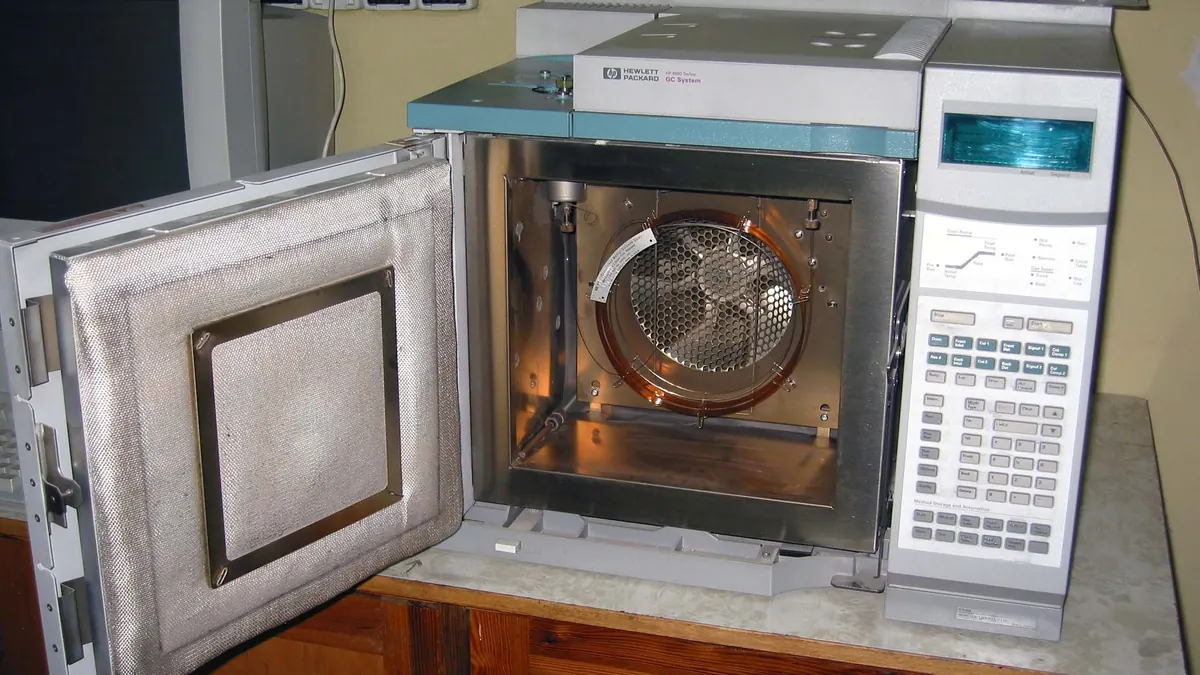
| Chromatography (GC) | CH₄/CO₂ composition | essential when biogas, not methane alone, is measured |
| Automatic systems | measurement of methane volume after CO₂ is bound in lye | convenient, require calibration |
The volume is converted to normal conditions, to dry gas, taking into account water vapour pressure and temperature. Standardised calculation methods (the "Standard BMP Methods" collection, DBFZ) and the conclusions of the study by Hafner et al. (2020) are discussed in a separate article.
7. Termination and calculations
According to current guidelines the test is considered finished when the daily methane production from a single bottle for 3 consecutive days is lower than 1.0% of the cumulative net methane increase from the substrate. Then:
BMP = (V_CH₄,sample − V_CH₄,blank·m_inoc,sample/m_inoc,blank) / m_VS,substr
In the simplest form, if the sample and the blank contain the same mass of inoculum, the mean of the blanks is simply subtracted. For three replicates the mean and the standard deviation (or relative standard deviation) are given.
Example
Sample weight: 1.5 g VS; V_CH₄ of the samples after 28 days: 560, 575, 590 NmL (mean 575); blank: 140 NmL. BMP = (575 − 140) / 1.5 = 290 NmL CH₄/g VS. Standard deviation of the samples: 15 NmL → RSD of the net result ≈ 15 / 435 ≈ 3.4%.
Checklist before starting
- [ ] Calibrated scales, pipettes, manometers, GC.
- [ ] Inoculum degassed and tested.
- [ ] I/S protocol checked by calculation.
- [ ] Blanks and cellulose in the same series.
- [ ] Bottles checked for tightness.
- [ ] Temperature, time and measurement method recorded.
Typical mistakes
- Too large a sample weight — acidification, inhibition, delay.
- No degassing of the inoculum — high background.
- Neglecting CO₂ solubility in pressure measurements.
- Leaks — gas losses, underestimated result.
- Calculating on TS instead of VS without stating so.
- Ignoring the lag — wrong interpretation of kinetics.
Documentation and sample tracking
Each bottle should have a unique number, and the test log records masses, dates, times of measurements, incubator temperature, pressure readings, GC results and the operator's signature. Raw data are archived together with the calculation sheet so that an auditor can reproduce the result. Keeping reserve samples of the substrate and inoculum for a possible repeat also helps.
Duration
For easily degradable substrates the test ends after 2–3 weeks; for fibrous or difficult ones it can last more than a month. Termination according to the daily production criterion is fairer than a fixed time, because it does not cut off the slow fraction.
What to do with heterogeneous samples
Municipal waste, silages with additives, and mixtures with stones or plastics require special care. The sample is divided by the quartering method, non-degradable fractions are removed (with their mass recorded), and a larger number of replicates is taken for the test. If the size reduction is to reflect the technique used at the biogas plant (e.g. a shredder, a mill), this must be described, because it affects kinetics.
Sources
Related articles