BMP testingExplainer
VDI 4630 and ISO 11734: what they regulate and how they differ from BMP protocols
Two documents often cited in fermentation test reports: the German guideline VDI 4630 and the standard ISO 11734. We explain their scope and why they are not interchangeable.
Other language versions: polski.
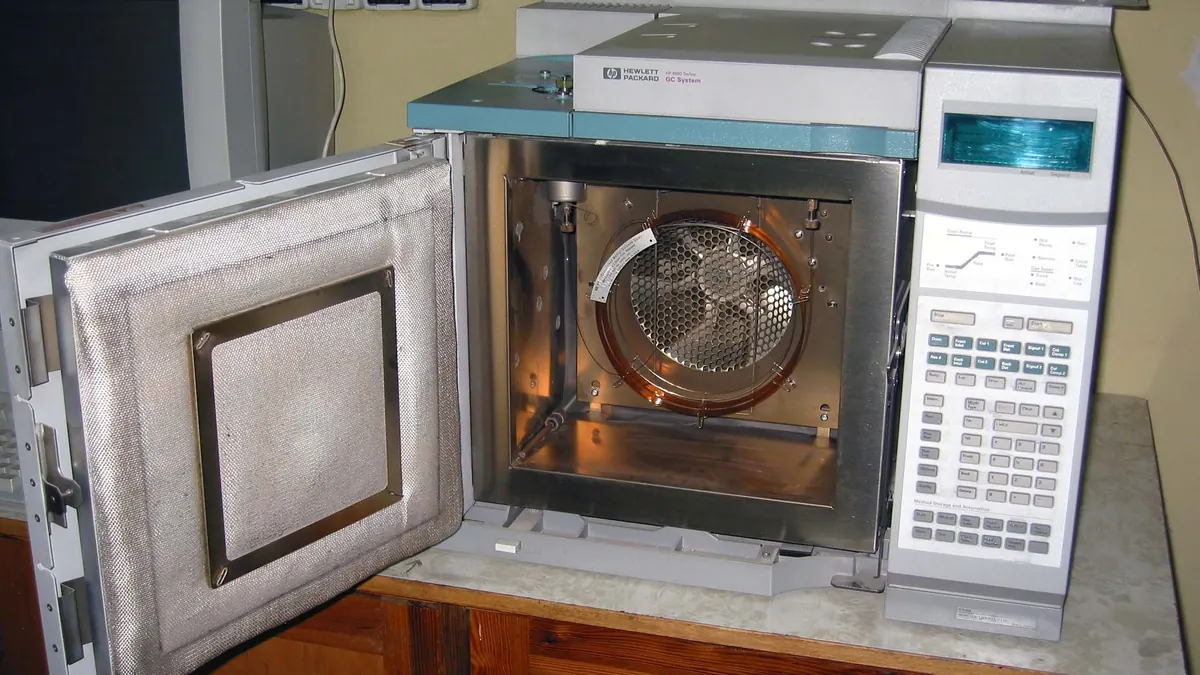

VDI 4630 and ISO 11734 are two different documents with different aims. VDI 4630 is a guideline of the German association of engineers describing the fermentation of organic matter in the context of biogas plants: the characterisation of substrates, sampling and fermentation tests (batch and continuous). ISO 11734 is an international standard concerning the determination of the ultimate anaerobic biodegradability of organic compounds in digested sludge by measuring biogas. In both cases the details of execution matter, not merely the document number in the report.
VDI 4630 — what it covers
The guideline VDI 4630 ("Fermentation of organic materials") is widely cited in German-speaking countries and in many European laboratories as the basis for biogas potential testing. It covers, among other things:
- principles of sampling and preparing substrate samples,
- determination of material parameters (dry matter, volatile solids, constituents),
- fermentation tests under batch conditions together with requirements for the inoculum, loading and evaluation of results,
- principles of converting results to standard conditions.
The document is a guideline (not a statute), and its current edition is available for a fee from the publisher. It is therefore worth stating the year of issue of the guideline in reports.
ISO 11734 — what it covers
ISO 11734 describes a method for assessing the "ultimate anaerobic biodegradability" of organic compounds in digested sludge, based on measuring biogas pressure or volume. It arose in the context of assessing chemicals and their behaviour in an anaerobic environment. For biogas plant substrates (silage, slurry) it is not a typical protocol, although its elements (diluted sludge, biogas measurement) resemble BMP tests. The status and current version of the standard should be checked with the publisher.
Differences in brief
| Aspect | VDI 4630 | ISO 11734 |
|---|---|---|
| Type of document | industry guideline | international standard |
| Main aim | biogas potential of substrates for biogas plants | biodegradability of chemical compounds |
| Type of sample | biomass, waste, substrates | chemical compounds (dissolved or dispersed) |
| Inoculum | sludge/digestate, description of requirements | digested sludge |
| Interpretation | biogas/methane yield per unit of VS | percentage of biodegradation relative to the theoretical yield |
What the protocols from the literature add
The publications by Angelidaki et al. (2009) and Holliger et al. (2016) compiled recommendations. They cover the selection of the inoculum and its degassing, the inoculum-to-substrate ratio (I/S), the positive control with cellulose, the blank, the minimum number of replicates, and the criteria for validation and reporting. These are recommendations, not standards. In practice, however, they have become the reference point for test quality. Hafner et al. (2020), in turn, described a method of calculating yield that reduces errors arising from gas conversions.
How to read citations in reports
- Check whether the report states the version (year) of the document.
- See whether deviations are indicated: a different I/S, test duration, temperature.
- Make sure the results of the cellulose control and the blank are given.
- Treat wording such as "tested according to standards" without details with caution.
- For comparisons between laboratories, choose reports with the same procedure.
Typical misunderstandings
- "An ISO standard gives a certified BMP." No — it is a method for assessing the biodegradability of compounds, not a certificate for a substrate.
- "VDI 4630 is the law." It is a guideline; its application is sometimes required by contract or in support programmes, but it does not follow from a statute.
- "One procedure gives one, absolute result." The result depends on the inoculum, the feed and the measurement; hence the scatter between laboratories.
Recommendations for the client
When ordering a test, specify in the order: the procedure, the version of the document, the temperature, the minimum number of replicates, the required controls, the method of conversion to standard conditions and the report format. Ask for raw data (cumulative curves), not just the final value. In case of doubt, verify the current scope of the documents with their publishers (VDI, ISO).
A practical example of wording in an order
A good wording in an order might read: "BMP test under mesophilic conditions (38 °C), batch test, at least three replicates of the sample and of the cellulose control, a blank, I/S of not less than 2 in g VS/g VS, duration until the termination criterion is met, conversion to dry gas at standard conditions of 0 °C and 101.325 kPa, report with cumulative curves." Such wording is unambiguous regardless of whether the laboratory cites the VDI guideline or a protocol from the literature. If the laboratory uses its own accredited procedures, ask for a description of the scope of accreditation and for the results of participation in proficiency studies.
Proficiency studies
Inter-laboratory comparisons have shown that even laboratories applying the same guidelines obtain scatter in results. Participation in proficiency studies and regular use of the cellulose control are the best available tools for building trust in a result.
Why it is worth knowing both documents
Even if in everyday work you order only BMP tests, knowing the scope of these documents protects against errors of interpretation. The biodegradability result of a chemical compound (e.g. a process additive or a cleaning agent) does not say how much biogas a silage will give, and the BMP result of a silage does not prove that an additive does not inhibit the process. When you assess a new additive for the digester, you need an inhibition test or a continuous study, not BMP alone. It is also worth remembering that documents are sometimes updated, so specify the particular edition in contracts.
Sources
Questions and answers
Is a result in line with VDI 4630 comparable with a result according to ISO 11734?
Not directly. The documents have different purposes, and the procedures differ, among other things, in the type of inoculum, the loading and the way of interpretation. Results from the same procedure and with explicitly described parameters can be compared.
Related articles