BMP testingExplainer
What is BMP? Biochemical methane potential: definition, uses and limitations
BMP is the maximum amount of methane that can be obtained from a unit of a substrate's organic matter in an anaerobic batch test. We explain what it is used for and what it does not tell you.
Other language versions: polski.
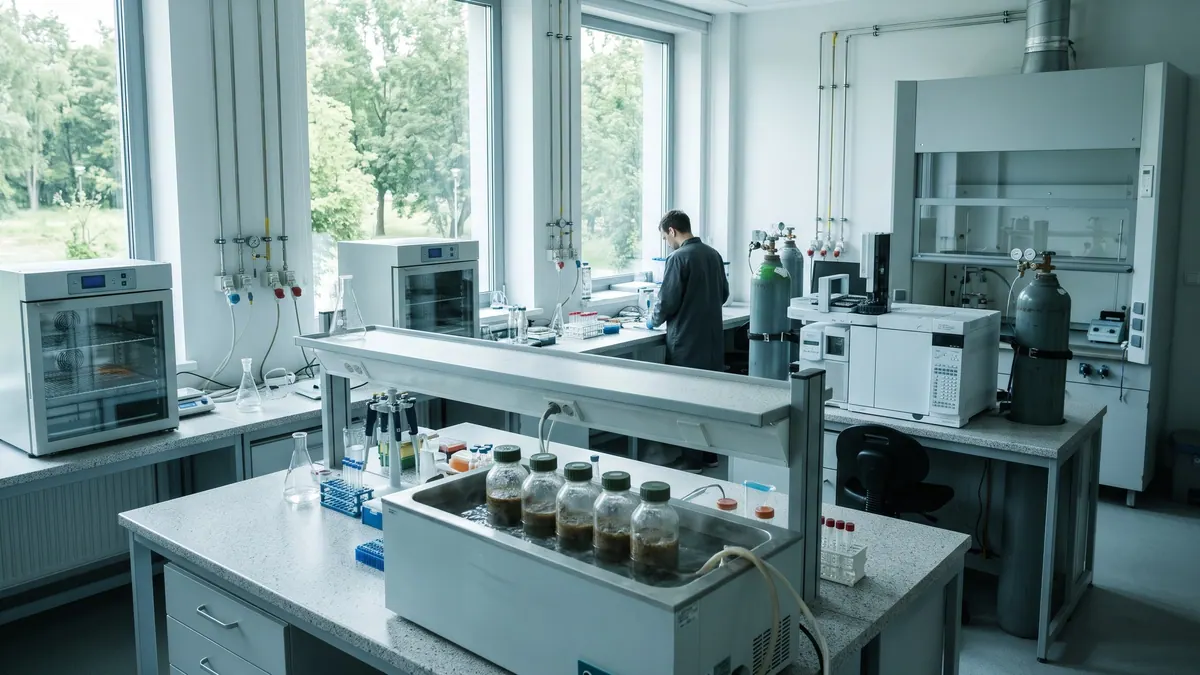
BMP (biochemical methane potential) is the amount of methane that can be obtained from a unit of substrate in an anaerobic batch test, run with active inoculum until gas production is exhausted. The result is most often given in NmL CH₄ per gram of volatile solids (VS); it is a reference value for comparing substrates, not a forecast of the yield in a biogas plant, because at technical scale there are factors the test does not reproduce.
The idea of the test
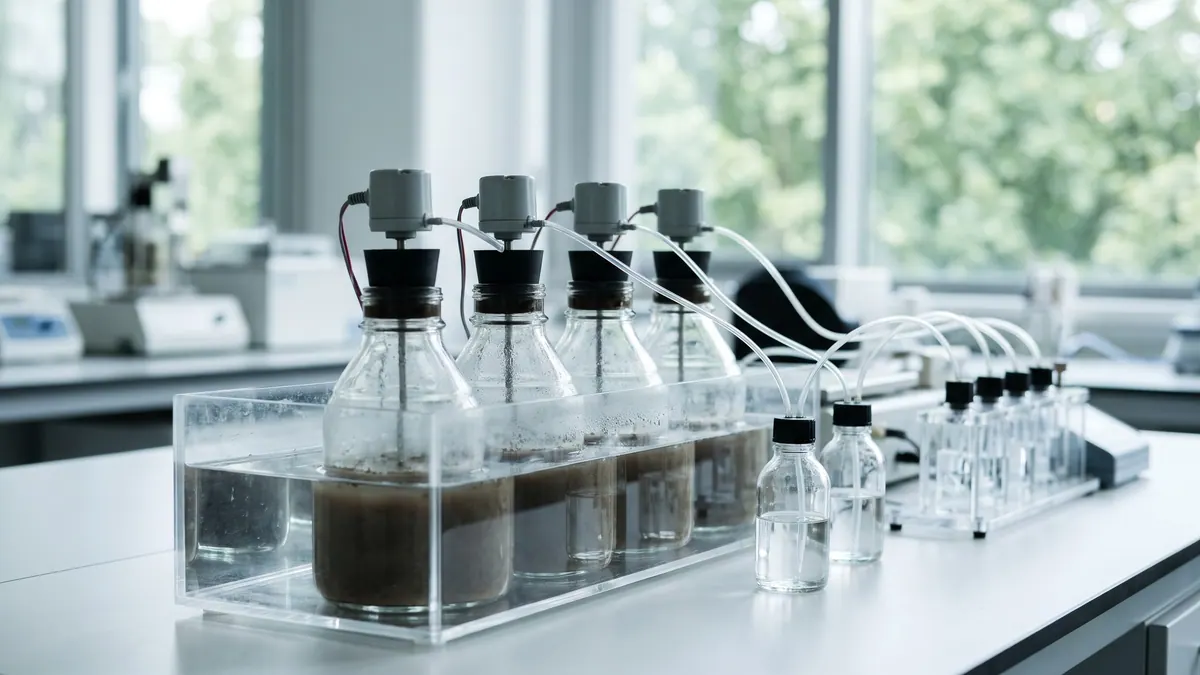
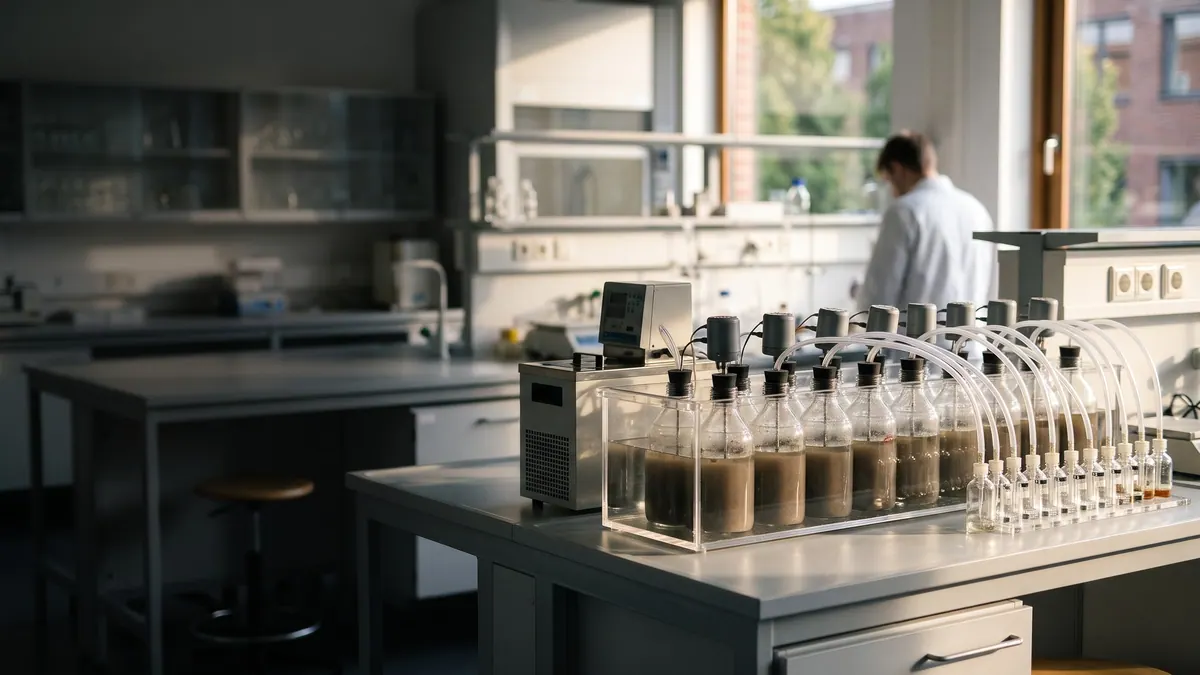
A sample of the substrate is mixed in a sealed vessel with inoculum (usually digestate from a working plant), topped up with nutrient medium and water, and then incubated at a constant temperature (mesophilic or thermophilic). Alongside it, blanks (inoculum only) and a positive control (cellulose) are run. The methane produced is measured throughout, and the endogenous production of the inoculum is subtracted from the result of the tested sample. Divided by the mass of VS loaded, it gives the BMP.
Units and reference conditions
| Quantity | Notes |
|---|---|
| NmL CH₄/g VS | the basic unit; "N" means normal conditions (0 °C, 1013 hPa) and dry gas |
| mL CH₄/g TS | includes ash; depends on the VS content |
| m³ CH₄/t fresh mass | useful in planning, but depends on the TS of the sample |
It is necessary to state whether the result refers to dry gas and which normal conditions were used, because different conventions (0 °C or 20 °C, 25 °C) change the number by several to a dozen or so per cent.
What it is used for
- Comparing substrates and ranking them.
- Estimating production in a biogas plant for a planned mix (with a correction for technical scale).
- Assessing the effect of pretreatment, e.g. size reduction or hydrolysis.
- Assessing the residual potential of digestate.
- Detecting inhibition or toxicity of a substrate (a drop in yield relative to expectations).
- Scientific research on kinetics, e.g. fitting a first-order model.
What BMP does not tell you
- The rate at technical scale. The test lasts many weeks, while a digester has an HRT of several dozen days and operates under continuous conditions.
- Process stability. In a batch test you cannot reproduce overloading, foaming or biomass washout.
- Synergy effects in the mix. The result for a single substrate does not add up linearly when inhibition or buffering increases in the mix.
- Logistic effects. Losses in the silo or size reduction in the plant are not part of the test.
Where the scatter comes from
The result is influenced by the origin and preparation of the sample, the inoculum, the inoculum-to-substrate ratio, the temperature, the method of gas measurement and the way of calculation. Interlaboratory studies show scatter even with shared materials; that is why guidelines (Angelidaki et al., 2009; Holliger et al., 2016) and test validation criteria (cellulose control, repeatability of triplicates) were developed. The next articles in this series describe these elements one by one.
A simplified example
Suppose 2.0 g VS of the tested substrate was loaded into a bottle; methane production from the bottle with the substrate after 30 days was 1,050 NmL, and from the blanks 250 NmL on average. BMP = (1,050 − 250) / 2.0 = 400 NmL CH₄/g VS. If the blank had been 400 NmL, the result would have dropped to 325 — you can see that the endogenous activity of the inoculum (gas production in the blank) matters for the error.
How BMP differs from other indicators
- Theoretical potential (Buswell, Boyle) follows from the elemental composition and assumes complete biodegradation.
- Yield at technical scale is the result of all losses and of kinetics.
- Continuous tests (in laboratory reactors) better reflect process stability.
Good practice is to always give, together with the BMP result: the test method, temperature, duration, inoculum, I/S and number of replicates. Only with this context does the number have comparative value.
Typical questions from laboratory clients
Can I translate a laboratory BMP directly into m³ of biogas per tonne? Not directly. A result in NmL CH₄/g VS has to be converted using the dry matter and VS of the substrate, and then corrected for the actual degree of degradation in the digester, which is usually lower than in the test. That is why safety factors or data from your own plant are used for planning.
Is one result enough? For variable substrates (silages, waste) one sample describes one batch. A series of samples from different dates and locations gives a better picture.
Will another laboratory give the same result? Usually a similar one, but with scatter; the stricter the protocol and the better the cellulose control, the smaller the scatter. That is why comparisons are best made within one laboratory and one method.
BMP, BMP₂₈ and "after-time" values
In the literature you will find designations such as BMP₂₈ or BMP₃₀, which denote the yield after a fixed test time, and "asymptotic BMP", i.e. the value after production has ceased or extrapolated from a model. For easily degradable substrates the difference is small; for fibrous ones it can reach over a dozen per cent. Always check which version is meant before you compare two numbers.
Sources
Questions and answers
What units is BMP given in?
Most often in NmL CH₄ per gram of volatile solids (VS), less often per gram of dry matter or per tonne of fresh mass. The volume is converted to normal conditions (0 °C, 1013 hPa), dry gas.