BiogasExplainer
Chinese agricultural biogas: the declining importance of household digesters and the turn towards large plants
For decades China built small digesters at farms. Since the middle of the previous decade state support has been shifting towards large projects, and the number of active household installations is falling.
Other language versions: polski.
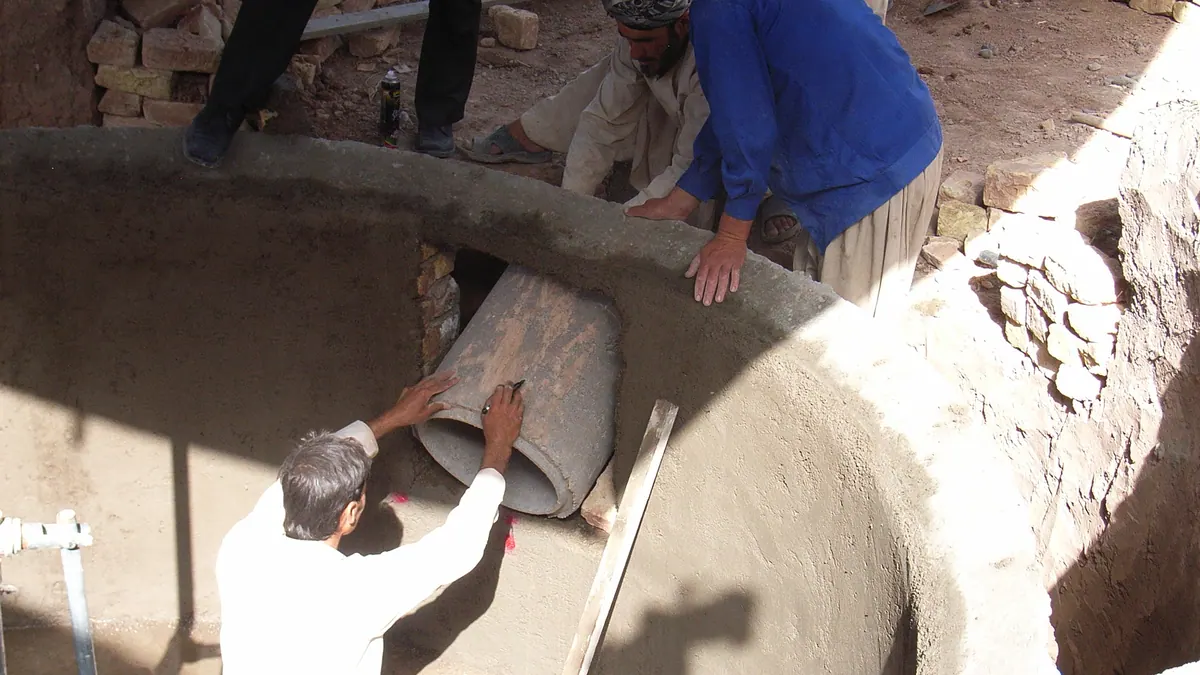

China is the country in which agricultural biogas has the longest tradition: millions of small, dome-type digesters at rural homes produced gas for cooking. By 2015 nearly 42 million of them had been installed, but since then the number of active units has been declining, and support policy is betting on larger installations and biomethane.
Scale and trend
According to IEA Renewables 2023, cited by the Anaerobic-digestion.com service, nearly 42 million household digesters had been installed in China by 2015. This figure refers to installations built, not operating: later IEA assessments speak of a decline in the number of active units. Figures on operating digesters after 2015 are not unambiguous in the sources available to us and depend on the definition (built or operating), so we do not give them. The production data follow the same logic: the 13th bioenergy plan of 2016 gives theoretical biogas production for 2015 of 19 billion m³ (in the plan's table, cited by the IEA, the item is called “biogas (methane)”, so the base unit is unclear), of which 14 billion m³ was attributed to rural households and 5 billion m³ to large projects.
Why household digesters are losing importance
A review in Renewable and Sustainable Energy Reviews (2016) points to the concentration of livestock farming in large farms, agricultural modernisation and urbanisation. These factors reduce the amount of feedstock available at farms and weaken the fit of small digesters to modern agriculture. Survey studies show that the use of household biogas was falling and many installations were abandoned. The authors recommended supporting medium- and large-scale projects, allowing household projects to be phased out gradually, and a regional approach to decisions on expanding or abandoning them, and also pointed out that large projects need suitable development models and operating mechanisms to remain profitable.
The turn towards large scale
According to IEA Renewables 2023 (via Anaerobic-digestion.com), in 2015 policy turned towards large installations, and since 2019 greater emphasis has been placed on large biomethane projects. A 2019 study covering 1125 households in four provinces found that users of large installations have a higher biogas utilisation rate (by about 29%), and that the price of biogas is their main constraint. A typical dilemma is visible here: an industrial-scale installation is more efficient, but needs a buyer for the gas and a fair price.
State targets in the plans
The 13th bioenergy plan for 2016–2020 (NEA, 5 December 2016) set for 2020 a target of 8 billion m³ of biogas a year from large installations and 0.5 GW of capacity in biogas power plants. The guidelines of December 2019 already concerned biomethane: more than 10 billion m³ a year in 2025. They name as feedstocks, among others, straw, animal manure and kitchen waste. We describe these targets in separate posts.
What this means for technology
Large agricultural installations in China, in line with the direction of the guidelines, are to use animal manure, straw and kitchen waste, which require different preparation than simple slurry from a household farm. Straw has a high lignocellulose content, so it requires size reduction or pretreatment. The 2019 guidelines provided for collecting feedstock and using the gas within a short distance in order to limit logistics costs.
What we do not know
The available statistical compilations differ in their definitions: whether we count operating or built installations; whether projects are fed with manure only or also with straw; whether the data concern raw biogas or biomethane. For international comparisons, figures from China should therefore be treated as an order of magnitude, not as exact statistics. We were unable to confirm in open sources figures for the exact decline in the number of household digesters or the number of medium- and large-scale projects in a given year.
What this means for Poland/Europe
The history of Chinese household digesters is a cautionary tale for “small-scale” programmes in Africa and South Asia: building installations is not enough; access to feedstock, servicing and a market for gas or fertiliser are needed — as confirmed by the abandoned installations described in RSER. For Europe it is also important that moving to large scale does not solve all problems: the 2019 study points to the gas price as the key barrier even for users of large installations.
Sources
- RSER 2016 — Development process and probable future transformations of rural biogas in China (EconPapers)
- Household biogas digesters or medium–large-scale biogas plants: a conflicting issue in rural China (AGRIS)
- IEA — China 13th Bioenergy Development Five Year Plan (2016–2020)
- Anaerobic-digestion.com — Biogas in China: Household Digesters to Biomethane (cytuje IEA Renewables 2023)
Related articles