BMP testingEvent
Rice straw and pig slurry: biological pretreatment with a cellulolytic microflora gives 342 mL CH₄/g VS
Researchers from Jiangxi Agricultural University increased the methane yield from the co-digestion of rice straw and pig slurry by about 45% through biological pretreatment with a cellulolytic microflora.
Other language versions: polski.
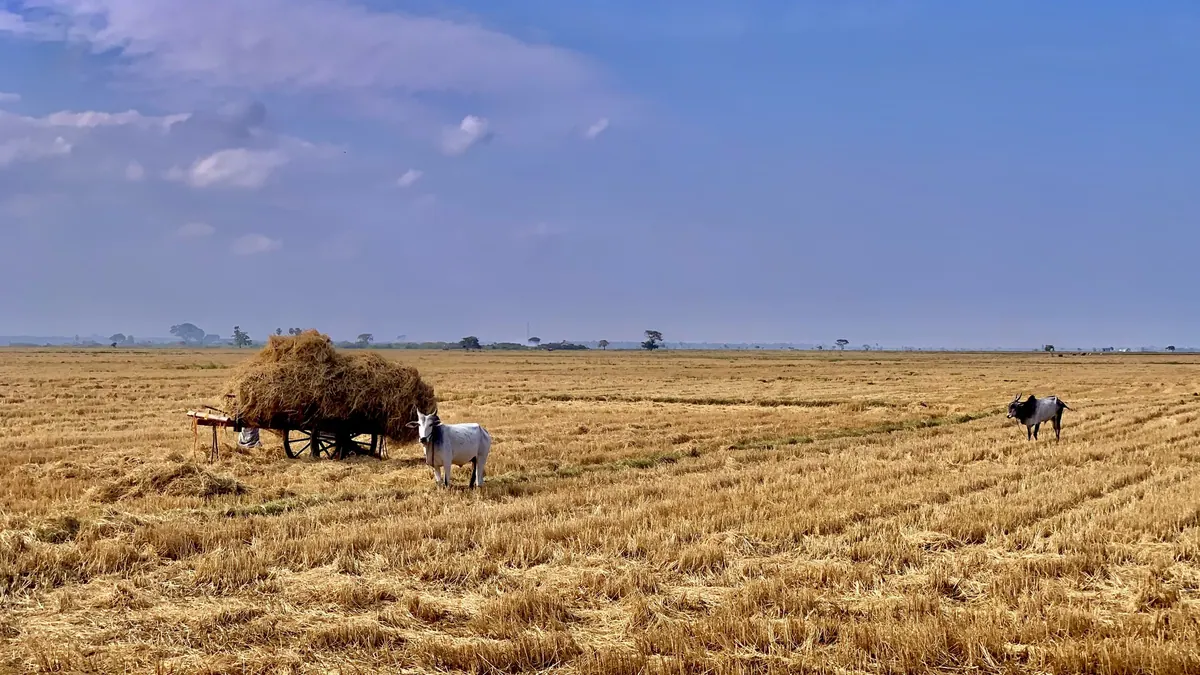

A team from Jiangxi Agricultural University (Nanchang, China) showed that a short biological pretreatment of a mixture of rice straw and pig slurry with a cellulolytic microflora increases the methane yield by about 45%. In the treated sample the cumulative yield was 342.35 mL CH₄/g VS, and in the control 236.03 mL/g VS. The paper appeared in Frontiers in Bioengineering and Biotechnology (volume 8, 2020; published online on 4 February 2021).
How the experiment was designed
A mixture of rice straw (51.15 g) and pig slurry (47.85 g) was selected to obtain a C/N ratio of 30:1, considered favourable for digestion. Biological treatment was carried out with 10% (v/v) cellulolytic microflora at 55 °C, without mixing, for 30 hours at pH 7.6. Anaerobic digestion was then carried out in nine reactors of 9 L volume (three each for the treated sample, the control and a blank with sludge only), under mesophilic conditions (35 ± 0.5 °C) for 15–20 days, with mixing at 30 rpm. The maximum load was 2.5 kg COD/(m³·d). Methane was measured by water displacement, after removing CO₂ and H₂S with a NaOH solution.
Results
Besides the cumulative yield, the authors fitted kinetic models: the modified Gompertz model gave M_max of 350.79 mL/g VS for the treated sample and 241.82 for the control; the first-order model gave 321.78 and 231.13 respectively. The maximum methane production rate rose from 24.60 to 45.36 mL/(g VS·d), and the lag phase shortened from 2.43 to 1.79 days. The hydrolysis constant (k) rose from 0.26 to 0.46 d⁻¹, and the time to reach 90% of yield shortened from 10.7 to 8.92 days. The fit of the Gompertz model was R² 0.996–0.997, and of the first-order model 0.966–0.973.
Why this matters for BMP
The result of 342 mL CH₄/g VS concerns a straw–slurry mixture after treatment, not pure straw. It is therefore not suitable for entry as the BMP of rice straw; it is a value for a specific composition. At the same time the kinetic constants are valuable for designers, because they show that treatment shortens the retention time and not only raises the final yield.
Limitations
The test was carried out at laboratory scale, with one type of inoculum (300 g of anaerobic sludge). Transferring the results to industrial scale requires verification of the energy balance (heating to 55 °C for 30 hours) and of the costs of maintaining the microbial cultures; the authors presented their own energy balance, whose values in the source text are not consistent, so we do not quote them.
What this means for Poland/Europe
Co-digestion of straw with pig slurry is also feasible in Polish conditions, but most studies indicate that simpler methods — size reduction, stable feeding and adjusting the retention time — give a good effect at lower cost. The Chinese paper is an example of a direction of research on biological hydrolysis techniques.
Sources
Related articles