BMP testingAnalysis
Chinese research on rice straw: chemical pretreatment raises biogas yield by 36–45%
A team from the Jiangsu Academy of Agricultural Sciences in Nanjing compared three chemical agents for pretreating rice straw. Slaked lime gave 413.5 mL of biogas/g VS — 45% more than untreated straw — after 72 hours of treatment.
Other language versions: polski.
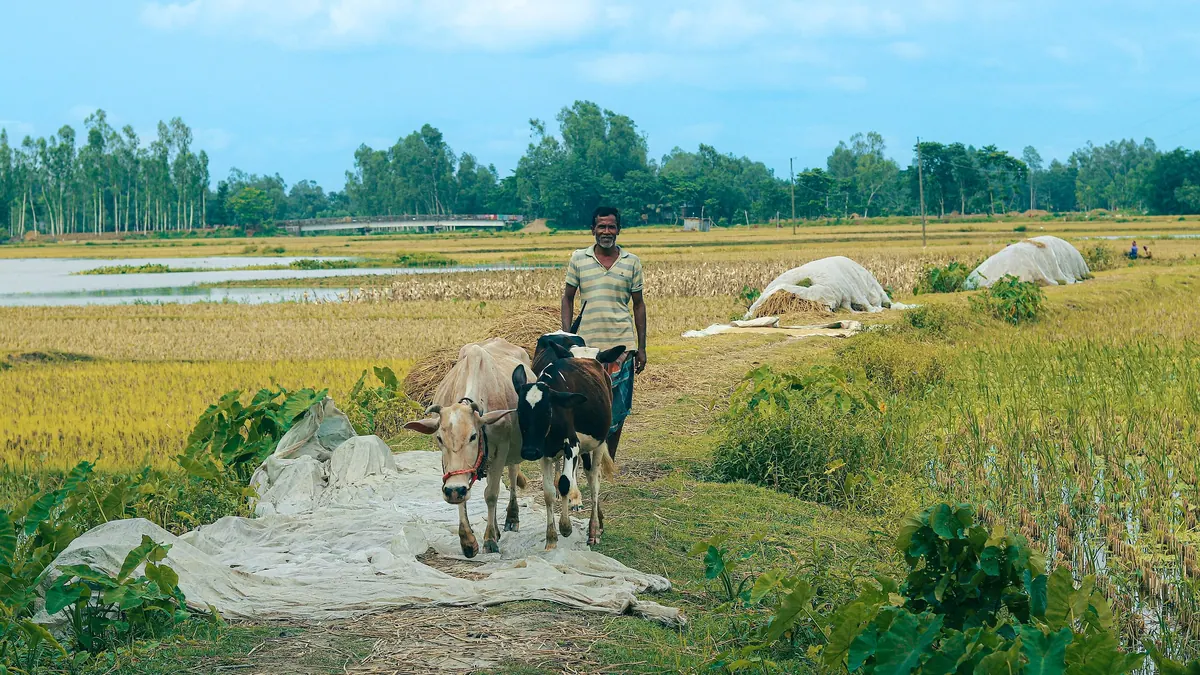

Rice straw is one of Asia's largest agricultural waste resources, but because of its high lignocellulose content it ferments slowly and incompletely. A study by a team from the Jiangsu Academy of Agricultural Sciences in Nanjing (co-authors from Southeast University), published in the journal BioResources in March 2019, tested whether three cheap chemical reagents can improve biogas yield with a short treatment time. The best result was achieved by calcium hydroxide: 413.5 mL of biogas per gram of volatile solids, that is 45.2% more than untreated straw.
Methodology
The straw was mixed with water at a ratio of 1:3 and treated at room temperature in a “dry” (solid-state) system. Concentrations (by mass) were: 3% H₂O₂, 8% Ca(OH)₂ and 5% NH₃·H₂O. Treatment times of 6, 24, 72, 120 and 168 hours were tested. Digestion was carried out in batch mode at 37 ± 1 °C in 1000 mL bottles with a working volume of 800 mL, with 48 g of treated straw (dry matter) and 500 g of inoculum in the form of digestate from sewage sludge. The pH was set at 7.5, and the air in the headspace above the medium was removed by flushing with nitrogen.
Results
| Agent | Best treatment time | Biogas yield, mL/g VS | Increase relative to control | Methane yield, mL/g VS |
|---|---|---|---|---|
| Control (no treatment) | – | 284.7 | – | 138.7 |
| H₂O₂ | 168 h | 386.6 | +35.8% | 182.6 |
| Ca(OH)₂ | 72 h | 413.5 | +45.2% | 198.0 |
| NH₃·H₂O | 120 h | 390.5 | +37.2% | 185.2 |
The authors conclude that shortening the treatment time is feasible for all three solutions, and that Ca(OH)₂ gave the highest yield at the shortest of the three optimal times (72 h); the difference between lime and the other two variants was statistically significant (P < 0.01), whereas H₂O₂ (168 h) and NH₃·H₂O (120 h) did not differ significantly. The average volumetric rate of biogas production in these variants was 35.4–45.8% higher than in the control.
How to read this
First, the main result concerns biogas, not methane: the average methane content in the study was about 46%, and the methane yield after the best treatments was in the range of 182.6–198.0 mL/g VS (31.7–42.8% more than in the control, 138.7 mL/g VS). Second, a batch test with one type of inoculum gives a result that depends on conditions; other laboratories may obtain different values for the same straw. Third, the percentage improvement relative to the control is more important than the absolute number, because it depends less on the sample and the inoculum. That is why, when compiling BMP summaries, we state the method and the type of result (biogas or methane).
Practical significance
For a biogas plant, pretreatment of straw should be assessed economically: the cost of the reagent, energy and time, as well as the effect on the digestate (lime raises the pH and calcium content, ammonia increases the nitrogen content). On farms where straw is a waste, simple size reduction and co-digestion with slurry may be enough (depending on the share of straw in the ration and on the installation); we describe co-digestion of rice straw with pig slurry, with microbiological treatment, in a separate post.
Why rice straw is a difficult substrate
The authors stress that pretreatment is meant to remove part of the lignin and hemicelluloses, which increases the availability of cellulose to enzymes. They list chemical methods as convenient, fast and cheap, but classical liquid treatment requires a lot of water for rinsing or acids and bases for neutralisation, causes corrosion and washes out some of the soluble organic matter. That is why the study used “dry” treatment at room temperature, without rinsing. In practice the choice of agent depends on price, safety of handling and the effect on the digestate.
How to choose the treatment time
The most important conclusion of the study concerns time: the best results were given by times of 72 h (lime), 120 h (ammonia) and 168 h (hydrogen peroxide), that is from three to seven days, not longer procedures. For a company this means the need to run its own BMP tests at several time points, rather than copying parameters from the literature.
A note on comparability
The BioResources study serves to compare pretreatment methods, not to determine the BMP of rice straw according to a standardised protocol; we therefore treat its numbers as an illustration of the scale of the pretreatment effect.
What this means for Poland/Europe
Polish cereal straws have similar lignocellulosic limitations to rice straw. Research from Asia shows that alkaline treatment can improve digestion, but requires adaptation to the feedstock and the infrastructure. For plant designers the most important thing is to run BMP tests on their own feedstock with and without pretreatment.
Sources
- Du J., Qian Y., Xi Y. et al. (2019) The feasibility of shortening the pretreatment time for improvement of the biogas production rate from rice straw with three chemical agents. BioResources 14(2), 3808–3822
- Zhong B. et al. (2020/2021) Anaerobic co-digestion of rice straw and pig manure pretreated with a cellulolytic microflora. Front. Bioeng. Biotechnol. 8:579405
Questions and answers
Is 413.5 mL/g VS the BMP of rice straw?
No. It is the biogas yield (not methane) from lime-treated straw under the conditions of a specific experiment. In that study methane made up about 46% of the biogas, and its yield in the lime variant was 198.0 mL/g VS. Results depend on the inoculum, temperature and sample preparation.
Related articles