BMP testingAnalysis
Rice straw and manure in Japanese studies: BMP, co-digestion and inoculum
A review of three Japanese studies on the methane potential of rice straw, manure and food waste: BMP from 1999, co-digestion of feed rice (2012) and solid-state thermophilic co-digestion (2022).
Other language versions: polski.
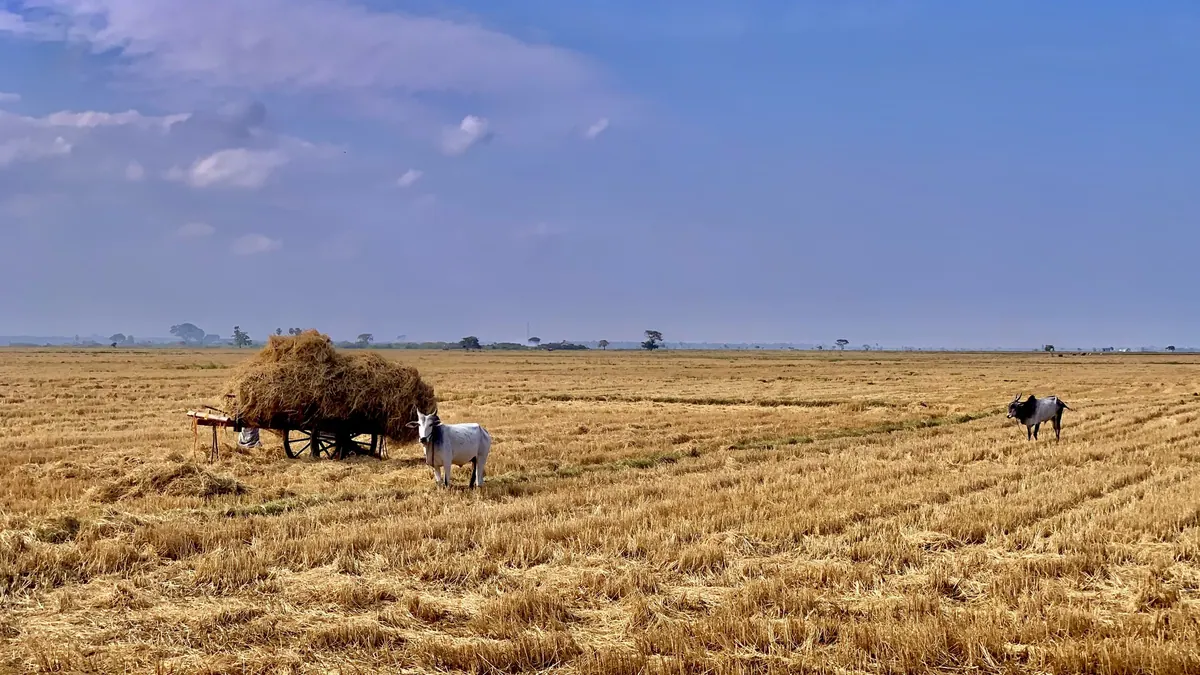

Rice straw is one of the most important agricultural wastes in Japan, and its energy use has been studied for years. Below are three studies from different decades: methane potential measurements from 1999, a study of co-digestion of feed rice from 2012 and solid-state thermophilic co-digestion from 2022.
BMP from 1999: manure, straw and slaughterhouse waste
Katou and Noike (Journal of the Japan Society of Waste Management Experts, 1999) studied the anaerobic digestion of agricultural and livestock waste. The methane yield (NmL CH₄/g VS) was: pig manure 236, cattle manure 158, poultry manure 320, pig offal 705, rice straw 264 and orange pomace 536. The authors found that rice straw and orange pomace are particularly suitable for energy recovery in the winter season. In a case study of a plant processing pig manure (from 35,000 animals; in the abstract “35,000 heads/d”), cattle manure (from 1,500 animals; “1,500 heads/d”), pig offal (4.2 t per day) and orange pomace (30 t per day), total methane production was 8400 Nm³ per day, of which 6400 Nm³ per day was a surplus that could be used without heating the process. The residues were supernatant liquor (300 m³ per day) and dewatered digestate (60 t per day); the liquor required further treatment (nitrification and denitrification) because of its high ammonia concentration, but after partial use it proved an effective liquid fertiliser, and the digestate was also a useful fertiliser.
Feed rice fertilised with excreta (2012)
Zhou, Iino, Nakashimada and Hosomi (Water Science & Technology 66(2), 2012) studied, in rice fields in Japan, three varieties of feed rice fertilised with liquid cattle excreta; fertilising with excreta can reduce the need for mineral fertilisers, and the straw is suitable for biogas production. The total methane potential of the Leafstar variety was higher than that of the others, and its lag phase was considerably shorter. Co-digestion of the residue from ethanol fermentation with Leafstar straw showed that the N-NH₄⁺ concentration falls as C/N rises, and that the methane potential of the mixture was higher than that of the ethanol residue or the straw used separately. The authors considered Leafstar a promising variety for agricultural resource recycling systems.
Food waste, rice straw and rice husk (2022)
Shimizu and co-authors (Journal of Material Cycles and Waste Management 24(6), 2022) carried out solid-state co-digestion of food waste (FW) in thermophilic digesters. Ammonia inhibition was limited by adding seasonal rice straw (RS) and year-round rice husk (RH), and the breakdown of lignocellulosic biomass was accelerated by adding cattle rumen content as a source of microorganisms. With restaurant waste alone (average C/N = 13), ammonia accumulation lowered methane production. Methane was produced stably when RS and RH were mixed with FW at a ratio of the dry matter of RS and RH to FW of 2.0 (30–40% TS, loading 5.08 kg VS/m³·d). The methane yields were: FW 0.573 m³/kg VS, RS 0.259 m³/kg VS (similar to the BMP of these substrates) and RH 0.115 m³/kg VS (more than the BMP). Hydrogenotrophic methanogens Methanoculleus and Methanothermobacter dominated in the sludge.
How to read the figures with caution
- Values from different studies differ in method (BMP vs. reactor tests), inoculum, temperature and unit (mL/g VS vs. m³/kg VS).
- Conversions: 0.259 m³/kg VS is 259 mL/g VS, i.e. very close to the result of 264 from the 1999 study for rice straw.
- The low yield of cattle manure (158) compared with straw (264) and food waste (573 in the reactor) suggests that in a mixture manure contributes a moderate share of methane rather than being its main source; its possible stabilising role and role as a source of microflora must be confirmed separately.
Conclusions for practice
- Rice straw is a substrate with a moderate BMP (about 260 mL/g VS in both studies) that combines well with nitrogen-rich substrates.
- Co-digestion improves the C/N balance and limits ammonia inhibition (2012 and 2022).
- When planning an investment, rely on your own BMP tests of samples from the given farm; the literature serves to establish a range.
Sources
Related articles