BMP testingExplainer
BMP of Korean food waste and leachate: the studies by Cho (1995) and Lee (2009)
Two studies on Korean food waste: Cho et al. (1995) – a mixture BMP of 472 mL CH₄/g VS and dry digestion – and Lee et al. (2009) – a leachate BMP of 358–478 mL/g VS and the effect of temperature, alkalinity and salinity.
Other language versions: polski.
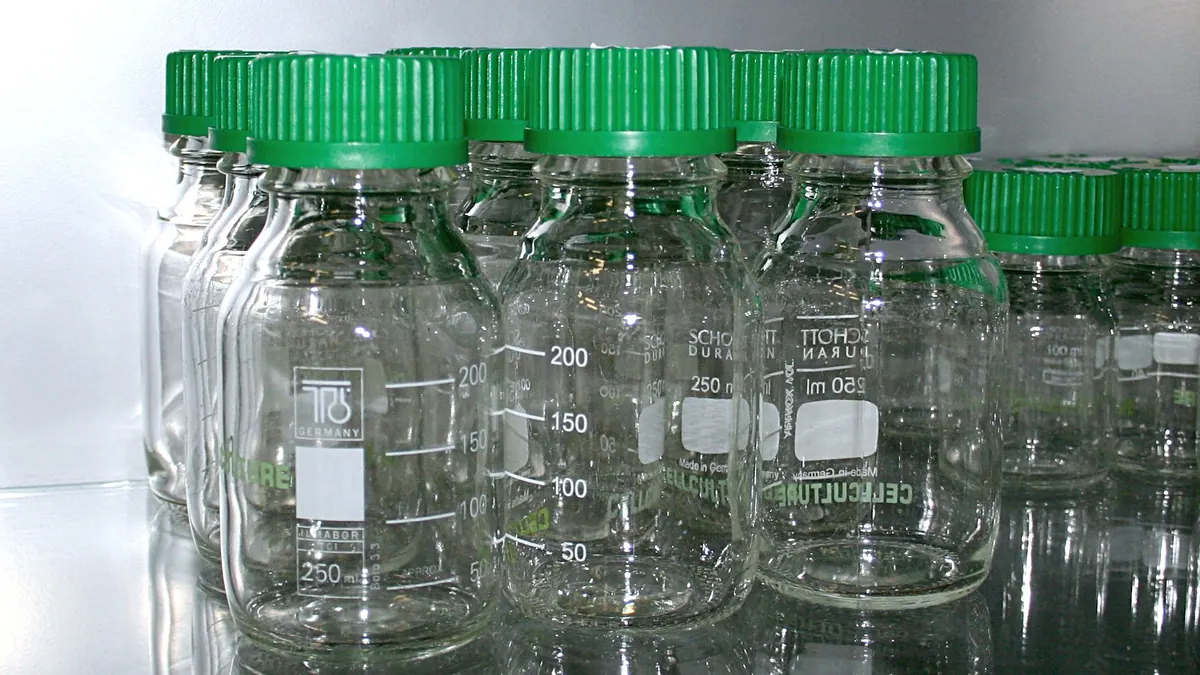

One of the early studies on Korean food waste – Cho, Park and Chang, Bioresource Technology 52(3), 1995 (pp. 245–253) – concerns waste with a dry matter (TS) content of 15–30%. The authors, from KAIST, measured the biochemical methane potential (BMP) of the waste components and of their mixture (MFW), and then tested dry digestion of the mixture in two-phase reactors. It is worth distinguishing two groups of figures: BMP (up to 482 mL CH₄/g VS added) and reactor yield (405–415 mL/g VS removed).
Who and why
The authors are researchers from the Bioprocess Engineering Research Center of the Korean institute KAIST in Taejon (with the participation of the biomass team of the Korea Institute of Energy Research). The keywords of the paper are: mixed food waste, biochemical methane potential, dry anaerobic solid-state digestion, two phases, fixed bed and leachate. The aim was practical: to develop a process for kitchen waste, which in Korea contains 15–30% dry matter, without adding large amounts of water.
What exactly was studied
According to the abstract, the methane yields were: 482 mL CH₄/g VS added for cooked meat, 356 for cellulose (control), 294 for cooked rice, 277 for fresh cabbage and 472 for the waste mixture (MFW). The corresponding anaerobic biodegradabilities relative to the stoichiometric methane yield were 0.82, 0.92, 0.72, 0.73 and 0.86. In a single-phase methane reactor, volatile fatty acids (VFAs) accumulated so strongly that they inhibited methane fermentation, so MFW with a dry matter content of 20% was digested in two-phase fixed-bed systems, in 1 L and 8 L reactors. In the 8 L reactor the effect of recirculating leachate onto the bed was also studied. In the 5 L bed no nutrients, buffer or seeding sludge were added.
Dry digestion results
In all cases 87–90% of the dry matter in the fixed bed was removed, and about 90% of the initial VS of the bed was converted into biogas. The processing time depended mainly on the performance of the methane digester: the hydraulic retention time and the loading. The methane yield was about 405–415 mL/g VS removed throughout the study period, i.e. about 86–88% of BMP (the ultimate methane yield) for the same sample.
How to read the figures
The BMP value describes the maximum potential of a substrate under laboratory test conditions, whereas reactor yield is what was achieved in a specific system. The difference is clear here: 405–415 mL/g VS removed is about 86–88% of the BMP of the mixture. When making comparisons, always check:
- the unit – mL CH₄ per g VS added (BMP) or removed (reactor yield) are not the same thing; a result in mL/g fresh matter will be many times lower;
- the substrate composition – components (meat, rice, cabbage) differ in BMP by as much as a factor of two, and the mixture lies in between;
- the experimental set-up – the single-phase reactor was inhibited by VFAs, while the two-phase fixed-bed one operated stably.
Why the 1995 study is still cited
According to the bibliographic record in the Zhenzhi database (343 citations at the time of checking), the paper is frequently cited. Later studies on Korean food waste – for example the work by Lee et al. on leachate, described below (358–478 mL/g VS in the BMP test) – indicate similar orders of magnitude, which increases confidence in a range of about 350–480 mL/g VS for these substrates. A specific plant may deviate from it.
Leachate from food waste recycling (Lee et al., 2009)
Leachate from food waste recycling plants (FWL) is a wastewater that is difficult to manage in Korea. Lee, Behera, Kim and Park of the University of Ulsan (Waste Management 29(2), 2009, pp. 876–882) investigated at laboratory scale whether FWL could be digested in landfill bioreactors or anaerobic digesters. The average moisture content of the leachate was 84%, and the VS/TS ratio was 91%; the elemental composition was expressed by the formula C₁₃,₀₂H₂₃,₀₁O₅,₉₃N₁, and the biodegradability was 82.6%. In a standard BMP test, 358 mL CH₄/g VS was obtained after 10 days and 478 mL/g VS after 28 days, with an average methane content of about 70%.
The highest yield after 20 days (403 mL/g VS) was recorded at 35°C, which the authors attribute to the adaptation of the inoculum microorganisms to mesophilic conditions; at 25, 45 and 55°C it was 370, 351 and 275 mL/g VS respectively. Adding alkalinity increased the methane yield, and diluting FWL to a salinity of 2 g/L NaCl gave 561 mL CH₄/g VS after 30 days. The authors conclude that, given the high biodegradability, FWL digestion with alkalinity and salinity control may be a sustainable solution to the leachate problem. The difference between the results after 10 and 28 days also shows that a BMP result depends on the duration of the test.
Conclusions for practice
- For kitchen waste mixtures BMP is high (here 472 mL/g VS), but the study shows that 86–88% of this value is achieved in a reactor, and the low tolerance of the single-phase system to VFAs requires the phases to be separated.
- Dry digestion (about 20% TS) requires different equipment from wet digestion, and its attractiveness depends, among other things, on how the leachate is managed.
- A BMP result from one laboratory should be compared with other sources to estimate the spread, rather than treating a single figure as a constant.
- In the leachate test the best temperature was mesophilic (35°C); alkalinity and salinity affected the yield, so in practice they require control.
Sources
Related articles