Law and regulationGuide
Guarantees of origin for biogas and biomethane: who issues them, how to apply and how to redeem them
A guarantee of origin for gas from RES is issued by the President of URE, but the application is submitted to the grid operator or an accredited body. Deadlines, validity, redemption and differences from certificates.
Other language versions: polski.
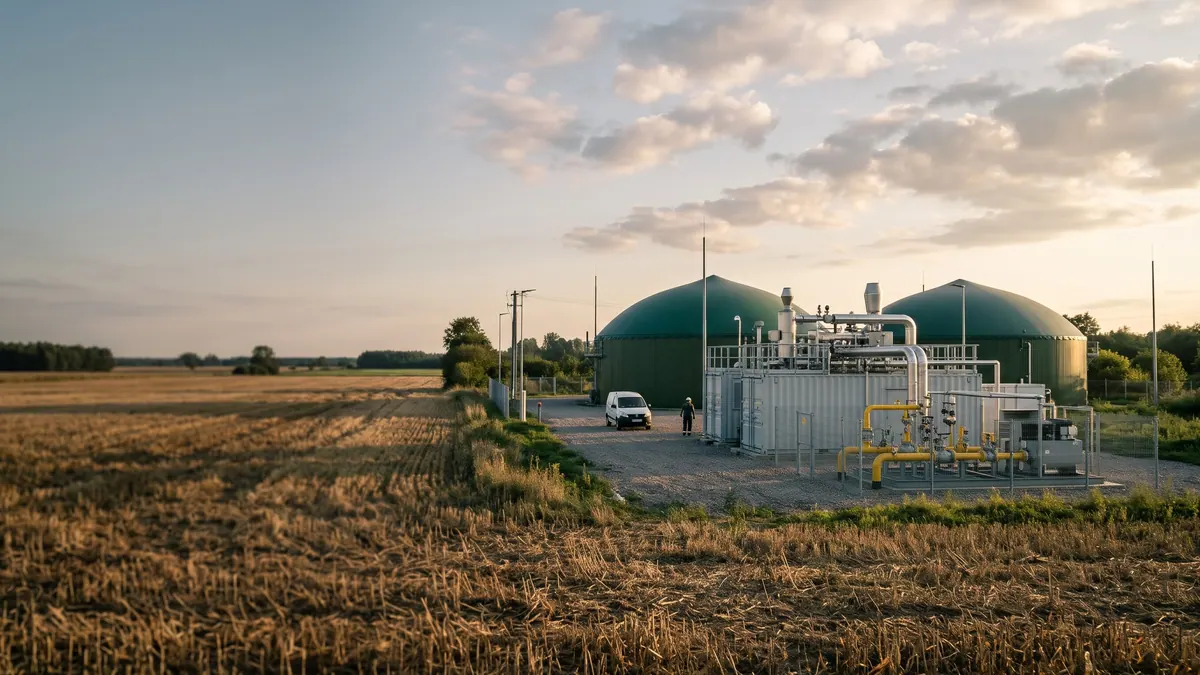
A guarantee of origin for biogas or biomethane is issued by the President of URE at the producer's request, but the application is submitted not to URE but to the gas grid operator (or to an accredited body), which verifies the data and passes it on. The guarantee is electronic, expressed in MWh, transferable, and its issue does not constitute state aid. It serves to show the final customer that the gas was produced from renewable energy sources — it does not replace a sustainability certificate.
What a guarantee of origin is
The Act on Renewable Energy Sources provides for guarantees for electricity, biomethane, heat or cooling, renewable hydrogen, biogas and agricultural biogas. A guarantee is "the only document" confirming to the final customer that a specified quantity of energy or gas was produced from RES and fed into the grid (to which at least one customer other than the producer is connected) or into another place indicated in the Act.
- No property rights arise from a guarantee.
- Guarantees are transferable, independently of trade in rights from certificates of origin.
- Issue and transfer do not depend on the use of support mechanisms and are not state aid.
- Guarantees are not issued for micro-installations.
- The unit is 1 MWh; gas is converted into energy according to the regulation of the minister for climate on the measurement and calculation of quantities of biogas, agricultural biogas and biomethane.
Who does what and by when
| Stage | Entity | Deadline |
|---|---|---|
| Application | producer of biomethane, biogas or agricultural biogas | within 30 days of the end of generation of the quantity covered by it; the reporting period may be up to 6 months |
| Addressee of the application | the gas system operator into whose grid the biomethane was injected; an accredited body in the case of transport outside the grid or on-site refuelling | — |
| Verification and transmission | the operator or accredited body | 30 days from receipt of the application |
| Issue of the guarantee | President of URE | 30 days from transmission of a complete application |
| Register | the entity operating a commodity exchange or regulated market (in practice the Polish Power Exchange (Towarowa Giełda Energii)) | the guarantee goes to the register, where it is split into units of 1 MWh and entered in the producer's account |
The application contains, among other things, the producer's identification, the location and type of the installation, the annual capacity, the quantities fed into the grid or into another place, the period of generation, information on whether the installation used support mechanisms, the date of first generation, and an indication of the carrier and source of energy. If the installation has been given a unique number on the URE auction platform, its value is also given.
Step by step
- Entry in the appropriate producers' register — KOWR for agricultural biogas, URE for other biogas and biomethane.
- Metering and documentation. The quantities of biomethane fed into the grid are confirmed by the operator on the basis of readings from metering devices; for transport outside the grid the requirements of the metering regulation apply.
- An account in the guarantee register with the entity that keeps it.
- The application, submitted after the end of the production period, but no later than 30 days from its end.
- Collecting the guarantee in the register, and any transfer to the customer.
- Redemption by the producer or buyer within the deadline, so that the guarantee does not expire.
Validity, redemption and special cases
- A guarantee is valid for 12 months from the end of generation; after this period it cannot be transferred.
- It must be redeemed within 18 months of the end of generation, otherwise it expires and is marked in the register as expired.
- On-site refuelling. A guarantee for biomethane used to refuel vehicles without transport cannot be transferred and is redeemed immediately.
- Energy conversion. When biogas is converted into biomethane or another carrier, the guarantee for the original carrier is redeemed before a guarantee for the derived product is issued; for the same producer the original guarantee cannot be transferred.
- Foreign guarantees. At request, the President of URE recognises guarantees from other EU states, Switzerland, the EEA-EFTA states and the Energy Community, provided there is no doubt as to their authenticity.
What a guarantee is not
| Document | What it confirms | Who issues it |
|---|---|---|
| Guarantee of origin | origin from RES and the quantity of gas in MWh | President of URE, the register is kept by the exchange |
| Sustainability certificate (e.g. ISCC) | compliance with the criteria and emission reduction | certification body |
| Certificate of origin (support system) | a property right in the certificate system | President of URE — for electricity from installations in which energy was first generated before 1 July 2016 |
Typical mistakes
- Submitting the application directly to URE instead of to the grid operator.
- Exceeding the 30-day deadline from the end of the generation period.
- A period covered by the application longer than 6 months.
- A discrepancy between the application and the readings of the metering systems.
- No redemption within 18 months — the guarantee expires.
- Treating a guarantee as proof of sustainability for an industrial customer who requires a certificate.
Why producers and customers want a guarantee
The producer can sell the guarantee separately from the gas itself: the buyer (most often a gas seller) redeems it to show its customers that a specified quantity of the fuel supplied comes from RES. The Act provides for an obligation to inform the final customer about the origin of energy and gas on the basis of redeemed guarantees, so demand for them results from "green gas" offers and customers' reporting requirements. A guarantee does not increase revenue from statutory support — it is a separate product.
What to do first
- Make sure the installation is entered in the appropriate producers' register and has a metering system compliant with the regulation on the measurement of biogas, agricultural biogas and biomethane.
- Check with the gas grid operator how data on the quantities injected into the grid are transmitted and in what format it accepts applications.
- Open an account in the guarantee register and decide a policy of sale or redemption (own use, sale on the market).
- Put reminders about the deadlines in the schedule: 30 days for the application, 12 months of validity, 18 months for redemption.
This text is for information purposes and does not constitute legal advice; before an investment or formal decision, check the current wording of the regulations and consult a lawyer or the competent authority.
Sources
- Ustawa o odnawialnych źródłach energii — tekst jednolity z 2024 r. (Dz.U. 2024 poz. 1361), art. 120–125
- Rozporządzenie MKiŚ z 26 czerwca 2024 r. w sprawie pomiarów, rejestracji i obliczania ilości biogazu, biogazu rolniczego i biometanu (Dz.U. 2024 poz. 974)
- Dyrektywa (UE) 2018/2001 (RED II), art. 19 — EUR-Lex
Questions and answers
Does a guarantee of origin confirm the sustainability of biomethane?
No. The guarantee confirms renewable origin and the quantity of gas fed into the grid. Sustainability and emission reductions are confirmed separately, in a certification scheme.
Who issues guarantees of origin for biomethane in Poland?
The guarantee is issued by the President of the Energy Regulatory Office (URE) on the basis of the producer's application, which is first verified by the gas grid operator (or an accredited body in the case of transport outside the grid). The register of guarantees is kept by the entity operating a commodity exchange or a regulated market.
Related articles