Law and regulationExplainer
Biomethane in Polish law: definition, producer and the URE and KOWR registers
How the Act on Renewable Energy Sources defines biomethane, who counts as a producer and which register you must enter: URE or KOWR. Deadlines, obligations and reports.
Other language versions: polski.
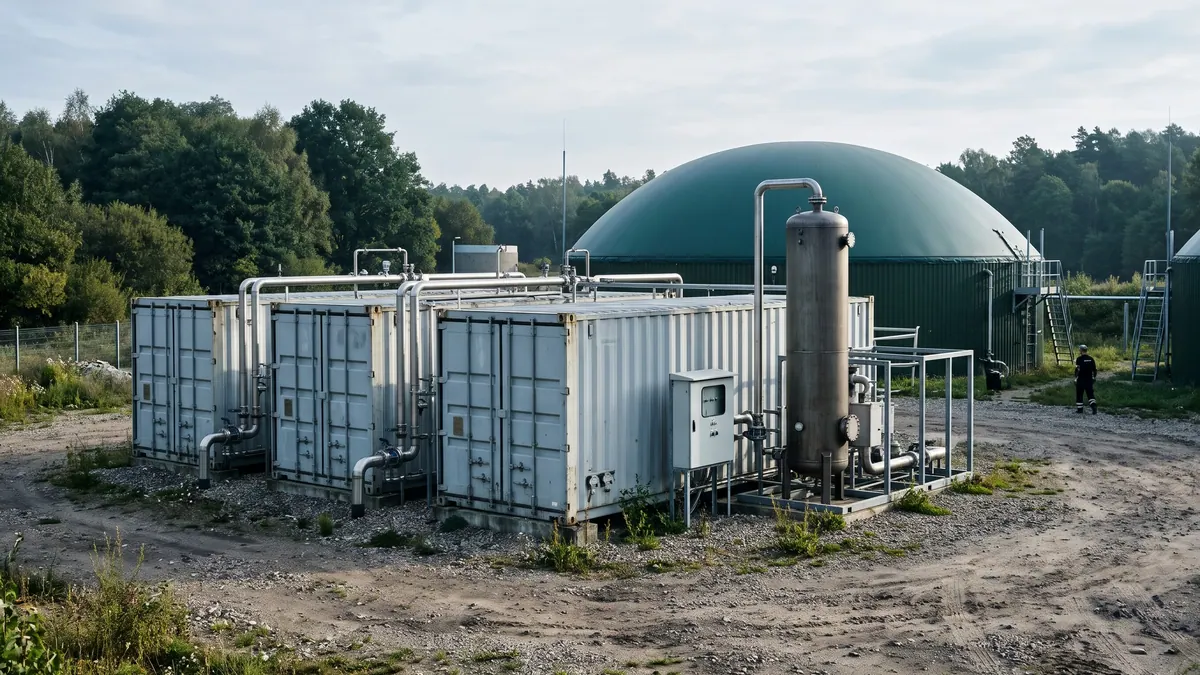
Biomethane in Polish law is gas obtained from biogas, agricultural biogas or renewable hydrogen, purified and injected into the gas grid, transported in compressed or liquefied form, or used to refuel vehicles without the need for transport (Article 2(3c) of the Act on Renewable Energy Sources). Biogas or biomethane activity is a regulated activity: you must enter the register of biogas producers kept by the President of the Energy Regulatory Office (URE), or, in the case of biomethane made solely from agricultural biogas, the KOWR register.
Definitions you need to tell apart
| Term | Meaning |
|---|---|
| Biogas | gas from biomass, in particular from animal or plant waste processing plants, wastewater treatment plants and landfills |
| Agricultural biogas | gas from methane fermentation of substrates solely from the list in Article 2(2) |
| Biomethane | purified gas from biogas, agricultural biogas or renewable hydrogen; injected into the grid, transported compressed/liquefied or used for refuelling on site |
| Capacity of a biomethane production installation | total maximum attainable capacity of the set of equipment for producing biomethane, expressed in MW of energy contained in the biomethane |
Biomethane as a transport fuel also appears in the Act on Biocomponents and Liquid Biofuels (compressed and liquefied biomethane), which matters for the National Indicative Target (NCW).
Which register
The Act distinguishes two routes, depending on the type of feedstock:
| Situation | Register | Authority |
|---|---|---|
| Biogas for biomethane production or biomethane from biogas other than agricultural | register of biogas producers | President of URE |
| Biomethane solely from agricultural biogas (substrates from Article 2(2)) | register of agricultural biogas producers | Director General of KOWR |
| Biomethane from a mixture of biogas and agricultural biogas | register of biogas producers | President of URE |
| Biogas plant producing only electricity from agricultural biogas (installation other than a micro-installation) | register of agricultural biogas producers | KOWR |
An entry in the URE register is not required for producing agricultural biogas for biomethane or biomethane from agricultural biogas — that activity belongs to the KOWR register.
Deadlines and obligations
URE register (biogas or biomethane).
- The application contains the producer's details, a description of the activity and a description of the installation (annual output in m³ and capacity in MW), as well as declarations that the data are true and that the conditions are known.
- The President of URE makes the entry within 21 days of receiving the application together with the declarations; if there is no entry after 28 days, the producer may start operating (unless URE has called for supplementary information).
- The producer must hold a legal title to the facilities and installations, have facilities that meet fire-safety, sanitary and environmental requirements, and must not use fossil fuels or biomass contaminated with substances that increase calorific value as raw materials.
- The producer keeps records of the quantities of biogas and biomethane (injected into the grid, transported outside the grid, used for refuelling, sold for the purposes of meeting the NCW) and of the raw materials.
- The producer submits half-yearly reports by the end of the month following the half-year and notifies the first production within 30 days.
KOWR register (agricultural biogas, including biomethane from agricultural biogas).
- The application covers the producer's details, a description of the activity and installation, and declarations of no tax arrears and of the accuracy of the data.
- The Director General of KOWR makes the entry within 7 days; 14 days after receipt of the application the producer may start operating (if not called to supplement it).
- The obligation is to use only substrates from Article 2(2) and, in the case of biomethane from agricultural biogas, only agricultural biogas.
- Quarterly reports are submitted within 45 days of the end of the quarter, and changes to the data are notified within 14 days.
Differences in practice
- Reporting frequency. Half-yearly at URE, quarterly at KOWR.
- Feedstock. A mixture of biogas and agricultural biogas moves the matter to URE, but the agricultural biogas substrates must still meet the definition.
- Removal from the register. In both registers, breach of obligations (false declarations, prohibited substrates) results in removal and a waiting period, after which you can apply for re-entry.
What to do first
- Determine the feedstock: only substrates from Article 2(2), or also other types of biomass or biogas.
- Choose the register according to the table, taking possible mixing into account.
- Prepare the legal title, documents confirming compliance of the facilities and a technical description with output and capacity.
- Plan the record-keeping system: quantities, raw materials, dates of first production, sales to the NCW.
- Set the reporting deadlines and appoint a responsible person.
Biomethane and other legal acts
- NCW and transport. The Act on Biocomponents and Liquid Biofuels refers to the definition of biomethane in the Act on Renewable Energy Sources; biomethane sold for the purposes of meeting the NCW is shown in the reports.
- Guarantees of origin. Biomethane injected into the gas grid or used for refuelling may be covered by a guarantee of origin (except for micro-installations).
- Support. Installations of up to 1 MW (converted to electrical capacity) may benefit from Chapter 4a; supported biomethane does not count towards the NCW.
- Measurements. The Regulation of the Minister of Climate of 26 June 2024 (Dz.U. 2024, item 974) sets out requirements for measuring, recording and calculating the quantities of biogas, agricultural biogas and biomethane.
The most common mistakes
- Registering with KOWR even though biogas other than agricultural biogas is also used in the mixture — in that case the URE register is the correct one.
- Confusing the reporting deadlines: half-yearly at URE and quarterly at KOWR.
- Failing to notify the first production of biogas or biomethane within 30 days.
- Using raw materials contaminated with substances that increase calorific value.
- Assuming that an entry in the register also covers a gas trading licence — that is a separate matter.
This text is for information only and does not constitute legal advice; before an investment or formal decision, check the current wording of the legislation and consult a lawyer or the relevant authority.
Sources
Questions and answers
Must a biomethane producer using agricultural biogas also be entered in the URE register?
No, if the biomethane is produced exclusively from agricultural biogas – then an entry in the register of agricultural biogas producers at KOWR is sufficient. Biomethane from biogas other than agricultural, and from a mixture, is registered with URE.
Related articles