BMP testingExplainer
Cellulose control and blank in the BMP test: why they matter and how to interpret them
Two elements determine the reliability of a test: the blank (inoculum background) and the positive control with cellulose. We explain their role, acceptance criteria and the consequences of failure.
Other language versions: polski.
The blank and the cellulose control are two mandatory elements of every BMP series. The blank (inoculum without substrate) makes it possible to subtract the endogenous methane production, and the positive control with microcrystalline cellulose verifies whether the inoculum is active and the procedure works; according to current validation criteria (Hafner et al. 2020; Holliger et al. 2021) the mean BMP of cellulose must fall within 340–395 NmL CH₄/g VS. Its relative standard deviation (RSD) must not exceed 6%. If the control does not meet these criteria, the result cannot be considered validated and the test must be repeated.
The blank
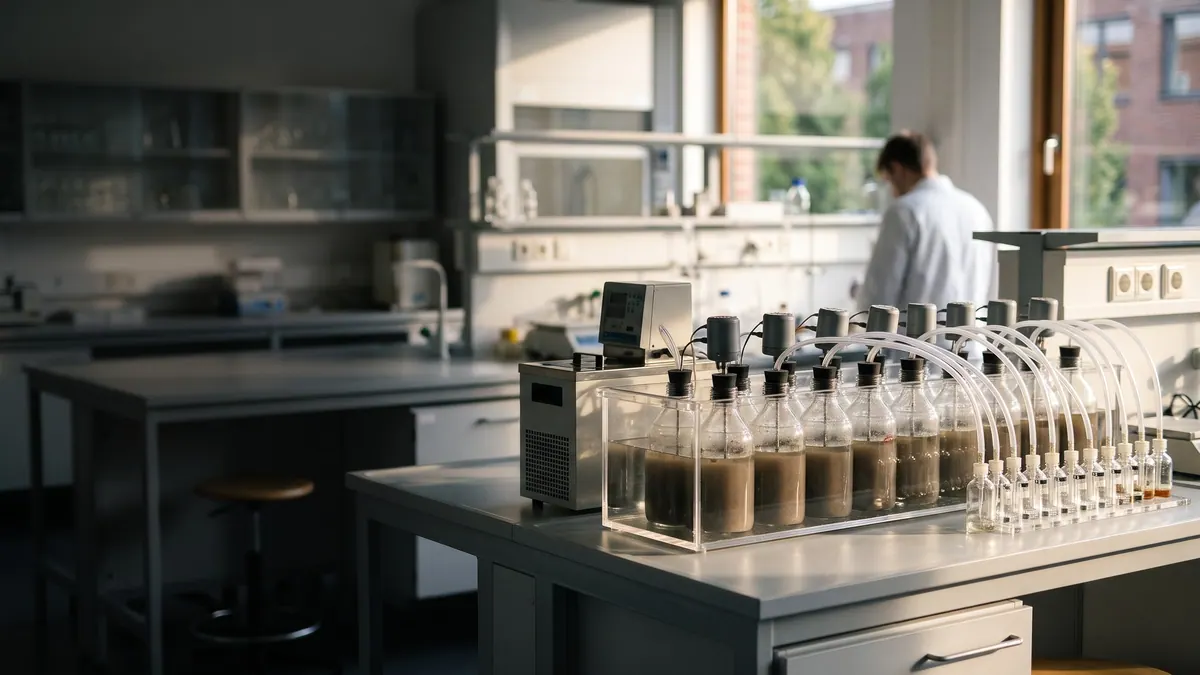
The bottle contains inoculum alone (in the same amount as in the samples with substrate) and water or medium. It produces methane from residual organic matter and biomass. The result is subtracted from every sample with substrate:
V_CH₄,net = V_CH₄,sample − V_CH₄,blank (at equal inoculum masses).
At least three replicates of the blank are recommended. Low and repeatable endogenous production is a sign of well-degassed inoculum. For comparison: if in a typical test the substrate gives 400–600 NmL and the background is 100–200 NmL, its uncertainty has a clear but acceptable effect.
The cellulose control
Microcrystalline cellulose is a well-defined substrate that is degraded slowly but completely. Its theoretical potential from the Buswell equation follows from the reaction:
C₆H₁₀O₅ + H₂O → 3 CH₄ + 3 CO₂.
Molar mass 162.14 g/mol, molar volume of gas under normal conditions 22.414 L/mol:
V = 3 × 22.414 / 162.14 ≈ 0.4147 L CH₄/g, or about 415 NmL CH₄/g VS.
The theoretical value is an upper limit that is not reached in practice. Part of the degraded carbon goes into the growth of microbial biomass. The current validation criteria, developed on the basis of a large inter-laboratory study (Hafner et al. 2020) and incorporated into the updated guidelines (Holliger et al. 2021), require that the mean BMP of cellulose fall within 340–395 NmL CH₄/g VS (about 82–95% of the theoretical value). A result below that means low activity, inhibition or a measurement error; one clearly above – an error in the VS determination, in the gas volume or in the calculations.
Repeatability test
The second criterion concerns variability: the relative standard deviation (RSD) of the cellulose BMP must not exceed 6%. The deviation includes the variability of both the cellulose bottles and the blanks, and the uncertainty of the VS sample weight. Large scatter indicates sample heterogeneity, filling errors or leaks. Each arrangement (blank, cellulose, substrate) must have at least three replicates, so the minimum series for one substrate is nine bottles.
Example of assessing a series
Data: cellulose 3 replicates: 362, 371, 358 NmL/g VS (mean 364, RSD ≈ 1.8%), blank: 128, 135, 131 NmL (mean 131).
- the mean of 364 NmL/g VS falls within the range 340–395 (364 / 415 = 87.7% of the theoretical value),
- RSD ≈ 1.8% is less than 6%,
- conclusion: the series is valid; the substrate results can be reported after subtracting the mean background.
Alternatively, a result of 310 NmL/g (about 75% of the theoretical value) lies below 340 NmL/g, which justifies invalidating the series and repeating it with fresh inoculum.
What to do with a failed series
- Verify the tightness of the bottles and the measuring system.
- Check the calibration of the pressure/volume measurement and the calculation methods.
- Assess the inoculum: activity, VFA, pH, NH₄⁺ concentration.
- Check the I/S and the method of preparing the cellulose.
- Repeat the test with refreshed inoculum.
- Document the cause in the laboratory log.
Reference substrates
In addition to cellulose, some laboratories use additional reference substrates (e.g. starch, gelatine, casein, glucose) to assess the inoculum's response to different fractions. The acceptance range for such materials is set internally; there is no single consensus on the numbers in the literature, so use them as a supplement, not instead of cellulose.
Good practices
- Use cellulose of the same grade and batch, record the supplier.
- Dry the cellulose and determine its VS.
- Carry out the control with every new batch of inoculum.
- Archive the raw data (pressures, volumes, GC).
- Report the deviation of the cellulose result from the theoretical value in the report.
The cellulose control is the "ticket of admission" for every series: without it the substrate result is hard to defend in discussion with a client, an auditor or in an inter-laboratory comparison.
Control chart for the laboratory
The cellulose results from successive series are plotted on a control chart with a mean and limits (e.g. ±2 standard deviations from earlier series). A gradual downward drift is a signal of equipment wear or a change in inoculum quality, before the series crosses the hard limit of 340 NmL/g VS. The chart is also evidence of quality during audits and in contacts with the client.
A common mistake: cellulose in the wrong amount
Cellulose is dosed according to the same I/S principle as the substrate, not in a fixed mass. Too large a quantity of cellulose with a small amount of inoculum can cause acidification and a lowered result — the criterion fails even though the inoculum was good. The result of the control must therefore be interpreted together with the I/S.
Summary for the recipient of the report
When reviewing a test report, find three numbers: the mean production of the blank, the cellulose result (in NmL CH₄/g VS or as a percentage of theory) and the RSD of the replicates. If all three are given, the cellulose result and RSD fall within the criteria, and the blank background is low and repeatable, you have a solid basis for trusting the results. If any is missing, ask the laboratory to supply it.
Sources
- Holliger C. et al. (2016), Towards a standardization of biomethane potential tests, Water Sci. Technol. 74(11), 2515–2522
- Hafner S.D., Fruteau de Laclos H., Koch K., Holliger C. (2020), Improving Inter-Laboratory Reproducibility in Measurement of Biochemical Methane Potential (BMP), Water 12(6), 1752
- Holliger C. et al. (2021), Towards a standardization of biomethane potential tests: a commentary, Water Sci. Technol. 83(1), 247–250
Questions and answers
What to do when cellulose gives a result below the criterion?
The series is invalid. Check the activity and degassing of the inoculum, tightness, the calibration of gas measurement and the I/S ratio, and then repeat the test. Do not correct substrate results with a factor.