BMP testingGuide
How to read a BMP test report: a checklist for the client
What a reliable BMP report must contain, how to assess the cellulose control and the blank, what to look at in the curves and when to commission a repeat test.
Other language versions: polski.
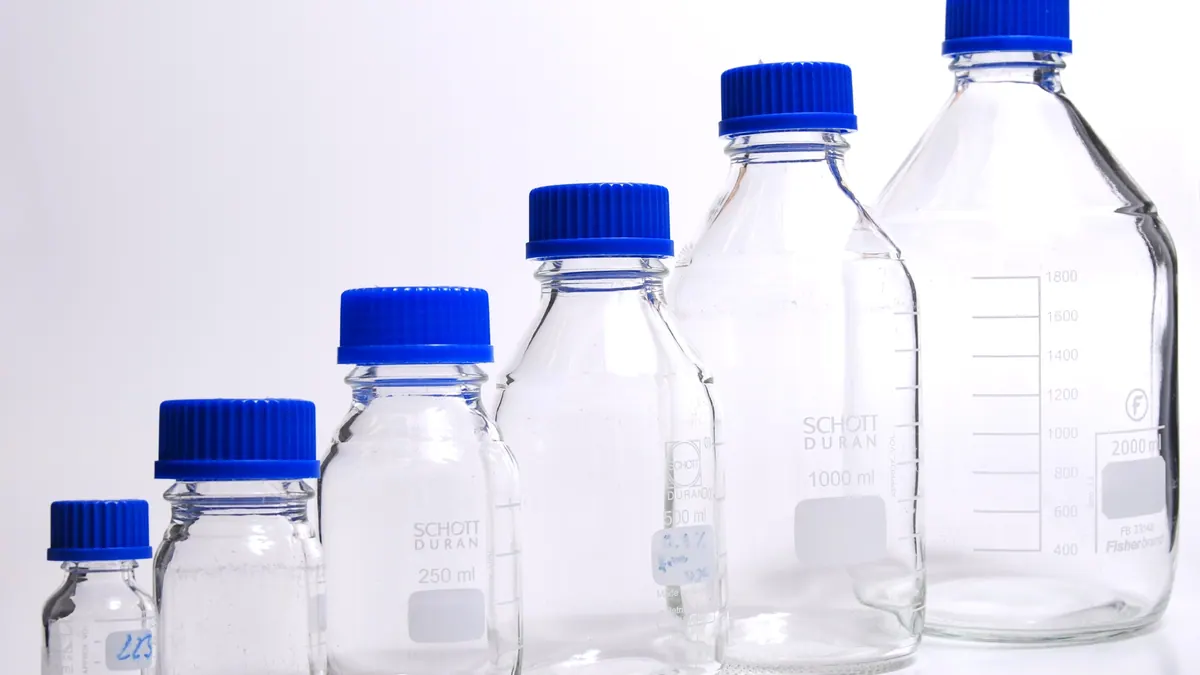

A BMP test report is worth reading like a quality control document: first check whether the test was reliable (controls, replicates, parameters), and only then look at the result. A BMP value without information on the inoculum, the I/S ratio, the cellulose control and the scatter of the replicates is not suitable for comparisons or for economic calculations.
Mandatory elements
| Element | What to check |
|---|---|
| Sample description | origin, sampling date, storage, preparation (size reduction) |
| TS and VS | values, method, any correction for volatiles |
| Inoculum | origin, temperature, degassing time, TS/VS, activity (blank) |
| I/S | value in g VS/g VS (usually ≥ 2 according to literature recommendations) |
| Conditions | temperature, duration, mixing, bottle volume |
| Replicates | at least 3 for the sample and the control |
| Positive control | microcrystalline cellulose (result and range) |
| Blank | production from the inoculum alone (subtracted) |
| Gas measurement | method, conversion to standard conditions |
| Result | mean ± SD, unit (NmL CH₄/g VS), duration |
Cellulose control
Microcrystalline cellulose is a reference substrate. Its degradation in a well-functioning test should give a result close to the theoretical one. The current validation criteria (Hafner et al. 2020; Holliger et al. 2021) require the mean cellulose BMP to fall in the range of 340–395 NmL CH₄/g VS (the theoretical value is about 415 NmL CH₄/g VS) and the relative standard deviation of the results not to exceed 6%. Outside this range the test is not considered validated and requires explanation (an inoculum of weak activity, inhibition, measurement error).
Blank
The inoculum produces methane from its own organic matter. Its contribution is subtracted from production in the samples. If the blank accounts for a very large fraction of the sample's production (e.g. above several dozen per cent), the uncertainty of the result increases. The report should give the value of the blank.
Cumulative curve
A plot of methane production over time shows:
- the lag phase — adaptation or inhibition,
- the rate — ease of degradation,
- the plateau — end of degradation; the test was ended too early if the curve is still rising,
- disturbances — sudden jumps or drops indicate a measurement error.
As standard, the test ends when the daily production over several consecutive days is lower than 1% of the cumulative one (a criterion often cited in the literature).
Example of an assessment
The report gives the BMP of maize silage as 330 ± 12 NmL/g VS (n = 3), I/S = 2, 38 °C, 35 days, cellulose 380 NmL/g VS (about 92% of the theoretical value), blank 25 NmL/g VS of inoculum. Assessment: the control is within the range, scatter about 3.6% (SD/mean), conditions clearly described — the result is reliable. Had the cellulose given 300 NmL/g VS, it would be worth asking the laboratory about the cause and considering a repeat.
Warning signs
- No cellulose control or blank.
- Replicates with large scatter (CV above a dozen or so per cent) without explanation.
- A result higher than the theoretical potential.
- No information on TS/VS and the method of conversion.
- Test duration too short (e.g. a few days) for a fibrous substrate.
- No explicit statement of the standard conditions.
How to use the result
- For comparing substrates — only with the same procedure.
- For biogas plant balance calculations — with caution: BMP is a maximum value, and the operation of a full-scale plant (HRT, mixing) usually gives less.
- For contracts — record the procedure and the acceptance range of the control.
When a report is incomplete
Ask the laboratory for additions: raw data (cumulative table), a description of calibration, the results of the controls. A reliable laboratory supplies them without problem. If an investment decision depends on the result, commission a repeat at a second laboratory and compare.
Questions for the laboratory
- Can you provide the raw cumulative data for each bottle?
- What was the activity of the inoculum and how was it prepared (degassing, storage)?
- Did the test meet the internal validation criteria? Which ones?
- What is the expanded uncertainty of the result?
- Was the sample retained for a possible repeat?
Caution in using the result
BMP answers the question "how much methane can the material give at most under the test conditions". For forecasting the production of a plant a reduction factor is adopted, resulting from the shorter residence time, imperfect mixing and losses. Differences of the order of a few per cent between two reports therefore rarely matter in practice, whereas differences of several dozen per cent always require explanation.
A short report cheat sheet
Before you accept a report, go through five questions: do I know the procedure, is the cellulose control within range, are the replicates consistent, have the curves reached a plateau, and are the units and standard conditions explicitly given. If the answer to all five is "yes", the result can be treated as a reliable reference point for the given material and batch. Remember that it applies to that batch: the next delivery of silage may give a different value, so for contracts it is worth commissioning tests periodically.
Sources
- Holliger C. et al. (2016), Towards a standardization of biomethane potential tests
- Hafner S.D., Fruteau de Laclos H., Koch K., Holliger C. (2020), Improving Inter-Laboratory Reproducibility in Measurement of Biochemical Methane Potential (BMP), Water 12(6), 1752
- Holliger C. et al. (2021), Towards a standardization of biomethane potential tests: a commentary, Water Sci. Technol. 83(1), 247–250
Related articles