Market and investmentAnalysis
Fixed price or the day-ahead market? A biogas plant in H1 2022
H1 2022: the day-ahead market at PLN 660.0/MWh exceeds the FIT of PLN 617.5/MWh. Should one move towards the market, and what about the positive balance in FIP?
Other language versions: polski.
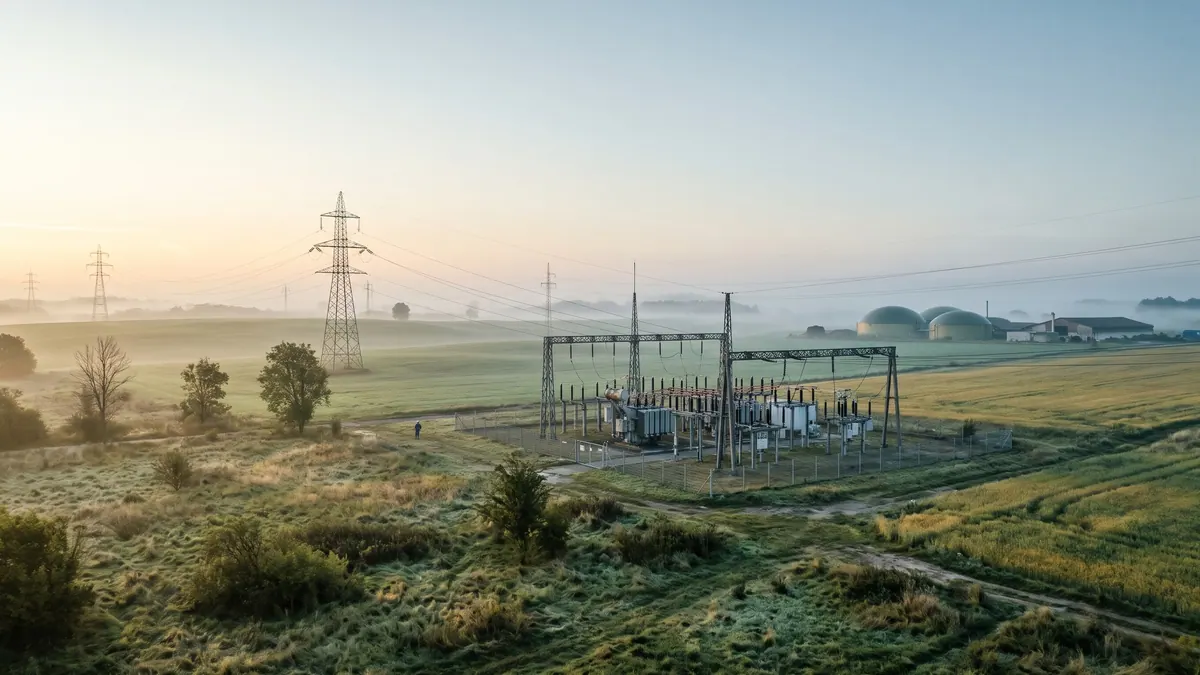
Yes, on paper the DAM won — in H1 2022 a biogas plant selling electricity at day-ahead market prices earned more than at a fixed price. The average DAM price was PLN 660.0/MWh against PLN 617.5/MWh for the FIT for a new installation, and operating in the twelve most expensive hours of the day raised revenue to PLN 779.6/MWh (126% of the FIT), and with 3× operation to PLN 833.9/MWh (135% of the FIT). This is the first time in the series that flexibility is not even needed to beat the FIT. Rising gas and energy prices and, from the end of February, the effects of the war in Ukraine pushed up wholesale prices; the June monthly average was PLN 860.6/MWh.
Reminder of the mechanism
The support rules (Articles 70a–70f of the Renewable Energy Sources Act, ustawa o OZE), the scenarios and the model assumptions are described in the first analysis in the series. You will find the results of the previous half-year in the previous analysis in the series (H2 2021).
Reference prices and support period
The regulations on reference prices from 2019–2021 applied to a single calendar year ("in 2019", "in 2020", "in 2021"), and the regulation for 2022 had not been issued by July. In the model for H1 2022 we adopt the last values in force (from 2021: PLN 650/MWh for agricultural biogas up to 500 kW, PLN 590/MWh for the 500 kW–1 MW band), hence a FIT of PLN 617.5/MWh and a FIP of PLN 531.0/MWh. An installation from 2019 after cumulative indexation (CPI for 2019–2021: 102.3; 103.4; 105.1) has a FIT of PLN 686.5/MWh. There is also a change in the act: the consolidated text published on 30 June 2022 (Journal of Laws (Dz.U.) 2022, item 1378) sets in Article 70f(1) a limit of 30 June 2047 instead of 30 June 2039 from the texts of 2020–2021. The support period is still 15 years from the first sale. The 2022 text also contains Article 70f(3): for installations of up to 1 MW running on biogas (including agricultural) or hydropower, for which certificates of origin were issued for at least 5 years, the period may not exceed a further 17 years counted from the first generation of energy confirmed by a certificate of origin.
Half-year figures
| Quantity (PLN/MWh unless stated otherwise) | Value |
|---|---|
| Average DAM price in the half-year | 660.0 |
| DAM, 2× operation (12 most expensive hours of the day) | 779.6 |
| DAM, 3× operation (8 most expensive hours of the day) | 833.9 |
| FIT, new declaration (price for the class below 500 kW) | 617.5 |
| FIT, 2019 installation after indexation | 686.5 |
| FIP, continuous operation (price for the 500 kW – 1 MW class) | 660.0 |
| FIP + 2× operation / FIP + 3× operation | 779.6 / 833.9 |
| DAM + energy storage 0.5 MW / 1 MWh | 693.1 |
| Hours with a DAM price below zero | 0 of 4,343 |
| Biogas storage for 2× / 3× (average, m³) | 2,798 / 3,772 |
The price of the "2019 installation" is 95% of the 2019 reference price (PLN 617.5/MWh) after cumulative indexation by the annual average CPI for 2019–2021 (Article 70e(3); GUS: 102.3; 103.4; 105.1).
- Fixed FIT price (2022 installation)
- DAM — monthly average
- DAM — captured price, 2× operation (12 h)
- DAM — captured price, 3× operation (8 h)
Monthly averages ranged between PLN 532.3/MWh (February) and PLN 860.6/MWh (June). The market beats the FIT in January, March, May and June, and in February (PLN 532.3/MWh) and April (PLN 577.4/MWh) falls below it; in February it is barely above the FIP price (PLN 531.0/MWh).
- DAM — average for the hour
- Fixed FIT price
Daily profile: minimum at 3:00 (PLN 560.5/MWh), maximum at 19:00 (PLN 900.7/MWh). The spread exceeds PLN 340/MWh, so 2× operation adds PLN 119.6/MWh, and 3× as much as PLN 173.9/MWh relative to continuous operation.
- Revenue (PLN/MWh)
FIP and the positive balance in practice
In FIP the result of PLN 660.0/MWh with continuous operation means that the generator receives only market revenue, because the top-up is zero: the monthly DAM averages exceeded PLN 531.0/MWh, so there was no negative balance on a monthly basis. A positive balance did arise, however. Article 93(11) of the Renewable Energy Sources Act says that a positive balance is settled against a future negative balance; paragraph 12 — that whatever has not been settled by the end of the support period is returned by the generator to the renewable energy settlement operator. A generator in FIP therefore does not receive a "premium up front": earnings from expensive months stay on the account, but support in future weak months will be reduced. The table contains a simplification: the balance is calculated monthly, without carrying a positive balance over to subsequent periods. The FIT has no such mechanism on the generator's side — the seller pays a fixed amount and settles with the operator on its own account.
Is a double-membrane roof enough
In the model, "2×" operation means that a generating set with capacity increased to about 1.0 MW runs only during the 12 most expensive hours of the day, and "3×" that a set of about 1.5 MW runs during the 8 most expensive hours; the same daily energy (about 10.96 MWh) is thus produced in a shorter time, at higher power. Biogas from fermentation flows around the clock (in the model about 216 Nm³/h, resulting from a capacity of 0.5 MWel, an electrical efficiency of 40% and a methane content of 53%), so the rest of the day is storage in the double-membrane roof. The gas balance for this half-year implies an average capacity of 2,798 m³ for 2× (95th percentile: 3,629 m³) and 3,772 m³ for 3× (4,839 m³). A single double-membrane roof with a diameter of 26 m has, according to DLG, a gas capacity of about 2500 m³ (we adopt this as an assumption for Polish installations too): in this half-year it accommodates the 2× demand on 37% of days, and the 3× demand on 4% of days. Two roofs, i.e. 5000 m³, cover all days of the half-year in the model in both variants (maximum demand did not exceed 5000 m³).
How much can be spent on flexibility
The premium for operating in expensive hours is in this half-year PLN 119.6/MWh for 2× and PLN 173.9/MWh for 3× relative to continuous operation. After annualising (×2, an assumption) this gives an annual surplus of PLN 474 thousand for 2× and PLN 690 thousand for 3×; divided by the instalment factor (depreciation of 12 years, cost of capital 10% or 6%), this gives a budget for an additional generating set and gas storage of PLN 3,231–3,976 thousand for 2× and PLN 4,700–5,783 thousand for 3× (the lower value at a cost of capital of 10%, the higher at 6%). The cost ranges are assumptions, not offers: EUR 500–800/kW of additional capacity plus EUR 20–70/m³ of missing storage, at an exchange rate of PLN 4.3/EUR, which gives PLN 1,101–1,810 thousand for 2× and PLN 2,259–3,823 thousand for 3×. Accounting conclusion: both variants (2× and 3×) pay back across the entire assumed cost ranges. The same benefit from the price profile occurs in FIP and in the pure DAM, because it comes from the market, not from support; the FIT does not give it, because it pays the same for every hour.
- Cost of capital 10%
- Cost of capital 6%
A third option: energy storage
A 0.5 MW / 1 MWh storage unit, one cycle a day, 85% efficiency, adds PLN 33.1/MWh to continuous operation (revenue PLN 693.1/MWh). The average of the daily differences between the average price of the two most expensive and the two cheapest hours of the day is PLN 507.2/MWh. The annual surplus is PLN 131 thousand; with a depreciation of 15 years, servicing at 2.5% of outlays a year and average capacity degradation of 2% a year (assumptions), this allows spending PLN 720–881 thousand on storage, i.e. PLN 720–881 per kWh of capacity. The assumed system cost range is PLN 1,500–2,500/kWh, and the additional connection PLN 50–400 thousand — these are assumptions, because there are no hard Polish prices for this scale. After deducting the connection (PLN 50–400 thousand) from the budget at a cost of capital of 6%, the permissible system cost is 481 to 831 PLN/kWh; the storage would not pay back under the assumed cost assumptions. The model omits distribution charges for offtake, the capacity charge and the balancing market, so the result is rather optimistic.
Conclusions for this half-year
- The DAM (PLN 660.0/MWh) exceeded the FIT by PLN 42.5/MWh; with 2× operation the advantage grows to PLN 162.1/MWh.
- For a generator in FIP the top-up disappears, but the positive balance is settled against a future negative balance, so the table result is a simplification.
- Flexibility brings PLN 119.6–173.9/MWh: the budget for a generating set and gas storage (PLN 3,231–3,976 thousand for 2×) covers the cost ranges (PLN 1,101–1,810 thousand).
- This one half-year is not enough for a 15-year decision; the high prices resulted from the crisis on the fuel market.
Sources
- Ustawa o odnawialnych źródłach energii — tekst jednolity z 30 czerwca 2022 r., Dz.U. 2022 poz. 1378
- Rozporządzenie Ministra w sprawie ceny referencyjnej energii elektrycznej z OZE — na 2021 r., Dz.U. 2021 poz. 722
- Energy-Charts — ceny day-ahead Polska (CC BY 4.0, Bundesnetzagentur | SMARD.de)
- NBP — kursy średnie walut obcych (tabela A)
Questions and answers
In H1 2022, was it worth choosing the day-ahead market (RDN) over FIT?
On paper, yes: the average day-ahead market (RDN) price (PLN 660.0/MWh) exceeded the FIT (PLN 617.5/MWh), and 2× operation gave PLN 779.6/MWh. However, the risk that prices will fall back must be kept in mind.
What reference prices applied in the first half of 2022?
The model adopts the last applicable values from the regulation for 2021 (PLN 650 and 590/MWh), because the regulations from 2019–2021 concerned single years, and no new one was issued for 2022 up to July. This is a model assumption.