BiomethaneExplainer
Membrane upgrading: how CH₄ and CO₂ separation works in a biomethane plant
Polymer membranes separate CO₂ from methane on the principle of different permeability. We explain the multi-stage system, pressures, methane losses and pretreatment requirements.
Other language versions: polski.
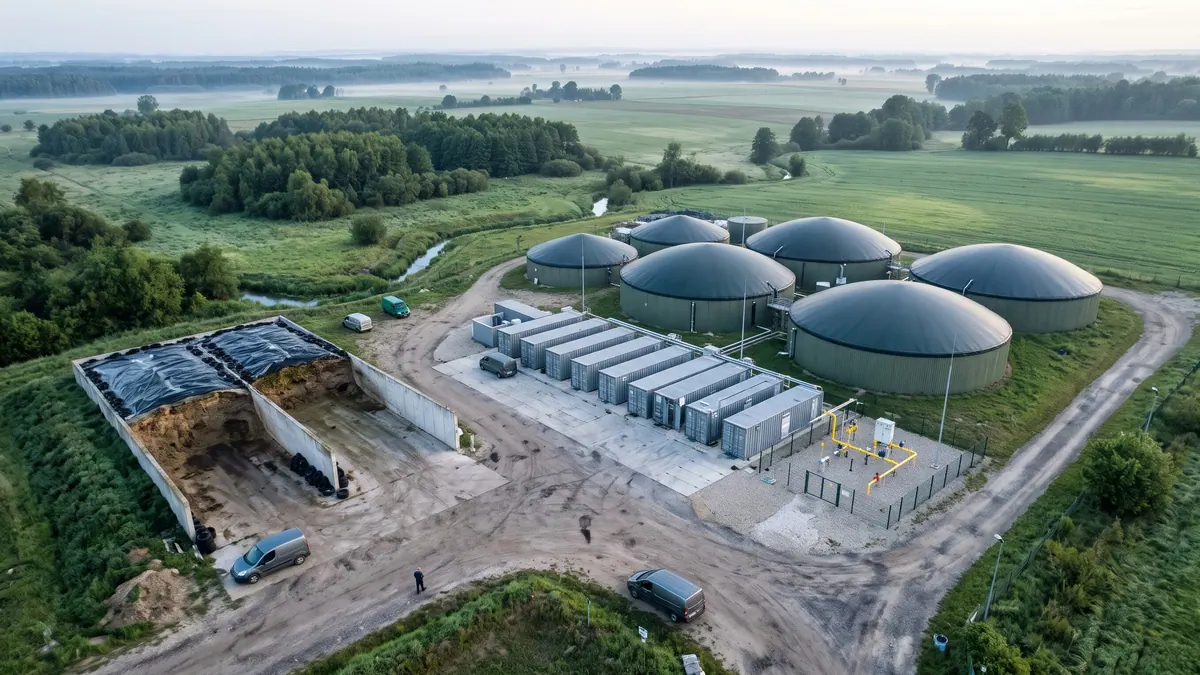
Membrane separation consists in passing compressed biogas through bundles of thin polymer fibres in which CO₂ permeates many times faster than CH₄. On one side of the membrane a methane-enriched stream is collected (the retentate – biomethane), and on the other a stream rich in CO₂ (the permeate). It is one of the most frequently chosen upgrading technologies, particularly in small and medium-scale installations, because it is modular, chemical-free and relatively simple to operate.
The mechanism: dissolution and diffusion
Permeation through a dense membrane is described by the solution-diffusion model. Gas molecules dissolve in the polymer on the high-pressure side, diffuse through the layer and desorb on the low-pressure side. The rate depends on the difference in partial pressures, the thickness of the active layer and the permeability of the material to a given gas. Water vapour, CO₂, H₂S and ammonia permeate very quickly, oxygen moderately, and methane and nitrogen slowly. The ratio of CO₂/CH₄ permeabilities is called selectivity; the higher it is, the easier it is to obtain pure methane at low loss. Typical materials are polyimides, polysulfones and cellulose acetate, formed into hollow fibres in modules connected in series and in parallel.
The process system
- Pretreatment – removal of H₂S (e.g. activated carbon or biological desulphurisation), aerosols, condensate droplets and volatile organic compounds. Compressor oils and siloxanes are harmful.
- Compression – the biogas is compressed usually to a dozen or so bar (of the order of 8–16 bar(g), depending on the supplier).
- Membrane stages – in a two-stage system the retentate from the first stage goes to the second, and the permeate from the second returns before the compressor. In three-stage systems the permeate from the first stage goes to an additional stage that recovers methane.
- Drying and conditioning – after the membranes the biomethane is dried, and possibly enriched with propane and odorised.
- Off-gas – the permeate from the last stage contains mainly CO₂ with a trace of methane and requires afterburning or other management.
Methane losses and purity
The higher the required biomethane purity and the lower the loss, the larger the membrane area and the compression energy. Modern multi-stage systems achieve losses usually below 1%, and some suppliers declare levels of the order of 0.5% or lower; the contractual value depends on the guarantees and the load. A fall in load below the design load may worsen the parameters, so installations are designed with the control range in mind.
Energy
The main energy consumer is the compressor. For membrane systems an electricity demand of the order of 0.2–0.35 kWh per m³ of raw biogas is usually given, which corresponds to approx. 0.35–0.6 kWh per m³ of biomethane at 55% biogas. It is worth requiring the supplier to give a declaration for the full system (with drying, cooling and pretreatment), because different companies compile values for different balance boundaries.
Advantages and limitations
Advantages: compactness, quick installation, no chemicals or process water, easy scaling by adding modules, possibility of operating in containers.
Limitations: sensitivity to contaminants (oil, condensate, siloxanes), the need to replace modules after years of operation, a CO₂ stream of low purity (with traces of CH₄), limited flexibility at very low load.
Tips for the investor
- Demand a guarantee of methane losses at a specified load and biogas composition, together with a penalty mechanism.
- Ask about the conditions for module replacement and the cost per m³ of biomethane produced.
- Plan the management of the off-gas: afterburning alone is simple, but without heat recovery it wastes energy.
- Match the pretreatment to the biogas from specific substrates (e.g. a lot of H₂S with slaughterhouse waste).
- Check the quality of compression: oil-free compressors or those with good oil filtration extend the life of the membranes.
A calculation example
Assumptions: 500 m³/h of biogas, 55% CH₄, slip 0.6%, compression approx. 0.25 kWh/m³ of biogas. Electrical power of the compressors ≈ 125 kW (500 × 0.25). Methane before losses: 275 m³/h; loss ≈ 1.65 m³/h; methane production in the biomethane ≈ 273 m³/h. Annual electricity consumption at 8000 h: approx. 1000 MWh. At an assumed electricity price of PLN 600/MWh this is approx. PLN 600 thousand per year, i.e. ≈ PLN 0.27 per m³ of biomethane. The values are illustrative and do not replace a manufacturer's offer.
Summary
Membranes are a compromise between simplicity and efficiency. A well-designed multi-stage system gives low methane losses, but requires clean input gas and careful operation.
Sources
Questions and answers
How many membrane stages are needed?
Most often two or three, with permeate recirculation. A multi-stage arrangement lowers methane losses and raises the purity of the biomethane, at the cost of a larger compressor.