BiomethaneGuide
Biogas pretreatment: H₂S, siloxanes, water and VOC before upgrading
Before CO₂ separation, biogas must be dried and cleaned of H₂S, siloxanes, ammonia and VOC. We describe desulphurisation methods, the order of equipment and design errors.
Other language versions: polski.
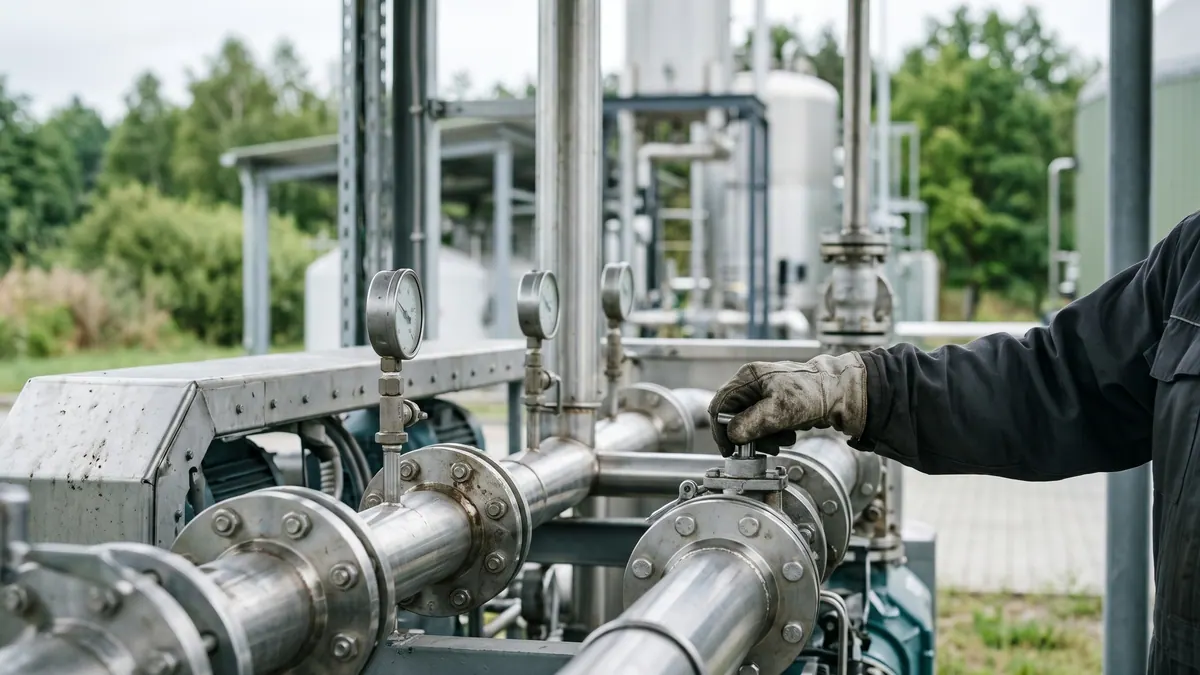
Biogas pretreatment consists in removing, before the actual CO₂ separation, those components that destroy equipment or disturb the process: hydrogen sulphide (H₂S), water, siloxanes, volatile organic compounds (VOC), ammonia and solid particles. It is the stage that decides the availability of the installation and is sometimes underestimated in budgets. A typical line is desulphurisation in the digester (biological or chemical), drying by cooling, filtration and polishing on activated carbon.
Hydrogen sulphide (H₂S)
The H₂S concentration in biogas from slurry and silage is sometimes of the order of hundreds of ppm, and from protein-rich and waste substrates even a few thousand ppm. H₂S causes corrosion, poisons sorbents, and after combustion forms sulphuric acids. Methods:
- Biological desulphurisation in the digester – introducing a small amount of air (usually up to a few percent of the biogas volume) causes the oxidation of H₂S by bacteria to elemental sulphur. It is simple and cheap, but raises the nitrogen and oxygen content of the biogas, which matters for biomethane because it limits the possibility of removing N₂ and O₂ at later stages.
- Chemical desulphurisation – dosing iron salts into the substrate or digester binds the sulphur in the form of sulphides.
- Biological and chemical scrubbers – dedicated columns in which H₂S is oxidised or absorbed.
- Adsorption on activated carbon or iron oxides – polishing to the level of single ppm.
In practice a combination is used: coarse desulphurisation in the digester or a column and final polishing on a bed.
Water
Biogas leaves the digester saturated with water vapour. Drying is done by cooling to a few degrees Celsius (the condensate is drained), followed by reheating to lower the relative humidity. Further drying is sometimes carried out by adsorption (silica gel, molecular sieves), especially before cryogenics. The condensate contains dissolved H₂S and other compounds, so it must be managed in accordance with the regulations.
Siloxanes and VOC
Siloxanes occur in cosmetics, detergents and care products, so they get into biogas mainly from municipal waste, sewage sludge and landfill gas; in agricultural biogas they are much rarer. During combustion in an engine they form silica deposits, and in upgrading they contaminate membranes and sorbents. They are removed with activated carbon or special adsorbents, and the bed is replaced once exhausted. VOC (aromatic hydrocarbons, terpenes, halogenated compounds) are also adsorbed on activated carbon. Their concentration depends on the substrate – e.g. waste from fruit processing or silage may contain terpenes.
Ammonia and particles
Ammonia in biogas is usually removed during cooling and condensation and in the scrubber. Coalescing filters retain aerosols (oil, droplets) that could block membranes or sorbent.
Order of equipment
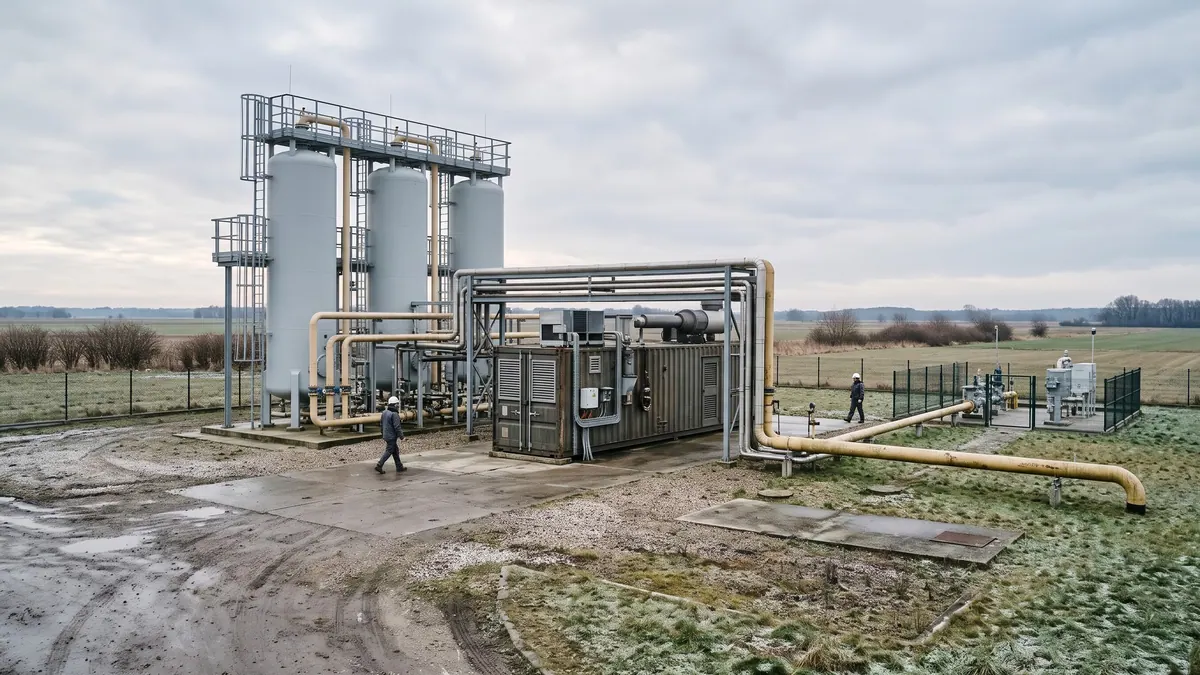
A typical order: digester (biological desulphurisation) → cooling and condensation → pre-compressor → further cooling and condensate separation → coalescing filter → activated carbon bed (H₂S, VOC, siloxanes) → upgrading. It is important that the activated carbon works in gas of low relative humidity, because moisture lowers its sorption capacity.
Example: replacing the carbon bed
Assumptions: 800 m³/h of biogas, polishing of H₂S from 100 ppm to below 2 ppm. Mass of H₂S to be removed: 100 ppm × 800 m³/h = 0.08 m³/h of H₂S ≈ 0.08 × 1.54 kg/m³ ≈ 0.12 kg/h, i.e. approx. 990 kg per year at 8000 h. If the carbon has a working capacity of approx. 15% of the mass of H₂S (an illustrative assumption – the value depends on the product and conditions), approx. 6.6 t of carbon per year is needed. This mass shows that high H₂S concentrations are worth reducing with cheaper methods before the carbon, leaving polishing for the final stage.
Design errors
- Overlooking the variability of biogas composition (new substrates raise H₂S).
- No redundancy – a single bed means downtime during replacement.
- Underestimating the effect of air from biological desulphurisation on the O₂ and N₂ content.
- Too little cooling, which causes condensation in the compressor.
- No H₂S measurements before and after the bed, which makes it impossible to plan replacements.
Control and documentation
Before ordering the installation, commission an analysis of the biogas from at least a few weeks of operation, taking into account different substrate mixtures, and on that basis set design concentrations for H₂S, siloxanes and VOC with a margin. After start-up keep a log of bed replacements and measurement results, because this is data needed both for planning service and for warranty discussions with the supplier of the membranes or sorbent. Manufacturers usually make the warranty conditional on keeping the input gas within specified limits, so a lack of pretreatment documentation may mean loss of the warranty.
Summary
Well-designed pretreatment is the cheapest way to protect expensive upgrading modules. It is worth planning measurements and a stock of consumables from the start.