BiomethaneExplainer
Water scrubbing in biogas upgrading: operating principle and water balance
Water scrubbing removes CO₂ thanks to its good solubility in water under pressure. We describe the absorption and desorption columns, the water balance, methane losses and limitations.
Other language versions: polski.
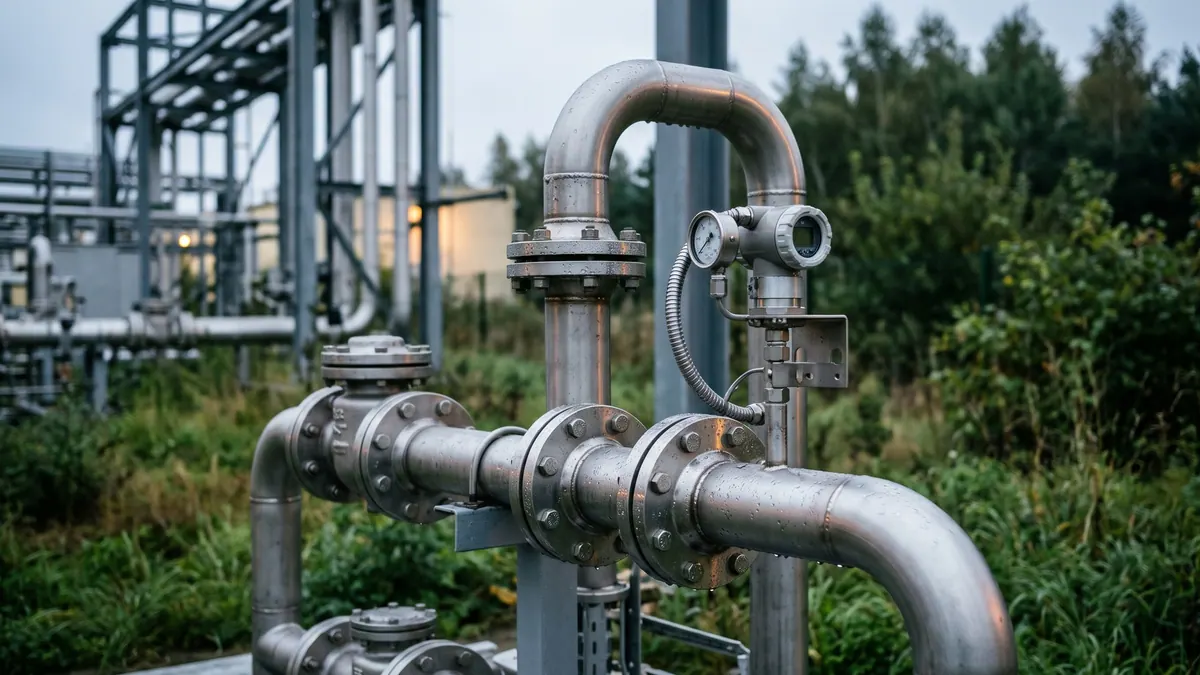
Water scrubbing is the physical absorption of CO₂ in water, carried out in a column under a pressure of the order of 5–10 bar. The solubility of CO₂ in water is many times higher than that of methane (roughly 25-fold at room temperature), so the water collects mainly CO₂, and the methane leaves the column as biomethane. The water is then regenerated in a desorption column and returns to the loop. The method is conceptually simple, robust against contaminants and widely used in larger installations.
Layout of the installation
- Compression – the biogas is compressed to a few to a dozen or so bar and cooled.
- Absorption column – the biogas flows from the bottom, the water from the top, in counter-current. Packing increases the contact area. The biomethane, saturated with moisture, is taken off at the top.
- Flash tank – the water saturated with CO₂ goes to a tank at reduced pressure. A gas rich in dissolved methane is released, which is returned before the compressor, limiting losses.
- Desorption (stripping) column – the water meets air in counter-current. The air strips out the CO₂ (and part of the H₂S), and the cleaned water returns to absorption, usually after cooling.
- Drying of the biomethane – the gas after the scrubber is moist, so it requires drying before injection.
Water and temperature balance
The water circulates in a closed loop, but some is lost through evaporation and blowdown, so it has to be topped up. The make-up water demand is small compared with the circulation, but it matters in areas with limited water availability. Temperature is important: the colder the water, the better the solubility of CO₂, so cooling affects efficiency and energy consumption.
Hydrogen sulphide and contaminants
Water scrubbing partially removes H₂S, which also dissolves in water, but in stripping it is blown out into the off-gas. This causes corrosion and odour nuisance, so in practice preliminary desulphurisation is used. Water in the loop favours the multiplication of microorganisms, which can lead to fouling of the packing, a fall in performance and the need for rinsing or dosing of biocides.
Methane losses and off-gas
Methane losses in modern scrubbers are usually in the range of 0.5–1.5%. The off-gas from the stripper is air with CO₂, traces of CH₄ and H₂S, which must be cleaned or afterburned if it is to meet emission and odour requirements. Too aggressive a reduction of methane losses increases energy use (larger recirculation, more intensive flash).
Energy
The electricity demand is similar to that of membranes and PSA – of the order of 0.2–0.3 kWh/m³ of biogas. The main consumers are the compressor, circulation pumps and the stripping blower. Process heat is not needed.
Advantages and limitations
Advantages: no chemicals, high resistance to variable biogas composition, the possibility of removing part of the H₂S, stable operation over a wide range of loads, low requirements for the purity of the input gas.
Limitations: large column dimensions, the need for water and cooling, somewhat higher methane losses than in amine scrubbing, biology of the loop, emissions from the off-gas, lower profitability at small scales.
An illustrative example
Assumptions: 800 m³/h of biogas, 53% CH₄ (424 m³/h CH₄), 8000 h/year. At a loss of 1.0%, 424 × 0.01 × 8000 ≈ 33.9 thousand m³/year (approx. 340 MWh) is lost. If better recycling reduced the loss to 0.3%, the loss would fall to approx. 10 thousand m³/year. The value of the avoided loss at an assumed price of PLN 200/MWh is approx. PLN 47 thousand per year – a background for negotiating guarantees.
When water scrubbing makes sense
- When the scale is large (a few hundred to a few thousand m³/h of biogas).
- When the biogas has a variable composition or contains H₂S, so a tolerant technology is needed.
- When water and space for the columns are available, and there is no cheap heat for amine scrubbing.
Operation of the water loop
The most common operating troubles are biofilm and deposits in the column packing, foaming, and limescale with hard make-up water. They are prevented by water treatment, periodic rinsing and quality control of the loop (pH, conductivity, suspended solids content). It is also worth checking whether cooling of the loop is provided for in summer, because a rise in water temperature of a few degrees worsens the solubility of CO₂ and increases energy consumption. In winter the risk is freezing of auxiliary lines. Wastewater from blowdown is usually discharged in accordance with a water permit, so the question of its quantity and composition should be agreed at the design stage, not after commissioning.
Summary
Water scrubbing is an uncomplicated, robust technology in which the main challenge is managing the water and the off-gas. When designing, it is worth planning afterburning or methane recovery from the off-gas from the start.