BiomethaneExplainer
Cryogenic separation of CO₂ from biogas: operating principle and the link with bioLNG
Cryogenics separates CO₂ by cooling biogas to very low temperatures. We explain why the technology is linked to the production of bioLNG and liquid CO₂ and what limitations it has.
Other language versions: polski.
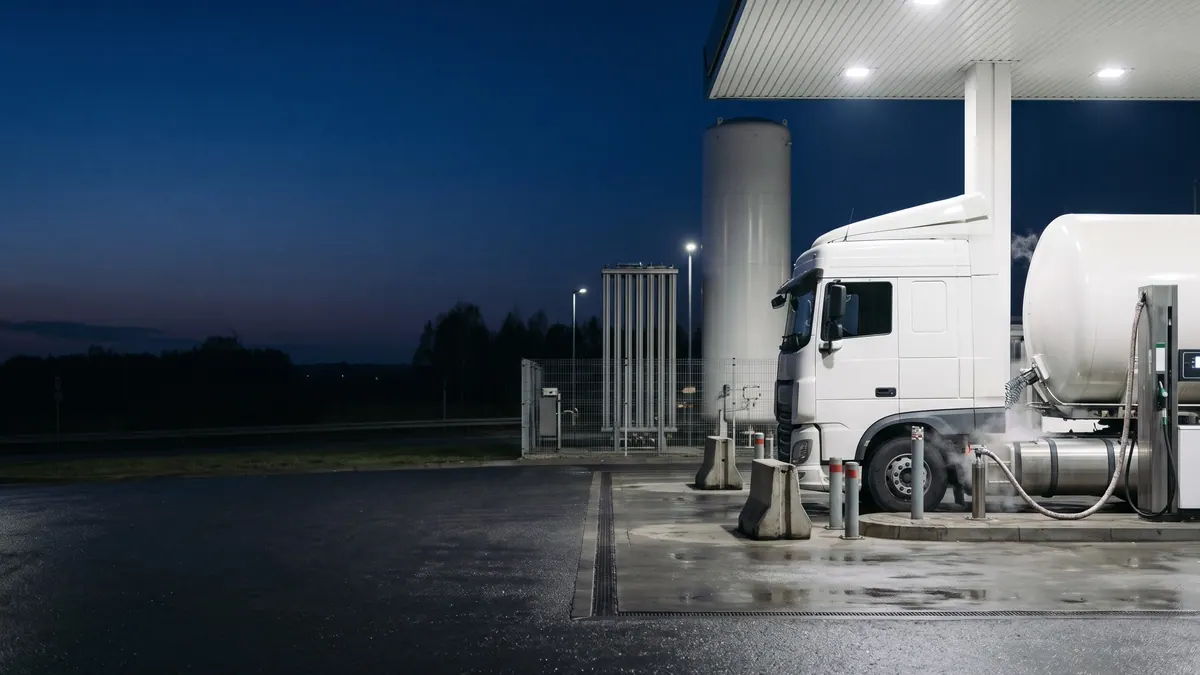
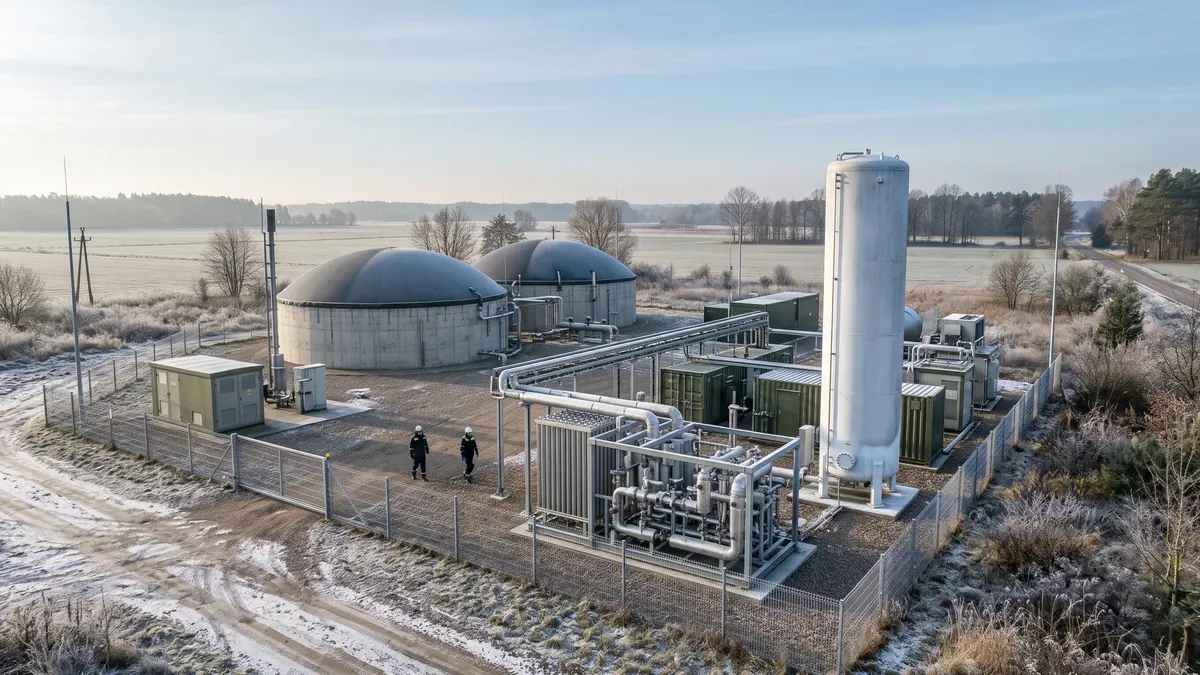
Cryogenic separation exploits the differences in phase-change temperatures: CO₂ changes to a liquid or solid state at a much higher temperature than CH₄, which condenses only at around −162°C at atmospheric pressure. So if we cool compressed biogas to a range of the order of −50…−90°C (depending on pressure and composition), the CO₂ will condense or crystallise and can be separated from the gaseous methane. The technology is less widespread than the others, but it has an exceptional feature: it can lead further to the liquefaction of methane, i.e. to bioLNG, and it gives liquid CO₂.
Why CO₂ can be separated so easily
The triple point of CO₂ lies at a temperature of about −56.6°C at a pressure of about 5.2 bar. Above this pressure carbon dioxide can exist as a liquid, below it, it desublimates to a solid (dry ice). Methane under these conditions remains a gas, because its critical temperature is about −82°C. Separation is therefore possible by selecting the pressure and temperature; the details depend on the gas composition and configuration.
A typical process line
- Pretreatment – removal of H₂S, siloxanes, VOC and water. Water and H₂S freeze in the exchangers and cause blockages.
- Compression and pre-cooling – the gas is compressed and cooled gradually, with recovery of cold.
- Condensation or desublimation of CO₂ – in an exchanger or a distillation column the CO₂ separates as a liquid or solid and is collected.
- Further cooling of the methane – if the aim is bioLNG, the biomethane is cooled to about −162°C. If the aim is the grid, the methane returns to ambient temperature.
- Cold recovery – the cooling energy of the products is used to cool the input gas.
Advantages
- High purity of CO₂ and direct production of liquid CO₂, easy to transport and sell.
- Low methane losses in well-designed systems.
- Consistency with bioLNG production – instead of two separate installations (upgrading and liquefaction) an integrated line is created.
- No chemical solvents.
Disadvantages
- Complexity and CAPEX – cryogenic exchangers, compressors, cold recovery, material requirements.
- Sensitivity to contaminants – water, H₂S and siloxanes must be removed very thoroughly.
- Energy – cooling to low temperatures costs; if, however, the aim is bioLNG, part of the energy would have to be spent anyway on liquefying the methane.
- Scale – profitability increases with larger streams, although containerised units are being developed.
Where it makes sense
The technology fits where two aims combine: the sale of bioLNG (for transport, including heavy-duty and marine) and the sale of liquid CO₂ (to the food industry or as a feedstock). Because the price of bioLNG and CO₂ is sometimes higher than that of grid biomethane, the value of the by-products can justify the higher CAPEX. The condition is stable offtake of both products and logistics (cryogenic tankers).
An illustrative example: how much CO₂ is in biogas
Assumptions: 1000 m³/h of biogas, 45% CO₂, CO₂ density approx. 1.98 kg/m³ (normal conditions), 8000 h/year. CO₂ stream: 450 m³/h ≈ 890 kg/h ≈ 7100 t/year. At an assumed sales price of liquid CO₂ of PLN 300/t (a purely illustrative assumption – prices depend on the local market and quality) the gross revenue is approx. PLN 2.1 million/year, from which the costs of liquefaction, storage and transport must be deducted. In a feasibility study one should rely on offtake contracts, not on assumptions.
Feed quality requirements
For cryogenic systems it is crucial that practically only CH₄ and CO₂ remain in the gas reaching the exchangers. Water must be removed to a very low dew point, and H₂S, siloxanes and volatile organic compounds to trace levels, because at low temperatures they form solid deposits and clog the exchanger channels. Ammonia and heavier hydrocarbons, if present, can also freeze earlier than CO₂. Cryogenic installations are therefore preceded by extensive cleaning (adsorbers, activated carbon, molecular sieves). The cost of this stage is included in the calculation, and its quality determines availability.
The role of storage capacity
Liquid CO₂ and bioLNG require insulated tanks and safety procedures (pressure, low temperatures, risk of asphyxiation in the event of a CO₂ leak). The store acts as a buffer between continuous production and periodic collection by tankers, so its size must be matched to the logistics schedule, not only to the capacity of the installation.
Summary
Cryogenics is a niche technology, but a logical one when the aim is bioLNG and liquid CO₂. It requires the highest standards of pretreatment and greater outlay, and in return offers high-quality products.
Sources
Related articles