BioLNG and bioCNGAnalysis
Biomethane micro-liquefiers: cooling technologies and selection criteria
Small bioLNG liquefiers use nitrogen cycles, mixed refrigerant cycles or cascade cycles. We compare the technologies in terms of efficiency, simplicity, scale and safety.
Other language versions: polski.
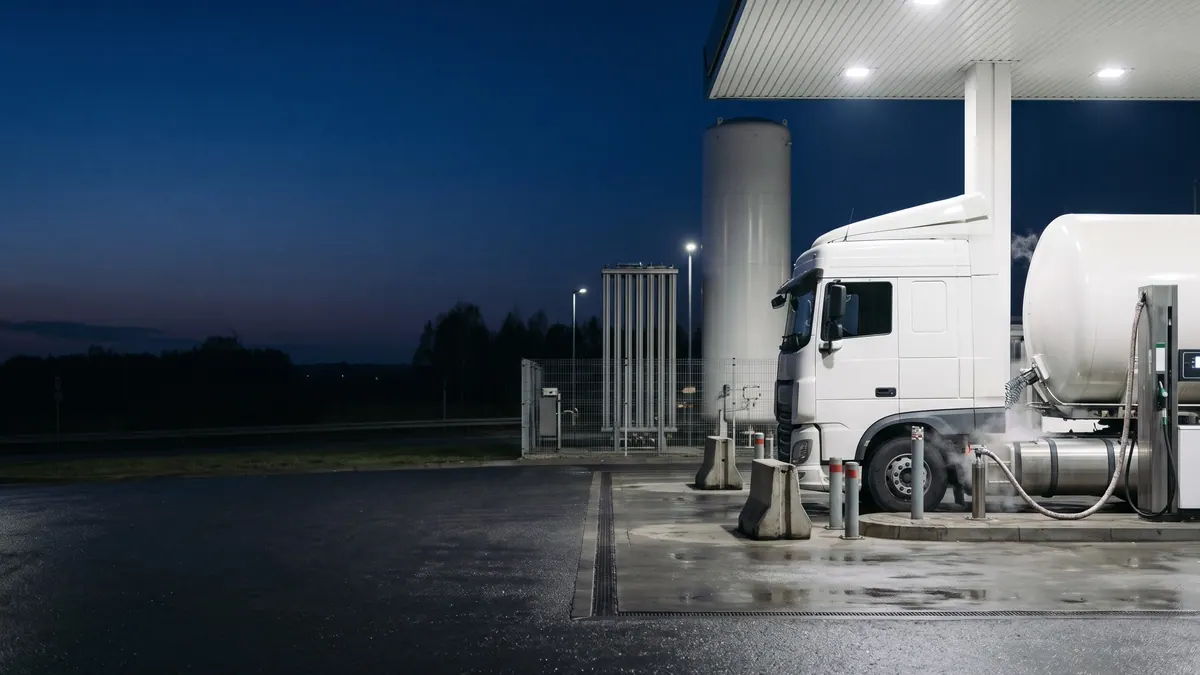
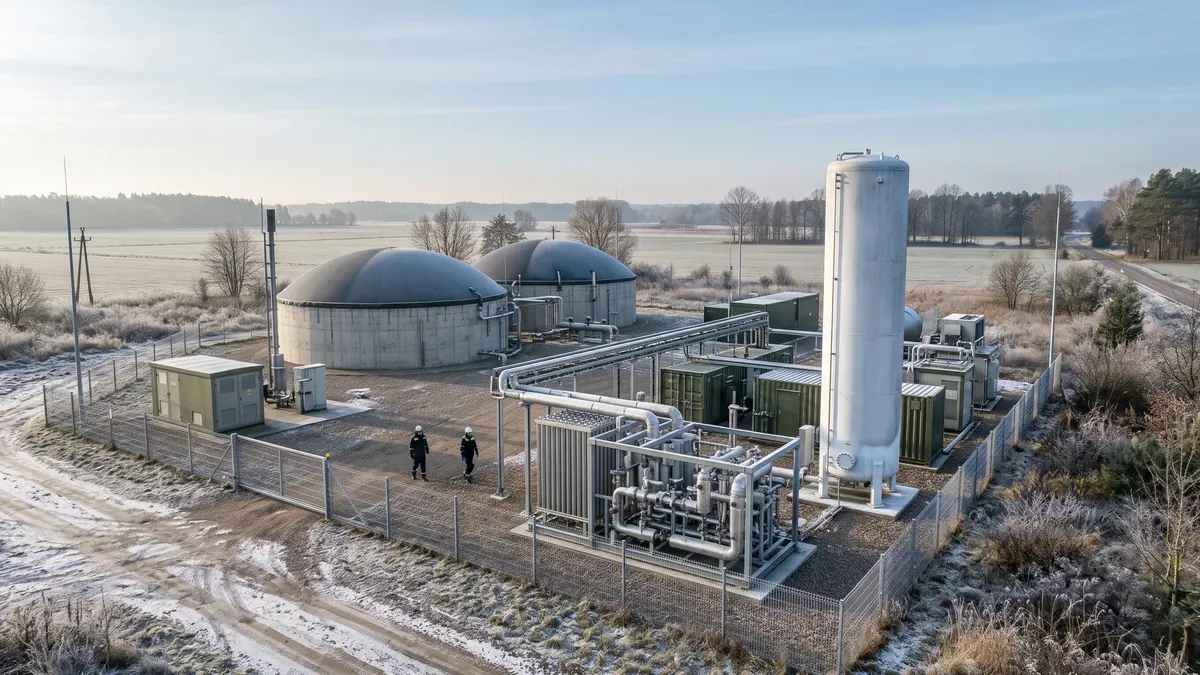
Biomethane micro-liquefiers are installations with a capacity of a few to several dozen tonnes of liquefied biomethane per day, which cool purified biomethane to about −162°C. They work in one of three arrangements: a nitrogen cycle (reverse Brayton cycle), a cycle with a mixed refrigerant, or a cascade cycle. The choice depends on scale, the required efficiency, investment costs and the approach to safety. All of them require very thoroughly purified inlet gas.
Stages of liquefaction
- Final purification: removal of CO₂ down to several dozen ppm (CO₂ freezes at low temperature), water below 1 ppm, H₂S, mercury and heavy hydrocarbons, if present.
- Pre-cooling: water or mechanical cooling.
- Liquefaction: a cryogenic exchanger in which biomethane gives up heat to a cold refrigerant.
- Subcooling and expansion: to limit evaporation during storage.
- Storage: a vacuum-insulated tank, loading into tankers.
Technologies
| Cycle | Principle | Advantages | Disadvantages |
|---|---|---|---|
| Nitrogen (reverse Brayton) | compression and expansion of nitrogen in a turboexpander; the nitrogen cools the gas | simple, safe (non-flammable refrigerant), easy to operate | lower efficiency, higher energy consumption |
| Mixed refrigerant (SMR/DMR) | a mixture of hydrocarbons and nitrogen condenses over a wide temperature range | higher efficiency | flammable refrigerant, more complex control |
| Cascade | several circuits with different refrigerants | high efficiency | high complexity and CAPEX |
At small scales nitrogen cycles or simplified mixtures are most often chosen, because simplicity, safety and low operating costs matter. In larger installations efficiency grows in importance and mixed refrigerants are used.
Selection criteria
- Scale. With small bioLNG production, energy costs matter less relative to CAPEX, so simplicity counts; with larger production efficiency becomes more important.
- Energy consumption. Typical values in the literature for small liquefiers are around 0.4–0.8 kWh/kg of bioLNG, depending on scale and cycle.
- Safety. A non-flammable refrigerant (nitrogen) makes it easier to obtain permits and simplifies safeguards.
- Load flexibility. It is good if the liquefier can operate with a variable biomethane supply.
- Service availability. Support is required for turboexpanders, compressors and exchangers.
- Integration with purification. A combination with CO₂ liquefaction (cryogenic separation) is sometimes beneficial.
- Availability. Cryogenic plants require regular inspections and defrosting.
Example: energy comparison
Assumptions: a liquefier of 10 t/day (417 kg/h), 8000 h/year. Nitrogen cycle 0.7 kWh/kg, mixed refrigerant cycle 0.5 kWh/kg (illustrative assumptions). Annual consumption: 417 × 8000 × 0.7 ≈ 2335 MWh vs 417 × 8000 × 0.5 ≈ 1668 MWh. Difference: about 667 MWh, which at PLN 600/MWh gives about PLN 400 thousand a year. If the higher efficiency costs PLN 2 million more in CAPEX, the simple payback period is about 5 years – this is an example way of assessing, which should be repeated for real offers.
Typical operating problems
- freezing of exchangers by impurities (CO₂, water),
- evaporation losses and the need to return the boil-off gas,
- underestimated energy consumption in heat, when cooling is less effective,
- start-ups and shutdowns, which consume energy and need time for cooling down.
Integration with logistics
A liquefier is not an island: it has to work with the storage, the loading arm and the fleet of tankers. Its capacity makes sense if offtake is even. Plan a tank buffer corresponding to several days of production so as not to interrupt liquefaction because of a tanker delay.
Utilities demand
Besides electricity, a micro-liquefier needs water or air cooling (removal of the heat of compression), instrument air or nitrogen, a venting system and boil-off gas recovery, and emergency power for the safeguards. At summer temperatures cooling efficiency falls, so projects assume worst-case conditions, not annual averages. Emergency power matters, because an interruption in the operation of the control or cooling system without a controlled cut-off can lead to a rise in pressure in the tanks.
Questions for the supplier
Ask about guaranteed energy consumption in kWh/kg at summer ambient temperature, the minimum load (turndown), start-up time from cold and hot states, the required CO₂ concentration at the inlet, references of installations of a similar scale and the delivery time of key components. Also establish who is responsible for the boil-off gas and how it is dealt with, because without resolving this issue methane emissions or product losses arise. It is also worth assessing the risk of a service monopoly: the more proprietary the technology, the more important a service agreement with a guaranteed response time.
Summary
The choice of liquefaction technology is a compromise between efficiency and simplicity and safety. In small agricultural installations the nitrogen cycle often wins, and in larger ones – systems with mixed refrigerants. Total costs must always be compared, not only the price of the equipment.
Sources
Related articles