Technology and operationAnalysis
Mesophilic or thermophilic digestion? Comparison, advantages and risks
Mesophilic (approx. 35–42 °C) or thermophilic (approx. 50–58 °C)? We compare the rate of degradation, hygienisation, heat balance, stability and ammonia risk to help choose the regime.
Other language versions: polski.
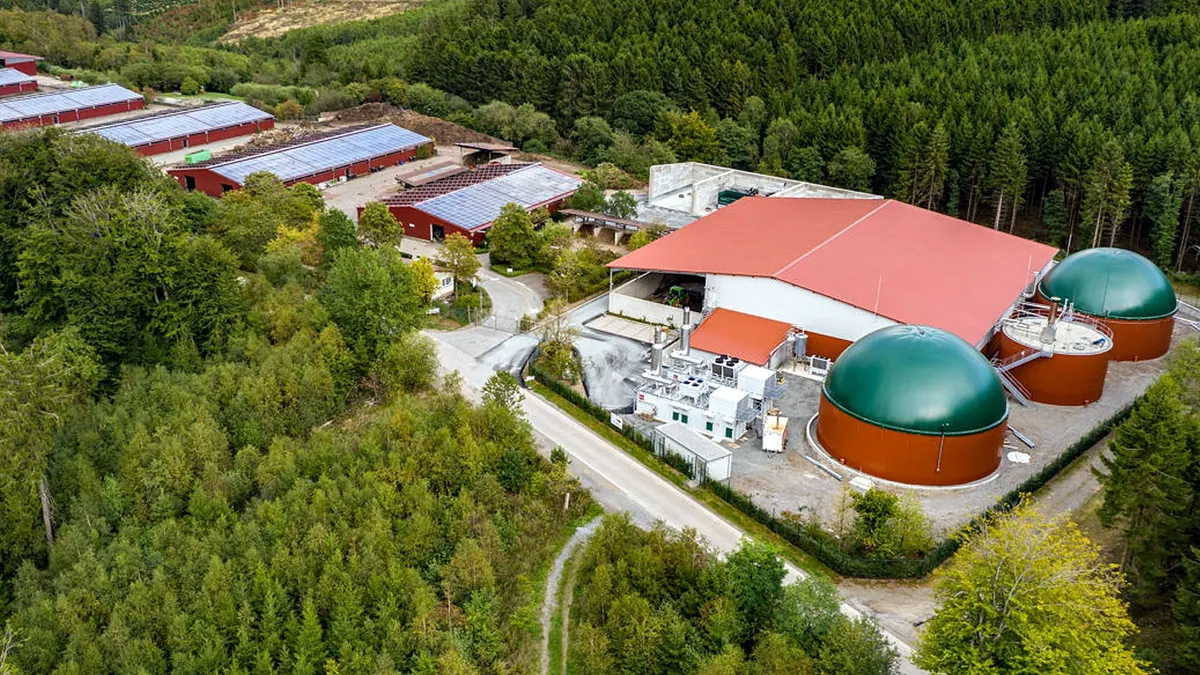
For a typical agricultural biogas plant the safer and cheaper choice is the mesophilic regime (usually 37–42 °C); the thermophilic one (usually 50–55 °C) gives faster degradation and better hygienisation, but needs more heat and more precise control, and tolerates only substrates that do not generate much ammonia. The choice is decided by the substrate mix, the options for using heat and the experience of the crew.
What changes as temperature rises
As temperature rises, the rates of enzymatic reactions increase, the viscosity of the slurry falls (easier mixing and pumping), and gas solubility decreases. At the same time the share of free ammonia (NH₃) in total ammonium nitrogen grows, because the NH₄⁺ ⇄ NH₃ equilibrium shifts to the right. Thermophilic methanogens also have a less diverse community, so they react more quickly to disturbances.
Comparison
| Feature | Mesophilic (approx. 35–42 °C) | Thermophilic (approx. 50–58 °C) |
|---|---|---|
| Rate of degradation | moderate | faster, shorter possible HRT |
| Stability | high | lower, sensitivity to fluctuations |
| Ammonia risk | moderate | higher (more free NH₃) |
| Heat demand | lower | higher, often significant in winter |
| Hygienisation | requires a separate stage, if required | contributes to pathogen reduction, does not replace legal requirements |
| Foaming, volatile acids | less frequent | VFA problems more frequent |
| Experience in the industry | very large | smaller, found in special cases |
Heat balance — a simplified example
Assumptions: 100 m³ of substrate per day, inlet 10 °C, digester 40 °C, specific heat of the slurry as for water (approx. 4.18 kJ/(kg·K)), density 1000 kg/m³. Heating: 100,000 kg × 4.18 kJ/(kg·K) × 30 K ≈ 12.5 GJ/d, that is approx. 3,480 kWh/d (approx. 145 kW of continuous thermal power, without losses through the walls). For a 55 °C digester this is a 45 K difference: approx. 5,220 kWh/d (approx. 217 kW). Under the same assumptions the difference rises by 50%. Losses through the walls come on top, depending on insulation and ambient temperature. A heat exchanger between outlet and inlet (recovery) reduces demand significantly.
When thermophilic makes sense
- a high share of substrates for which hygienisation is required, and space or heat allow it to be completed in the digester,
- a need to shorten retention time with limited volume,
- constant waste heat available,
- substrates with a low nitrogen concentration, without a large share of poultry slurry, meat or fish waste.
When mesophilic
- a mix with a large share of slurry and poultry manure,
- limited waste heat in winter,
- a crew without experience of the thermophilic regime,
- stability and simplicity are the priority.
Changing the regime: principles
- Raise the temperature gradually, in practice a fraction of a degree up to approx. 1 °C per day, with parallel control of VFA and pH.
- Reduce the load for the duration of the adaptation.
- Plan for a drop in performance during the transition period.
- Check the plant's durability (materials, insulation, heating system).
Temperature stability
Regardless of the regime, temperature fluctuations in the digester are a frequent, underestimated cause of reduced performance. Typical causes: cold substrates introduced in large portions, a failure of the heat pump/CHP, badly positioned heaters. Sensors at several points in the digester and an alarm for a change of more than approx. 1–2 °C within a day are a cheap precaution.
The final choice is best based on a heat balance, an analysis of the mix composition and an economic simulation, not on the mere promise of a higher yield.
Hygienisation and digester temperature
The effect of temperature in the digester must be distinguished from legal requirements. For animal by-products, EU regulations provide for specific treatment parameters (e.g. 70 °C for 60 minutes with limited particle size — details in a separate article), and operation at 52–55 °C alone does not always meet them, because the residence time of each portion counts, including the risk of material "short-circuiting" through the digester. That is why plants often use a separate hygienisation tank.
Economic conclusion
Heating the digester in winter can absorb a significant part of the heat from cogeneration, and in the thermophilic regime even more. Before you decide on a higher temperature, calculate whether the gain from faster degradation outweighs the cost of heat and the risks. In most agricultural plants the answer is no, unless there is a constant, cheap heat source or a hard technological requirement.
Decision step by step
- List the substrates and their seasonal availability, including the share of nitrogen-rich manures.
- Calculate the heat demand for both temperatures and compare it with the heat available in winter.
- Check the legal requirements for hygienisation with respect to the specific substrates.
- Assess the competence of the crew and the availability of VFA and ammonia analyses.
- If doubts remain — start with mesophilic; moving to a higher temperature is possible later, while going back after a failed attempt can be costly.