Emissions and climateAnalysis
Biogenic CO₂ from biomethane plants: uses in the food industry, greenhouses and e-fuels
Biogas upgrading yields a CO₂ stream of about 99% purity after drying in amine and cryogenic technologies. We analyse sales markets: beverages, packaging, greenhouses, e-fuels, and quality requirements.
Other language versions: polski.
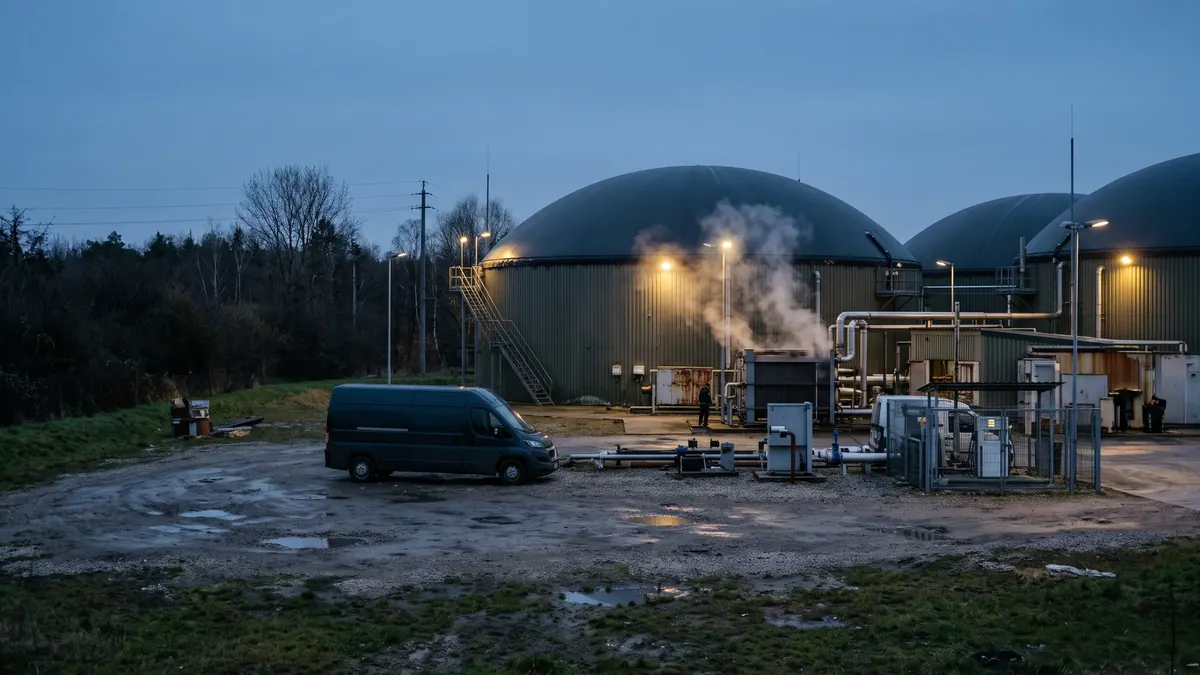
Biogas upgrading separates carbon dioxide, which makes up 35–50% of the volume of biogas. An installation processing 500 m³/h of biogas with 45% CO₂ produces about 225 m³/h of CO₂, i.e. about 445 kg/h and about 3500 t per year (8000 hours). This biogenic CO₂ can be released into the atmosphere, but it can also be purified and sold to the food industry or greenhouses, or used in e-fuels. Amine scrubbing and cryogenic technologies give the highest purity of the stream, while with membranes and PSA the off-gas contains admixtures of methane and requires additional treatment.
Stream quality depends on the technology
| Technology | Character of the CO₂ stream |
|---|---|
| Amine scrubber | approx. 99% after drying, slight traces of CH₄ |
| Cryogenics | high purity, liquid CO₂ |
| Water scrubber | CO₂ diluted with stripping air |
| Membranes and PSA | CO₂ with a few percent of CH₄ and other components |
Applications and requirements
- Carbonated drinks, beer, food. High purity is required (usually ≥ 99.9%) and control of impurities such as benzene, hydrocarbons, sulphur compounds, ammonia, aldehydes and others in line with industry specifications (including the guidelines of the European Industrial Gases Association, EIGA). Producers must have a HACCP system and batch testing.
- Modified atmosphere packaging and dry ice. Quality requirements similar to those for drinks.
- Greenhouses. CO₂ is dosed to increase yields (typically to a concentration in the order of 800–1000 ppm during the day). Purity requirements are less strict, but impurities (ethylene, SO₂, NOₓ, H₂S) harm plants. In the Netherlands a pipeline system supplying greenhouses with CO₂ from industry has long operated.
- Water treatment. pH regulation and decarbonisation.
- Welding and other industrial applications.
- E-fuels and chemistry. CO₂ is a feedstock for methanation (e-methane), methanol and other products.
Market and prices
The CO₂ market in Europe is largely based on by-products of the production of ammonia, bioethanol and other processes, so its supply depends on the output of those industries. In August 2018 there was a CO₂ shortage on the beverage market, and in 2022, when high gas prices forced some fertiliser producers to curtail production, availability problems appeared again. These episodes increased interest in alternative sources, including biogenic CO₂ from biomethane plants. CO₂ prices are contractual and depend on quality, scale and logistics; for a project, offers from customers must be obtained.
Economic example (illustrative assumptions)
Assumptions: 3500 t of CO₂ per year; sale of liquid CO₂ at PLN 250/t (assumption); cost of purification, liquefaction and storage PLN 120/t; transport PLN 60/t. Net margin: 250 − 120 − 60 = PLN 70/t, i.e. PLN 245 thousand per year. If the investment in liquefaction and purification costs PLN 3.5 million, the simple payback period is about 14 years – longer than is acceptable in many projects. When the sale price is PLN 400/t, the margin rises to PLN 220/t (PLN 770 thousand), and the payback period falls to 4.5 years. The example shows high sensitivity to price, and that is why the contract with the customer is key.
Legal requirements and certification
For food applications, sanitary permits and quality management systems are needed. For e-fuels, the accounting of biogenic CO₂ as a permitted source is regulated by the RFNBO rules and Delegated Regulation (EU) 2023/1184. Check whether the CO₂ from a given installation is permitted as a feedstock for renewable fuels and what the documentation requirements are.
Role in the GHG balance
Selling CO₂ does not always reduce emissions, because after use (e.g. in drinks) the CO₂ returns to the atmosphere. The climate significance lies mainly in replacing fossil CO₂ (from fertiliser production from gas) and in long-term carbon fixation in products or its storage. When accounting, be careful with claims.
CO₂ logistics
CO₂ can be transported as a liquid in isobaric tankers (pressure in the order of a dozen or so bar, temperature of about −30°C) or as a gas by pipeline if the customer is close. On a small scale, a liquid CO₂ store is a stationary tank with a refrigeration unit and a vaporiser, and the cost of transport rises with distance. When designing the balance, plan a storage buffer and an alternative in case of no offtake, e.g. controlled release into the atmosphere, so as not to halt biomethane production.
Summary
Biogenic CO₂ from a biomethane plant is a potential additional product, but its profitability depends on the technology, quality and customers. Before you invest in purification and liquefaction, confirm offtake contracts.
Sources
Related articles