BiohydrogenExplainer
Steam reforming of biogas and biomethane to hydrogen: balance, CO₂ and maturity
Steam reforming turns CH₄ from biogas or biomethane into H₂ and CO₂. We explain the reactions, conditions, efficiency, the mass and emissions balance and the place of the process among biohydrogen production routes.
Other language versions: polski.
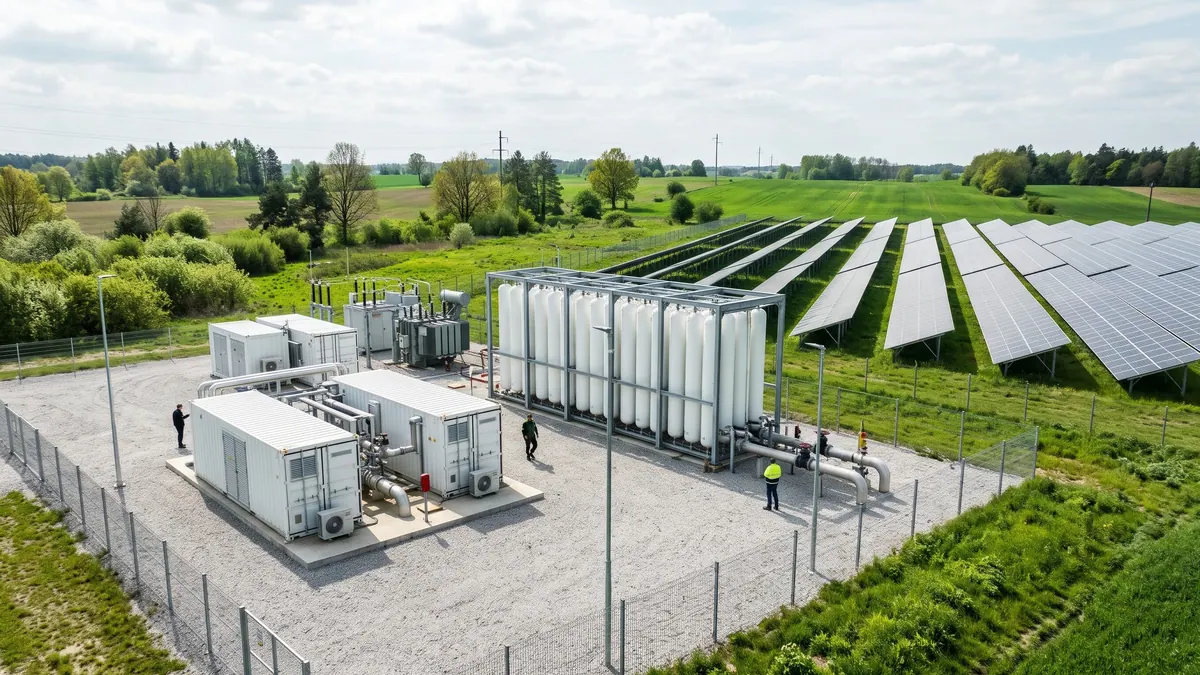
Steam methane reforming (SMR) is the most widely used method in the world for producing hydrogen from natural gas. It can also be applied to biomethane or purified biogas: methane reacts with steam at a temperature of the order of 700–900°C on a nickel catalyst, giving a mixture of hydrogen and carbon monoxide (synthesis gas), from which, after CO conversion and purification, hydrogen is obtained. If the feedstock is sustainable biomethane, the CO₂ formed in the process is of biogenic origin, and the hydrogen can have a much lower carbon footprint than hydrogen from fossil gas. Reforming technology is mature, whereas its application to small-scale biogas sources remains at the demonstration stage.
Reactions
- Reforming: CH₄ + H₂O ⇌ CO + 3H₂ (endothermic, ΔH ≈ +206 kJ/mol; requires heat).
- CO conversion (water-gas shift): CO + H₂O ⇌ CO₂ + H₂ (slightly exothermic).
- Overall: CH₄ + 2H₂O → CO₂ + 4H₂.
Stoichiometry: 16 g of CH₄ yields 8 g of H₂, i.e. from 1 kg of methane – at most about 0.5 kg of hydrogen and 2.75 kg of CO₂ (from the overall reaction). Additional CO₂ comes from burning the fuel that supplies heat to the endothermic reaction.
Process train
- Feedstock purification: removal of sulphur (which poisons the catalyst), halides, siloxanes.
- Reforming reactor with an Ni catalyst, a furnace with burners.
- CO conversion reactor (single- or two-stage).
- Hydrogen purification: most often PSA to a purity of >99.9%.
- Handling the waste gas (tail gas) – often recycled to the burners.
- Optional CO₂ capture from the synthesis gas or from the flue gas.
Energy and mass balance (example)
Assumptions: energy efficiency (H₂ energy in LHV / methane energy in LHV) of 70% (a typical value for industrial installations at larger scale, often lower in small ones), LHV of hydrogen 33.3 kWh/kg, LHV of methane 13.9 kWh/kg. Methane demand per 1 kg of H₂: 33.3 / (0.70 × 13.9) ≈ 3.4 kg of CH₄ (about 4.8 Nm³). For an installation producing 100 kg of H₂/h about 340 kg of CH₄/h (about 480 Nm³/h) is therefore needed. This quantity corresponds to a medium-sized biomethane plant. CO₂ emissions from the process are about 3.4 × 2.75 ≈ 9.4 kg CO₂/kg H₂ (from all the carbon in the methane), which corresponds to the order of magnitude of emissions of hydrogen from natural gas (about 9–10 kg CO₂/kg H₂ according to the literature). In the case of biomethane the CO₂ is of biogenic origin.
Biogas directly
Instead of upgrading biogas to biomethane, it can be reformed directly: the CO₂ in biogas is present from the start and takes part in so-called dry or mixed reforming. This leads to simplification (no upgrading), but requires solutions resistant to impurities and variable composition. Such installations are at the research and pilot stage.
Carbon footprint
Depending on the source of the methane and the presence of CO₂ capture, the carbon footprint of hydrogen can range from values close to fossil gas (when the feedstock is fossil, without capture) to very low or negative (biomethane from slurry with CO₂ capture). In EU law hydrogen from biomass is subject to the rules for biomass fuels (sustainability criteria), not to the rules for renewable fuels of non-biological origin. "Green hydrogen" (electrolytic, from renewables) must not be confused with hydrogen from biomethane.
Economics and scale
Reforming is more profitable at large scale, where fixed costs are spread over large quantities of hydrogen. In small agricultural installations the unit cost rises, and in addition purification, compression and distribution of the hydrogen have to be added. For this reason the realistic applications in the coming years are plants with an existing demand for hydrogen and access to larger quantities of biomethane.
Advantages and disadvantages
Advantages: mature technology, high efficiency, the possibility of integration with CO₂ capture, use of existing gas infrastructure.
Disadvantages: consumption of biomethane, which has other uses as well; CO₂ emissions without capture; the need to purify the feedstock; complexity at small scale.
What to avoid when assessing projects
When analysing reforming offers, it is worth checking whether the declared efficiency refers to the whole system (including purification, compression and handling of the waste gas), what the load range and start-up time are, and how the CO₂ is managed. A common simplification is to omit the energy for compressing hydrogen to transport pressures (several hundred bar), which can add several to a dozen or so per cent of the energy contained in the hydrogen. Similarly, the consumption of process water and auxiliary electricity must be added.
Summary
Reforming of biomethane is the nearest-to-market route to hydrogen from biomass, but it must be remembered that it consumes a valuable energy carrier. It is justified above all by local demand for hydrogen and the possibility of managing the CO₂.
Sources
Related articles