BiohydrogenExplainer
Biohydrogen: what it really means and what the production pathways are
Biohydrogen is hydrogen from biomass or biogas, not from electrolysis. We explain the pathways: dark fermentation, photofermentation, biogas reforming and gasification, together with the real state of development.
Other language versions: polski.
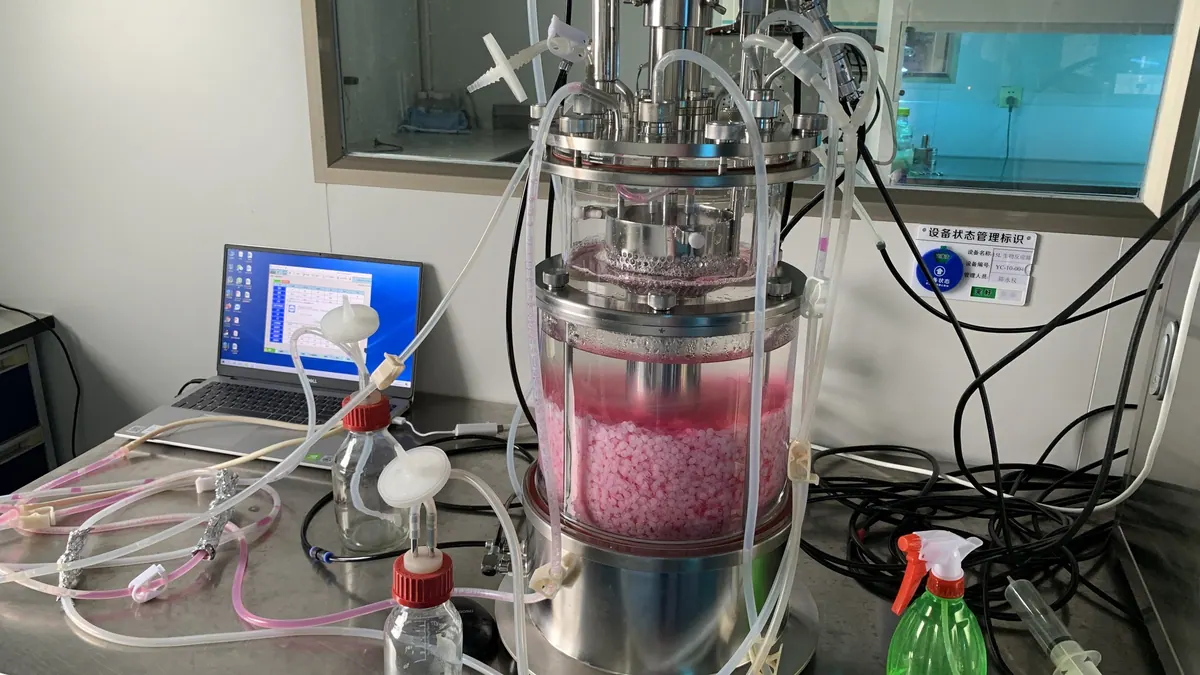

Biohydrogen is hydrogen obtained from biomass, organic waste or biogas, not from the electrolysis of water or from fossil natural gas. It comprises four main pathways: dark fermentation, photofermentation, steam reforming of biogas or biomethane, and biomass gasification. The biological pathways are still mainly a matter for research and pilots, while the thermochemical ones are industrial in nature, but are only now being adapted to renewable feedstocks. The name "biohydrogen" is not an official legal category; it is used colloquially and must be distinguished from renewable hydrogen from electrolysis.
Four pathways
| Pathway | Feedstock | Principle | State of development (general assessment) |
|---|---|---|---|
| Dark fermentation | carbohydrates: food waste, whey, agricultural residues | anaerobic bacteria produce H₂, CO₂ and organic acids | laboratories and pilots, low yields |
| Photofermentation | organic acids, waste | phototrophic bacteria produce H₂ in light | laboratories, difficult scalability |
| Steam reforming of biogas/biomethane | biogas, biomethane | CH₄ + H₂O → CO + 3H₂, then CO shift conversion | natural gas reforming is mature; the biogenic variant is in development |
| Biomass gasification | wood, straw, waste | syngas → CO shift → H₂ purification | pilots and demonstrations |
What falls within the concept and what does not
- Hydrogen from electrolysis powered by electricity from a biogas plant is in practice electrolytic hydrogen. In EU law it is classified according to the origin of the electricity, not as a fuel from biomass.
- Hydrogen from biomethane reforming is a fuel from biomass if the biomethane meets the sustainability criteria. Reforming emits CO₂, but biogenic.
- Hydrogen from natural gas with CO₂ capture is "low-carbon" fossil hydrogen, not biohydrogen.
Why biohydrogen is interesting
Biogas plants and biomethane plants are distributed sources of renewable feedstock, and hydrogen has uses that biomethane does not fill: the chemical industry (ammonia, refineries), metallurgy, part of transport. The biological pathways could additionally use low-value waste, such as whey or fruit residues. The growing interest in hydrogen in the EU stems from the climate neutrality goals.
Limitations
- Biological yield. Theoretically, dark fermentation can give a maximum of 4 moles of H₂ per mole of glucose (the acetate route), in practice much less is obtained, because the rest of the energy remains in organic acids.
- A mixture of gases. Biogas from dark fermentation contains H₂ and CO₂, and sometimes CH₄ and H₂S; purification to fuel quality requires additional stages.
- Scale. Biomass is limited and competes with other uses.
- Cost. The purification, compression and storage of hydrogen are costly and energy-intensive.
Example: how much hydrogen from 1 m³ of methane
Steam reforming with CO conversion: CH₄ + 2H₂O → CO₂ + 4H₂. Theoretically, 1 mole of methane gives 4 moles of hydrogen, i.e. from 1 m³ of CH₄ approx. 4 m³ of H₂ (at a hydrogen density of approx. 0.09 kg/m³ that is approx. 0.36 kg of H₂). In practice the energy efficiency of reforming at installation level is usually a few dozen percent relative to the energy of the gas feed, depending on scale and heat integration. Conclusion: converting biomethane into hydrogen is justified where hydrogen is indispensable, not as a general way of using biomethane.
What is happening in the EU
In July 2020 the European Commission presented a hydrogen strategy for a climate-neutral Europe. The priority is renewable hydrogen from electrolysis powered by renewable energy sources, and the role of other sources is supplementary. For the biogas sector biohydrogen is therefore a niche pathway, but it is worth following research and pilots.
How to assess reports about "biohydrogen"
In press releases the terms "biohydrogen", "green hydrogen" and "hydrogen from biogas" are sometimes mixed. For every project it is worth asking three questions. First, where do the energy and the feedstock come from: biomass, biogas or electricity from renewables? Second, at what scale does the installation operate (laboratory, pilot, demonstration, commercial installation) and what is its declared yield? Third, how is the emissions balance calculated: does it include the compression, purification and transport of hydrogen and methane emissions in the biogas chain? Only the answers to these questions make it possible to assess whether we are dealing with a technology ready for deployment or with a promising research direction. In this series, for each pathway we therefore give the order of magnitude of maturity, not cost promises.
Summary
Biohydrogen is a set of technologies of varying maturity, from laboratory fermentation to the industrially known reforming. When assessing offers and projects, it is worth asking about the technology readiness level, the energy and emissions balance, and whether the product has a real market. In the following entries we discuss the individual pathways.
Sources
Related articles