BiogasAnalysis
CHP, heat or biomethane? Technical criteria for choosing a biogas utilisation route
Three main routes: cogeneration, heat alone and upgrading to biomethane. A comparison of technical requirements, scale, off-takers, efficiency and risks, without rates and prices.
Other language versions: polski.
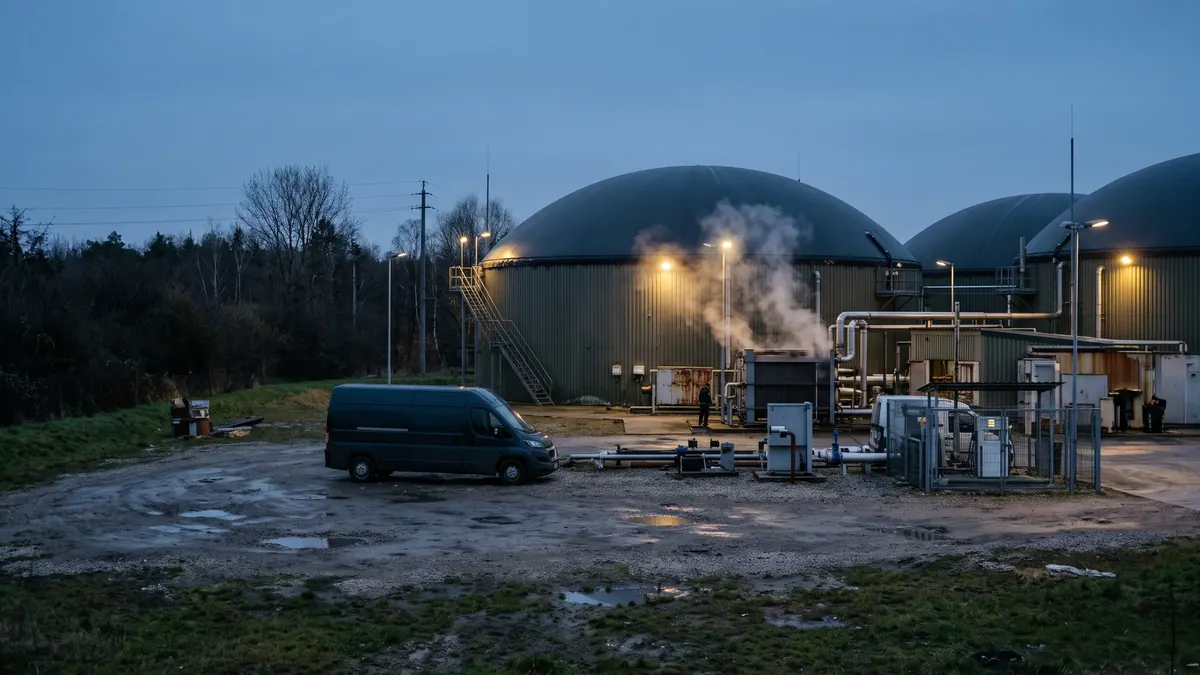
Choosing a biogas utilisation route is a decision about the form in which energy leaves the installation: as electricity and heat from cogeneration (CHP), as heat alone from a biogas boiler, or as biomethane after upgrading, injected into the grid or used as a fuel. The technical starting point is three questions: what is the scale of gas production, is there a heat off-taker all year round, and is there a gas grid with sufficient capacity or a biomethane off-taker nearby.
Comparison of the routes
| Criterion | CHP | Boiler (heat alone) | Biomethane |
|---|---|---|---|
| Technology maturity | very high | high | high, a growing number of installations |
| Typical scale | from several tens of kW to several MW | any, depending on the off-taker | usually larger; the viable scale depends on the technology |
| Products | electricity + heat | heat | grid-quality methane, CO₂ |
| Gas requirements | drying, desulphurisation, usually a carbon filter | simple cleaning | deep cleaning, removal of CO₂, O₂ and others |
| Dependence on the off-taker | electricity grid, heat off-taker | heat off-taker all year | gas grid or fuel transport |
| Flexibility | moderate (gas store) | low | high (storage in the grid) |
| Operational complexity | medium | low | higher (more equipment, quality control) |
CHP
Strengths: a known technology, service available in the country, the ability to operate in island mode or with the grid, modularity. Weaknesses: an electrical efficiency of several tens of per cent, the rest of the energy as heat, whose use is often seasonal. The key is the heat balance: how much heat can be sold or used (dryers, buildings, industrial processes). Good heat utilisation raises overall efficiency to over 80%, poor utilisation leaves a significant part of the energy unused.
Heat alone
A biogas boiler is simple and cheap, with high efficiency (usually about 90%), but makes sense only where there is a constant heat off-taker. It is used in continuous industrial processes, in food processing, at dryers and in local district heating. The drawback is the lack of a higher-value product (electricity) and dependence on a single off-taker.
Biomethane
Upgrading consists in removing CO₂ (and residual H₂S, water and other impurities) in order to obtain a gas with parameters close to natural gas. Technologies: water scrubbers, amine scrubbers, membranes, pressure swing adsorption (PSA). Advantages: the gas can be injected into the grid, stored, and used as a fuel in transport (CNG, LNG), and the energy is not limited by the need for a local heat off-taker. Disadvantages: a higher investment cost, requirements regarding scale and gas quality, methane losses in the process (so-called methane slip), the grid connection, metering and formal requirements.
Biomethane can be viable for installations with a larger gas stream or for clusters of smaller installations collecting gas (e.g. by a raw biogas pipeline to a shared upgrading plant).
Decision criteria
- Scale: how many m³ of biogas per hour? Small streams make upgrading difficult.
- Heat off-taker: quantity, constancy, distance, willingness to sign a long-term contract.
- Grid access: distance to the gas grid, pressure, summer capacity, connection cost.
- Electricity grid access: connection conditions, power limits.
- Legal framework and support: available schemes, sustainability requirements, certification.
- Competences and servicing: availability of contractors and parts.
- Development plans: the possibility of changing the route in the future (a land reserve, a design prepared for expansion).
- Risk: dependence on a single off-taker, regulatory volatility.
Example of a simplified energy comparison
With 1,000 kW of fuel energy: a CHP with an electrical efficiency of 38% and a thermal efficiency of 45% gives 380 kW of electricity and 450 kW of heat; if the off-taker uses 50% of the heat, overall efficiency is 60.5%. A 90% boiler gives 900 kW of heat, if all the heat is taken. Upgrading, assuming a methane loss of 1% and own energy consumption of around a few per cent of the fuel, makes it possible to deliver to the grid about 90–95% of the energy in the form of biomethane (depending on the technology and the power supply). The figures are illustrative; actual ones depend on the technology and the conditions.
Intermediate routes
- Cogeneration with a district heating network and a heat store.
- A raw biogas pipeline to a shared unit or off-taker.
- Hybrid: CHP plus a boiler at peak heat demand.
- Transport of liquefied or compressed biomethane to off-takers (bioLNG, bioCNG).
Conclusion
There is no universally best route. For small installations with a heat off-taker, CHP remains rational; for large gas streams and grid access, biomethane can be of interest; heat alone makes sense with constant demand. The decision should be supported by an energy balance, a risk analysis and verification of the current regulations.
When to consider changing route
A switch from CHP to biomethane is considered when contracts are expiring, engine servicing costs are rising, a connection is available, or the local heat off-taker is disappearing. It is then worth checking: the amount of gas available after modernising the installation, the biogas quality, the requirements for upgrading, the risk for existing contracts and the technical condition of the digesters. Prepare a feasibility study with variants and a sensitivity analysis to the price of substrates, energy and the cost of capital.
The role of waste heat
Even when biomethane is chosen, the process requires heat (heating the digesters, regeneration in amine technology), which must be provided from a boiler or another source. The heat balance is therefore an element of every variant, not only of CHP.
Sources
Related articles