Digester start-up: inoculum, heating and load build-up
How to start a new or emptied digester: filling, inoculum, gradual heating, gas control and a safe path to the full feed rate over weeks.
Other language versions: polski.
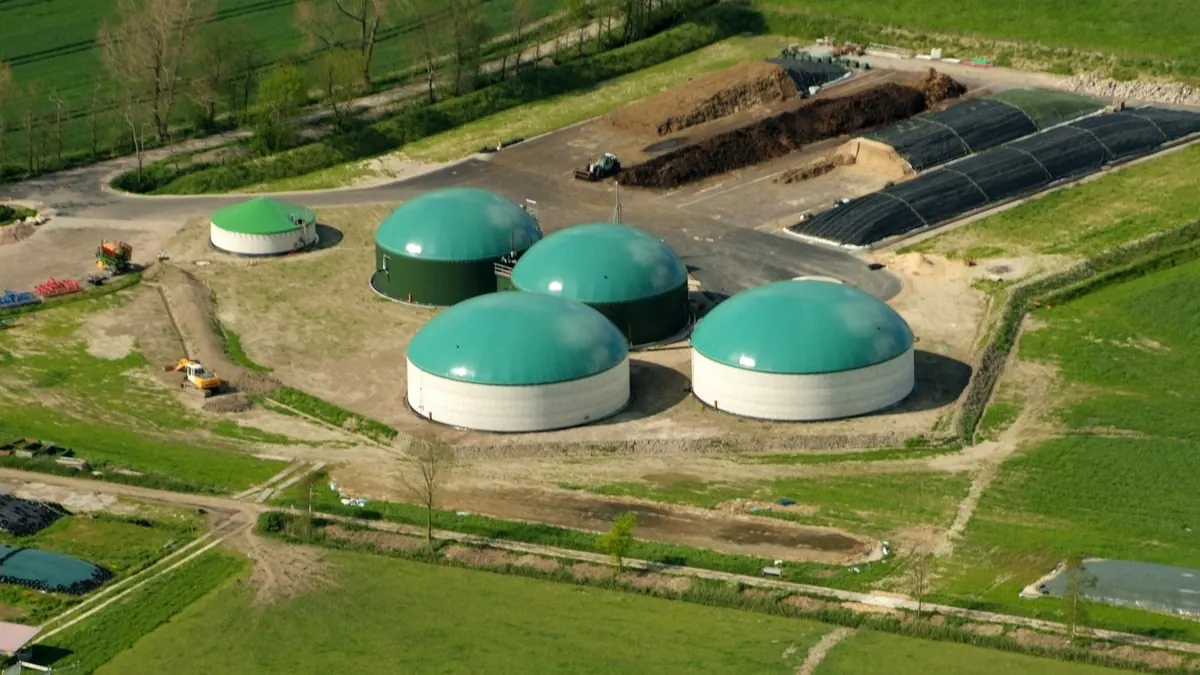
Starting up a digester means building an active community of methanogens in it. The surest route: fill the digester with slurry from a working plant (inoculum), heat it gradually to operating temperature and start with a low feed rate, which is increased over several to a dozen or so weeks, guided by process indicators. The most common mistakes are feeding too quickly, no inoculum and sending low-quality gas to the CHP.
1. Preparation before filling
- leak tests of the tank and the gas system,
- checking mixers, pumps, heating and measurements,
- establishing an OHS plan: explosion hazard zones, detectors, entry procedure (see the articles on ATEX),
- ensuring an adequate quantity of inoculum and start-up substrates,
- agreeing the offtake or flaring of gas during start-up (flare).
2. Inoculum
The best is inoculum from a working plant with a similar mix and temperature. It fills a considerable part of the volume (in practice from several dozen per cent to all of it; the more, the faster the process starts). The remainder is slurry (it contains natural microorganisms and a buffer) or water. Inoculum from digesters running on other substrates requires longer adaptation. Cold material will lower the temperature, and transport itself can affect the state of the biomass.
3. Heating
Heat gradually, usually no faster than approx. 1 °C per day (faster steps of up to several degrees are acceptable in the mesophilic range, more carefully in the thermophilic range). Too rapid a change causes thermal shock. Sometimes start-up is carried out at a lower temperature, raising it after gas production has started.
4. Gas in the initial phase
At the beginning there is air in the gas space; as fermentation proceeds, CO₂ appears, and then methane. Passing through the explosive range (approx. 5–15% CH₄ in air, indicative values) is unavoidable if the digester has not been inerted. Therefore:
- Vent the gas in a manner consistent with the design (flare or a safe vent).
- Do not connect the CHP until the CH₄ content of the gas reaches the value required by the engine manufacturer and oxygen is minimal.
- Maintain a strict ban on ignition sources (ATEX).
- Use calibrated gas analysers.
5. Increasing the feed rate
| Week (indicative) | Typical practice |
|---|---|
| 1–2 | low feed rate (e.g. on the order of 0.5 kg VS/(m³·d) or less), only light substrates |
| 3–6 | gradual increase every few days, monitoring VFA and pH |
| 6–12 and longer | reaching the target mix and load |
The schedule must be adapted to the indicators: if VFA and FOS/TAC rise, the feed rate is held or reduced. Difficult substrates (fats, proteins, poultry droppings) are introduced last.
6. Monitoring
| Parameter | Frequency (indicative) |
|---|---|
| Temperature | continuous |
| pH | every few days, more often at first |
| FOS/TAC | 2–3 times a week |
| VFA | once a week or more often |
| Gas composition (CH₄, CO₂, O₂, H₂S) | continuous or daily |
| Gas production | continuous |
7. Typical problems
- No CH₄ after several weeks: too little inoculum, too low a temperature, too high a feed rate or inhibitors.
- Acidification: reduce the feed rate, buffer.
- Foam: reduce the load.
- Trace element deficiency: supplementation after analysis.
8. Acceptance and documentation
Start-up ends when the plant reaches a stable load and yield for a set time. Draw up a report: parameters, events, gas data, conclusions. It will be a reference point in further operation and for any claims against the contractor.
Patience in start-up brings more than haste: killing freshly built biomass by feeding too quickly can set the process back by weeks.
Example schedule (illustrative)
Assumptions: a 2,500 m³ digester, inoculum 60% of the volume, target mix silage + slurry. Day 0: filling, start of heating. Days 1–10: raising the temperature to 40 °C. Day 10: first slurry feeding (buffer). Week 3: silage in a small quantity, OLR approx. 0.5 kg VS/(m³·d). Week 6: OLR approx. 1.5. Week 10: OLR approx. 2.5. Week 14: reaching the target 3.0–3.5 with stable VFA. Each step depends on the results; if VFA rise, it stops at the current level.
Start-up after emptying and cleaning
If the digester has been emptied (inspection, overhaul), start-up is faster, provided part of the slurry can be kept in another tank and returned to the digester. Remember degassing and checking the atmosphere before entering the tank (a separate article on work in confined spaces).