Safety and ATEXAnalysis
Digester liquid level and agitator safety
Why too low a liquid level in the digester damages agitators and increases risk to people, and too high a level threatens the membrane and causes overflow. Principles, measurements and requirements for the protection system.
Other language versions: polski.
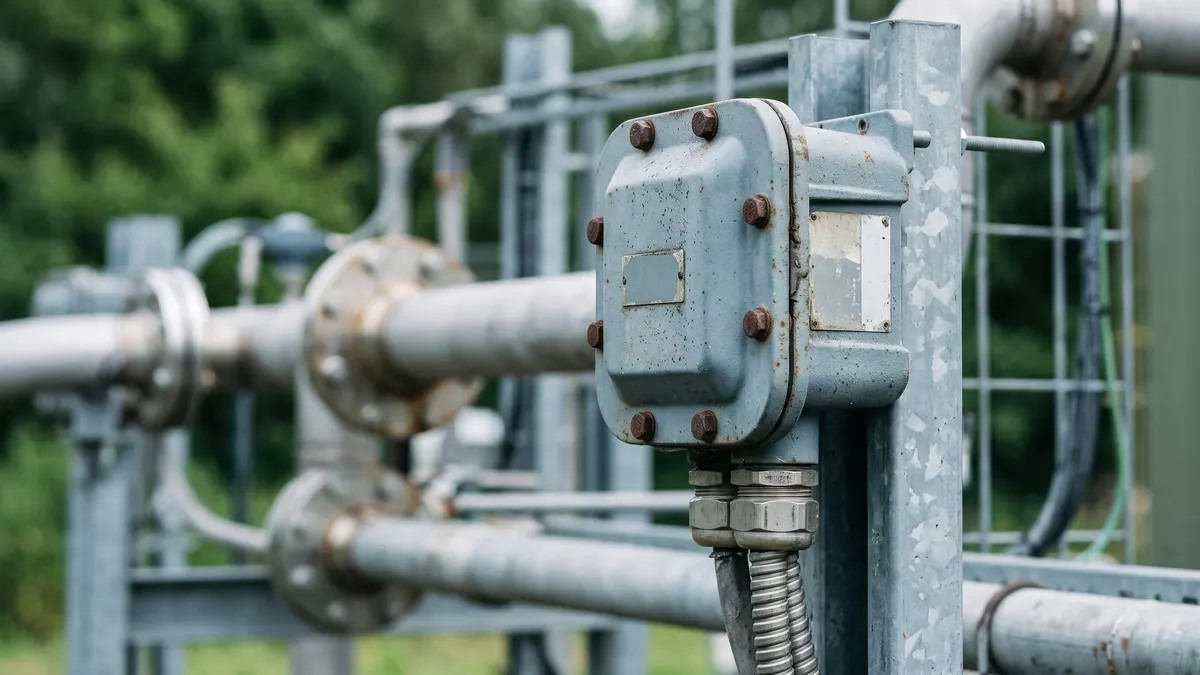
The liquid level in the digester determines whether the agitators work under the conditions for which they were designed. Too low a level exposes the impellers and causes vibration and damage, while too high a level loads the structure and reduces the gas space. For this reason level measurement and its link to an agitator interlock are among the basic elements of safe operation. The text below describes principles and criteria; the specific limit values are set by the manufacturer and the designer of the installation.
What happens to an agitator at a low level
Agitators in digesters are usually submersible (propeller) agitators, long-shaft agitators or central agitators, designed to work in fully submerged liquid. When the level falls:
- the impeller approaches the surface, draws in gas and air or works in foam, which changes the hydraulic load,
- the force on the blades becomes asymmetrical, so the shaft and bearings carry larger and variable loads,
- in the extreme case the blades emerge, causing strong vibration and shocks,
- mechanical seals and shaft penetrations suffer, through which biogas can escape,
- rotating elements at the surface of the contents splash liquid and aerosol.
The result is accelerated wear, a failure forcing service work on the tank and, in the worst case, a biogas leak. The general underlying mechanism is described in the post Agitators in the digester: types and selection.
Consequences of too high a level
Overfilling is not only a process problem:
- hydrostatic pressure on the walls and floor rises,
- the gas space shrinks, so biogas storage and the pressure buffer are limited,
- in tanks with a membrane the risk of damage to it or of it being drawn into the liquid rises,
- liquid can reach gas lines, safety valves and fittings, which threatens their operation,
- the contents can spill through the overflow, which is an environmental incident.
The upper level limit is therefore as important as the lower one and must be protected independently of the lower one.
How to measure the level so that it can be trusted
Level measurement in a digester is demanding. The surface of the contents is uneven, and there are foam, scum and sediment. There is no single method that always works, so a combination is used.
| Method | Advantage | Typical limitation |
|---|---|---|
| Hydrostatic pressure measurement | independent of foam, simple | effect of density and sediment on the transmitter |
| Radar | non-contact | foam, scum, condensate on the antenna |
| Float probe or reed switch (limit state) | simple, as a protection | fouling, jamming |
| Sight glass or inspection window | visual check | requires presence, unsuitable for interlocks |
Good practice is to use two methods with different operating principles, compare the readings and raise an alarm in the event of a discrepancy. The low-level limit switch that disconnects the agitator drives should be implemented as a protection independent of process control.
Linking the level to interlocks and control
The controller should take the level into account under several conditions:
- An agitator start interlock below the minimum immersion.
- Agitator shutdown after the level falls below a threshold, with a delay that guards against false alarms from waves.
- A high-level alarm before overfilling and blocking of further dosing.
- Taking history into account: if the level over a short time falls clearly faster than the removal of digestate would explain, this is a sign of a leak or a measurement error.
Thresholds, hystereses and delays are specified in the site documentation. They must not be changed during operation without approval.
Level, service work and risk to people
The most serious hazards arise during servicing of agitators. The digester tank and its surroundings are a place where biogas (CH₄, CO₂, H₂S) may be present, and therefore an explosive and toxic atmosphere. Work on agitators, including replacing seals, removal and especially entering the tank, is carried out only according to a written instruction, on the basis of a risk assessment and with the participation of authorised persons. Of particular importance are:
- a procedure for isolating and securing the drive against accidental start-up,
- an explosion hazard assessment in accordance with the explosion protection document and the use of equipment suitable for the zone,
- requirements for confined spaces and team working,
- measurement of gas concentrations and their continuous monitoring.
This post is not an instruction for carrying out this work. The detailed steps, required authorisations and protective measures follow from the site instructions, the equipment manufacturer and legislation, including Directive 1999/92/EC and the national provisions implementing it. For the hazard of hydrogen sulphide see Hydrogen sulphide H₂S: hazard to people, health and safety, detectors, procedures.
The most common causes of an uncontrolled change of level
The level changes not only as a result of operator decisions. Events that must be anticipated:
- a mismatch between dosing and removal of digestate (e.g. after a pump failure),
- freezing or blockage of pipelines,
- the formation of foam that increases the apparent level,
- damage to a penetration or valve leading to a leak,
- transmitter calibration errors after a change in the density of the contents.
For each of these situations the instruction should specify the operator's response and the person who must be called.
Checklist for the plant manager
- Is the working range of the level written down in the instruction and consistent with the agitator documentation?
- Is the low-level protection independent of process control?
- Are the level measurements compared with each other and periodically checked?
- Do the alarms have set responses and owners?
- Is work on agitators covered by a written procedure with a risk assessment?
- After a change of substrate or contents, have dry matter and density been taken into account in the calibration?
"Yes" answers to all the questions do not exhaust the requirements, but they show that the basic layer of protection exists and is maintained.
Level versus foam and scum
A particular problem is an apparent change of level. Foam and a thick scum on the surface make non-contact sensors show a value higher than the real one, and the liquid underneath may be lower than the reading suggests. If an agitator is set close to the minimum threshold, the apparent level can hide a real exposure of the impeller. Therefore, where there is a tendency to foaming or scum formation, hydrostatic measurement should be one of the two independent measurements, and the causes of foaming should be investigated as a separate process problem.
Documentation and training
Level limit values, how the interlocks work and responses to alarms should be described in the site instruction and known to every person working on a shift. Good practice is to check periodically the operation of the minimum-level interlock in the manner provided by the manufacturer and to record the result. Changes to sensor settings, calibration after replacement and every case of bypassing a protection should be approved and noted, so that nobody leaves the installation unprotected after service work is finished.
Sources
Questions and answers
Can a mixer run with exposed blades?
Such operation should not be allowed. An exposed impeller can be hydraulically unbalanced and produces vibrations that damage bearings and seals, and it may also splash the contents. The control system should switch the mixer off below the minimum level.
Who sets the permissible liquid level range?
The range follows from the agitator documentation, the tank design and the plant manual. The operator should not change it independently; a change requires the approval of the person responsible for operations and, usually, consultation with the manufacturer.