Mixers in the digester: types, selection and energy use
Mixing determines homogeneity and the distribution of sediments and scum. We compare submersible, central and long-shaft mixers, and the criteria for selection, energy use and servicing.
Other language versions: polski.
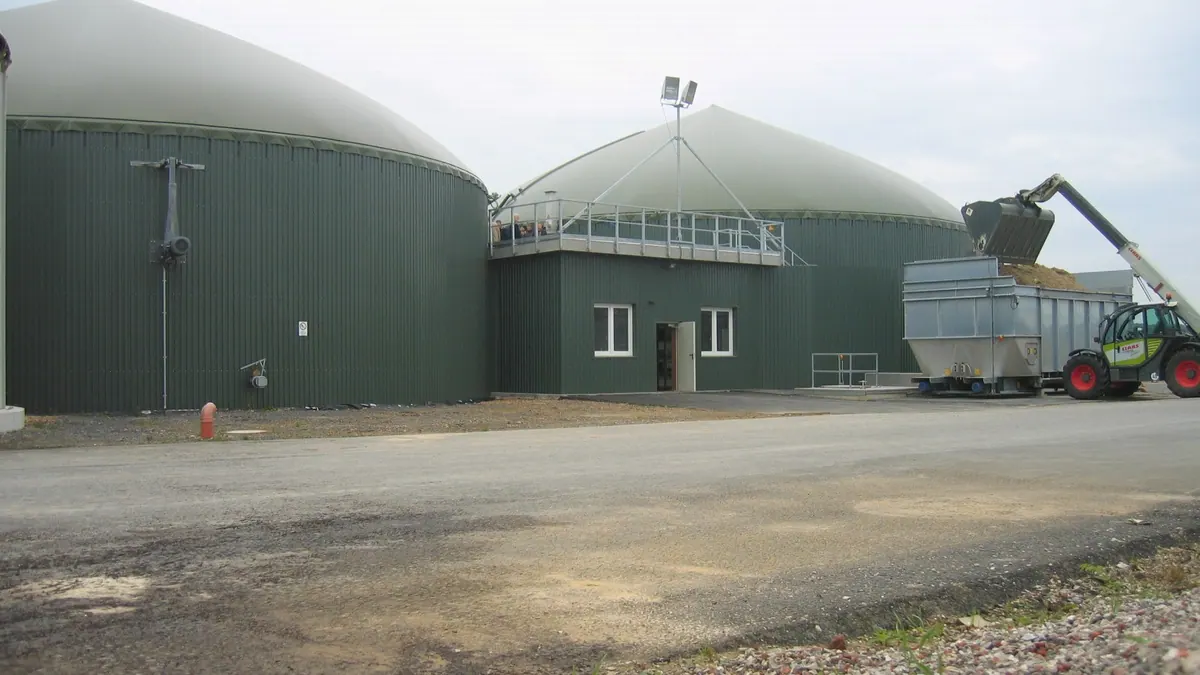

Mixing in the digester is meant to ensure uniform temperature and substrate concentration, contact of microorganisms with food, prevent the formation of sediments and scum, and facilitate the release of gas from the liquid. The choice of mixer depends on the dry matter of the slurry, the shape of the tank and the operating mode; for agricultural biogas plants the most commonly used are high-speed submersible mixers, slow-speed long-shaft mixers and central paddle mixers, and intensity is regulated by time, not by constant operation.
Types of mixers
| Type | Characteristics | Advantages | Disadvantages |
|---|---|---|---|
| High-speed submersible (propeller) | motor in the tank, propeller on a shaft, mounted on a guide | flexible positioning, good flow | wear of bearings and seals, difficult servicing, higher speeds |
| Slow-speed long-shaft (paddle) | motor outside, long shaft, large paddles | low speeds, easier motor servicing | requires stable mounting and shaft seals |
| Central | vertical shaft with paddles or propellers | even mixing in cylindrical tanks | requires a load-bearing roof, less flexible |
| Hydraulic and pneumatic | mixing by pumps or gas recirculation | few moving parts in the tank | energy use and risk of clogging, limited application |
Selection criteria
- Dry matter of the slurry — the higher it is, the greater the viscosity and the power needed; non-Newtonian (shear-thinning) slurries behave differently at different speeds.
- Tank geometry — diameter, height, shape of the bottom.
- Type of substrates — straw and manure increase the risk of scum, stones and sand — of sediments.
- Operating mode — continuous vs. intermittent mixing.
- Availability of servicing — the possibility of removing the mixer without emptying the digester (submersible on guides) or replacing seals from outside.
- Energy costs — motor power and operating hours.
Energy use
For mixing, a share of a few per cent of own electricity production is most often assumed; specific values depend on the arrangement and dry matter. A simplified example: a digester with a total mixer power of 30 kW operating for 12 h a day uses approx. 360 kWh/d. In a plant with an electrical capacity of 500 kW daily production is 12,000 kWh/d, so mixing is approx. 3% (assuming operation at full power). Reducing the operating time to 8 h lowers the figure to approx. 2%. These values are an illustration; measure your own consumption with meters.
Intermittent mixing
Studies and practice indicate that continuous mixing is not always needed; with suitably chosen intervals energy use can be reduced without a drop in yield. The intervals are chosen empirically, observing temperature, sediments, scum and gas production. Longer breaks increase the risk of stratification and caking of scum, and mixing right after feeding helps to distribute the substrate.
Typical problems
| Symptom | Possible cause | Action |
|---|---|---|
| Scum on the surface | insufficient mixing, straw, fibres | change the positioning or operating time, size reduction |
| Sediments on the bottom | sand, stones, precipitated carbonates | desludging, cleaning, removing sand before feeding |
| Temperature stratification | badly positioned mixers | correct the positioning |
| Foaming | excessive mixing at a low level | change the mode |
| Seal failure | wear, lack of lubrication | servicing, spare parts |
Servicing
- inspection of seals, bearings and lubrication in accordance with the manufacturer's documentation (DTR),
- measurement of current and vibration,
- a plan for replacing the mixer during operation without emptying (submersible design) or a suitable procedure for taking the digester out of service,
- a reserve of parts and a service contract,
- safety: work at inspection openings in an explosion hazard zone requires appropriate tools and procedures.
Well-chosen mixing is a quiet factor in the stability of a plant: neglecting it shows only after months in a loss of working volume and rising costs of cleaning the digester.
Measuring mixing effectiveness
The effectiveness of mixing is checked not only by energy use. The indicators are: uniformity of temperature at several points in the digester (a difference below 1–2 °C), the absence of lasting scum, a constant level of sediments at successive inspections, the homogeneity of samples taken from different heights (dry matter, pH, VFA). Some plants carry out tests with a dye or salt as a tracer to assess mixing time; this makes sense mainly for upgrades.
Replacement or upgrade
Before buying a new mixer, check: whether the problem is the equipment, or the way of feeding (e.g. substrate poured in at a dead spot), or the lack of sand removal. Upgrading the arrangement (an additional mixer, a change of angle, a change of operating mode) is sometimes cheaper than replacing the whole set and gives a comparable improvement.
Mixing and dry matter — a practical tip
As dry matter rises, the viscosity of the slurry increases non-linearly, so the same mixer power gives an ever smaller reach of the stream. When raising the share of dry substrates (silage, manure), check whether the mixers retain sufficient reach; often a change of angle setting or a longer operating time is enough before further equipment has to be added.
Sources
Related articles