Substrate size reduction and removal of foreign bodies, sand and stones in a biogas plant
Plastic, metal, stones and sand shorten the life of pumps and settle in the digester. An overview of size reduction methods and of separating contaminants before the digester.
Other language versions: polski.
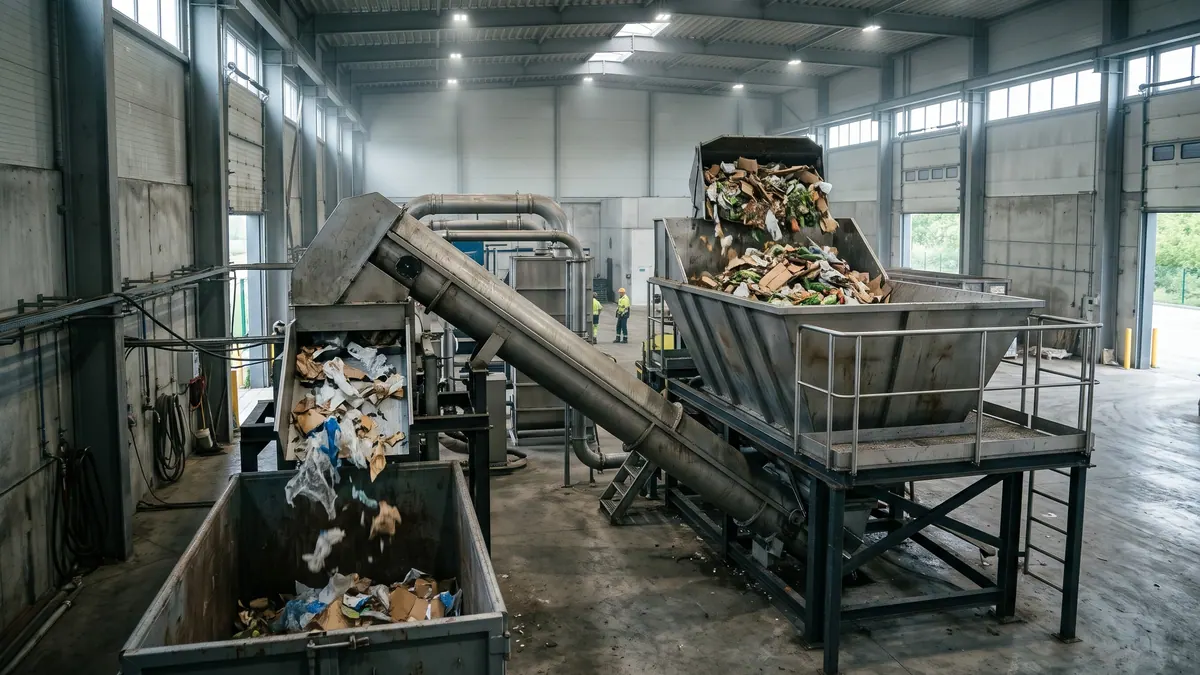
Size reduction of substrates increases the availability of material to enzymes and makes pumping and mixing easier, but equally important is the removal of foreign bodies, sand and stones, which destroy pumps, block pipelines and settle in the digester. In agricultural biogas plants running on silage and slurry there are few contaminants and simple inspection is enough; with food waste and biowaste from selective collection a full preparation line with depackaging and separation is usually needed.
Why reduce size
- a larger specific surface speeds up hydrolysis, especially for fibrous materials,
- the risk of clogging pumps and mixers is reduced,
- the slurry is more homogeneous, which improves mixing,
- the hygienisation requirements are met (e.g. particle size for ABP — see the separate article).
Size reduction does not always increase methane yield: the effect is greatest for straw, grasses and materials with a high fibre content; for easily degradable materials the difference is sometimes small, while the energy cost rises.
Size reduction equipment
| Equipment | Application | Notes |
|---|---|---|
| Hammer mill | straw, dry manure | sensitive to foreign bodies, dusty |
| Knife / cutting shredder | food waste, silage | knives require sharpening |
| Wet mill, macerators | slurries with fibres | protects pumps, uses energy |
| Chopper in the pump | slurries | in-line solution |
| Depackager | packaged food | separates packaging from the organic fraction |
| Screen, screw press | separation of fractions | the rejects require further treatment |
Removal of contaminants
- Ferrous metals — magnetic separators (magnets on a belt or in a pipe).
- Stones and heavy bodies — gravity separators, settling in the pre-tank (stone sinks, lighter fractions flow on).
- Sand — sand traps (hydrocyclones, settling tanks), common with slurry from litter-based husbandry and with silage contaminated with soil.
- Plastics and films — screens, screening after depackaging, manual selection during initial sorting.
- Glass and ceramics — gravity separation, often together with stones.
Sand balance example
Assumptions: a plant receives 40 t/d of slurry from litter-based facilities, in which the sand content is 0.5% of mass (an illustration, the actual figure depends on husbandry). Sand arrives at a rate of 200 kg/d, that is approx. 73 t a year. If it is not removed, within a few years it can occupy several dozen cubic metres in the digester (bulk density approx. 1.5 t/m³, that is approx. 49 m³ a year). In a digester with a volume of 3,000 m³ after several years the loss of working volume would therefore be several per cent, and the cost of removing it by taking the digester out of service would be high. Sand removal before dosing is much cheaper.
Consequences of no separation
- rapid wear of pumps, pipelines and mixers,
- a reduction in working volume and retention time,
- blocking of heat exchangers,
- contamination of the digestate with plastics (a restriction on fertiliser use),
- the need for costly digester cleaning.
Good practices
- Control the quality of deliveries at source, by signing a substrate specification with suppliers.
- Ensure hard-surfaced, clean loading and storage areas.
- Install a magnet and a stone separator upstream of positive displacement pumps.
- Plan the desludging of sediments from the bottom of the digester as part of a technical inspection.
- Store rejects (plastics, metals) and manage them in accordance with waste regulations; keep records.
- For municipal waste, check the legal requirements and suppliers' documents — the rules for accepting biowaste are set out in separate regulations.
When to invest in a preparation line
If the share of packaged waste exceeds a dozen or so per cent of the mass of substrates, or if the digestate is to be applied on fields, a depackaging and separation line ceases to be an option. The investment cost pays back through fewer failures, higher digestate quality and longer equipment life.
Particle size and requirements
Different goals require different granulation. For pumps and mixers, size reduction to a few centimetres is usually enough, for ABP hygienisation a limit of ≤12 mm applies, and for BMP analyses samples are often chopped to below 1–2 cm or ground to a few millimetres, depending on the protocol. Grinding too fine uses energy and can increase the risk of rapid acidification with easily degradable substrates, so granulation is chosen for the task, not on the principle of "the finer, the better".
Preparation line checklist
- Is there metal separation upstream of every positive displacement pump and shredder?
- Does packaged waste pass through depackaging, and do the rejects go to external management?
- Is sand removed from slurry before dosing?
- Are quality checkpoints for deliveries and a procedure for rejecting a batch defined?
- Do knives, screens and magnets have a cleaning and replacement schedule?
Sources
Related articles