Biological biogas desulphurisation: air dose, bacteria and risks
The cheapest way of lowering H₂S: a small dose of air into the digester headspace and bacteria that oxidise sulphides. How to choose the amount of air, how to control it and what to avoid.
Other language versions: polski.
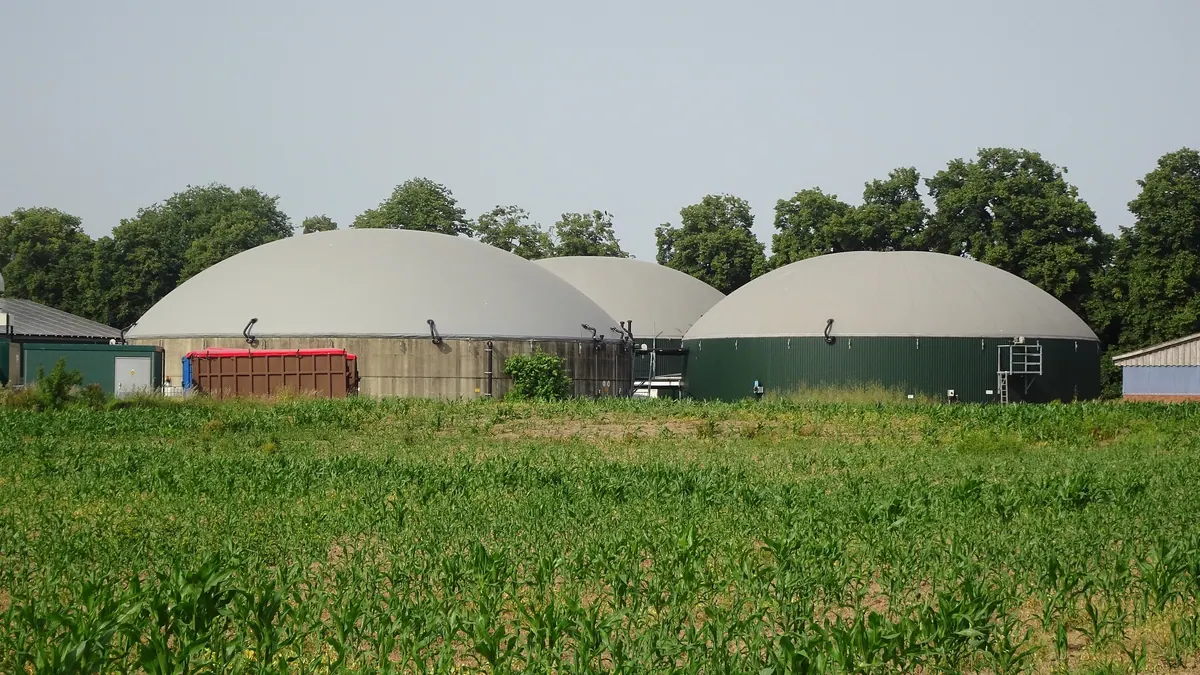

Biological desulphurisation is the most widely used first stage of biogas cleaning at agricultural biogas plants: a small amount of air is dosed into the digester headspace (or a separate tower), and sulphur-oxidising bacteria settled on the surfaces convert H₂S into elemental sulphur and sulphates. The method is cheap and simple and usually brings the level down from several thousand to several dozen–several hundred ppm, but it has limitations: it does not guarantee a constant, low level, it introduces oxygen and nitrogen into the gas and it requires safety control.
How it works
Bacteria of genera such as Thiobacillus and related ones use oxygen to oxidise hydrogen sulphide. Simplified reactions:
- 2 H₂S + O₂ → 2 S + 2 H₂O (oxygen deficiency: elemental sulphur),
- 2 S + 3 O₂ + 2 H₂O → 2 H₂SO₄ (oxygen excess: sulphuric acid).
The bacterial biomass grows on the surfaces of the headspace (membrane, walls, special packing), where it is damp and where H₂S and oxygen reach. The optimum conditions are a temperature of about 30–40 °C (close to the mesophilic digester), humidity and the presence of nutrients, which are supplied by the condensate from the digester.
Air dose — an example
Assumptions: biogas flow 1,200 m³/h, H₂S 2,000 ppm (0.2% vol.). H₂S stream: 1,200 × 0.002 = 2.4 m³/h. Oxygen demand for elemental sulphur: 0.5 mol O₂ per 1 mol H₂S, i.e. 1.2 m³ O₂/h; air contains about 21% O₂, so theoretically about 5.7 m³ of air/h (0.48% of the gas flow). For oxidation to sulphates, 2 mol O₂ per mol of H₂S is needed, i.e. four times more. In practice an excess is used, because contact is incomplete; the final dose is chosen by measurement. Too large an excess raises the oxygen content of the gas and the risk of approaching an explosive mixture, and also lowers the CH₄ content.
Effectiveness and limitations
| Parameter | Typical result / notes |
|---|---|
| H₂S reduction | usually 80–99%, depending on load and conditions |
| Final H₂S | often several dozen–several hundred ppm |
| Effect on the gas | increase in nitrogen and oxygen (dilution), trace O₂ |
| Sensitivity | cold conditions, lack of moisture, too high a sulphur load |
| Waste | yellow sulphur deposit on the membrane and in the condensate |
| Corrosion | sulphuric acid attacks concrete and uncoated steel |
Control and safety
- Measure oxygen in the gas downstream of desulphurisation (an O₂ analyser). Set a warning value and an alarm.
- Do not dose air manually without measurement. The controller should automatically limit or cut off the blower at high O₂ or low gas pressure.
- Protect against air flowing back into the gas line (non-return valves).
- Guard against an explosive mixture – biogas with oxygen has a wide explosive range; the system must be described in the ATEX documentation.
- Monitor the sulphur on the membrane: the deposit reduces flexibility and can damage it.
Typical problems
| Problem | Cause | Action |
|---|---|---|
| High H₂S despite air | too little air, poor contact, low temperature | check the dose, diffusers, contact surface |
| High O₂ in the gas | excess air, leak | reduce the dose, check tightness |
| Corrosion of concrete and steel | sulphuric acid | protective coatings, inspection |
| Sulphur deposit | normal product | periodic cleaning |
| Disturbances when the mix changes | increased sulphur load | iron addition, gradual change |
Combination with other methods
The most common arrangement is a series one: iron dosing in the digester (reducing the load), biological desulphurisation (removing most of it), and then an activated carbon filter (protecting the engine and capturing the remainder). This approach lowers costs and increases reliability compared with a single method.
What to record in the log
Air dose, H₂S before and after desulphurisation, O₂ and CH₄ in the gas, temperature, events (mix changes, blower failures). Conclusions from the log make it possible to set the optimum dose and plan cleaning and maintenance.
Design: in the digester or in a separate tower
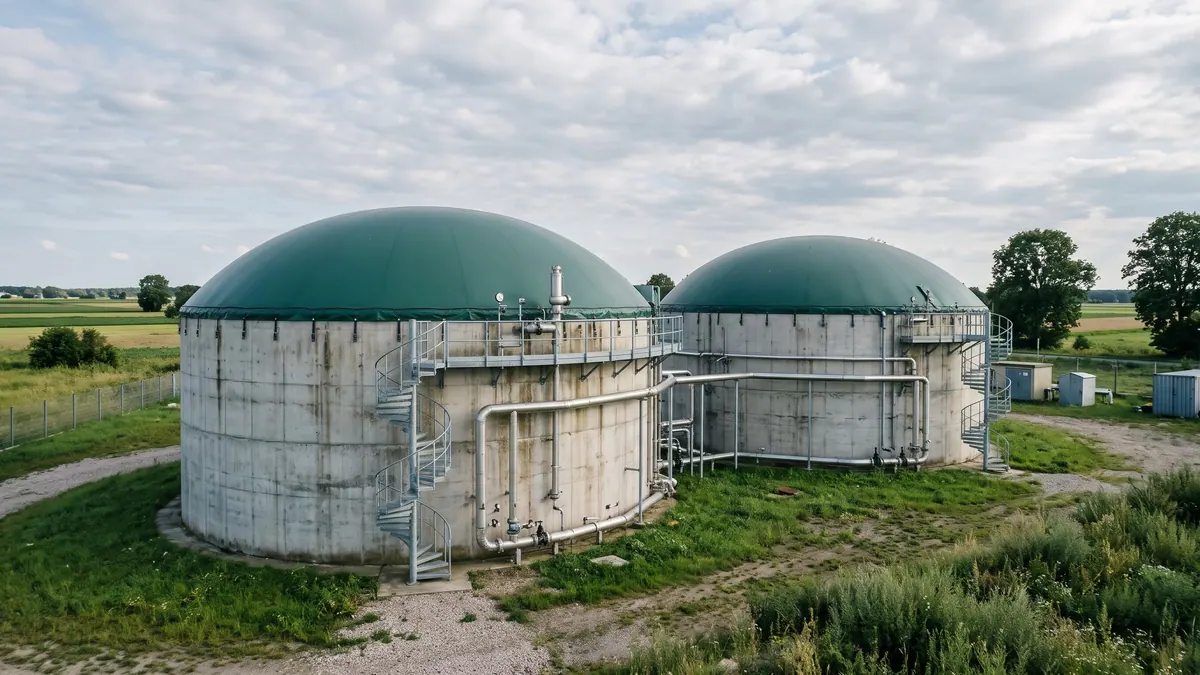
At most agricultural biogas plants desulphurisation takes place in the headspace above the suspension, because the surface of the roof and wall is a natural carrier for bacteria and the condensate supplies nutrients. The drawback is that the sulphur and acid act directly on the membrane and the concrete above the digester. An alternative is a separate tower with packing, in which the gas, air and a sprayed liquid come into contact. A tower is easier to service and control, but it costs more and requires additional space and a circulation pump.
Practical tips
- Distribute the air evenly (several diffusers), not at one point, to avoid zones with an excess of oxygen.
- Do not dose air into the digester while the gas pressure is very low – there is a risk of air predominating.
- After cleaning the roof or replacing the membrane, give the bacteria a few days to re-establish their colonies.
- In winter, check that the temperature in the headspace does not fall enough to slow the process.
- When switching to a sulphur-rich mix, increase the frequency of H₂S measurements.
Sources
Questions and answers
How much air must be dosed into biogas?
Stoichiometrically very little (a fraction of a per cent of the gas volume), in practice usually from a fraction of a per cent to a few per cent, depending on the H₂S load and the effectiveness of contact. The dose is selected by measuring oxygen and H₂S in the gas, not as a fixed value.
Related articles