Hydrogen sulphide (H₂S) at a biogas plant: hazard to people, detectors and procedures
H₂S is a poisonous gas that dulls the sense of smell. We explain the effects depending on concentration, where it accumulates, how to choose detectors and what rules to apply during work.
Other language versions: polski.

Hydrogen sulphide is a colourless gas with the smell of rotten eggs, which can be smelt at low concentrations, but at concentrations of the order of 100 ppm and more it paralyses the olfactory nerve, so the smell stops warning, and at several hundred to a thousand ppm it leads to loss of consciousness and death. At a biogas plant it occurs in biogas (from several dozen to several thousand ppm, without desulphurisation), in the spaces above the slurry and in rooms where gas accumulates from leaks or is released from digestate.
Effects depending on concentration
The ranges given are typical of the toxicological literature and are indicative; individual reactions differ.
| Concentration (ppm) | Typical effects |
|---|---|
| below 1 | smell of rotten eggs, detectable already at fractions of a ppm |
| 10–50 | irritation of the eyes and respiratory tract on longer exposure |
| 100 | strong irritation, loss of smell within a short time |
| 200–300 | strong irritation, pulmonary oedema possible on longer exposure |
| 500–700 | loss of consciousness and risk of death within several dozen minutes |
| 1000 and more | immediate collapse, death within a few breaths |
Workplace limit values: according to the regulation of the Minister of Family, Labour and Social Policy of 12 June 2018 on the MAC (NDS) and STEL (NDSCh) of agents harmful to health in the working environment (Journal of Laws (Dz.U.) 2018, item 1286, as amended), for hydrogen sulphide the MAC (NDS) is 7 mg/m³ (about 5 ppm) and the STEL (NDSCh) is 14 mg/m³ (about 10 ppm). The list is amended periodically, so before setting alarm thresholds check the current wording of the annex.
Where the greatest risk lies
- depressions, manholes, channels and tanks, because the gas is heavier than air,
- the space above the roof and around safety valves,
- rooms with a desulphurisation system, especially when replacing the packing,
- digestate tanks during mixing or emptying (sudden release of gas),
- the interiors of tanks and digesters during inspections,
- condensate tanks and separators.
Particularly dangerous is stirring up sediment or a crust: it can release a lot of accumulated gas in a short time.
Detection
- Fixed detectors in places of risk (technical rooms, areas around valves, manholes), with an optical and acoustic alarm and calibration tests according to the manufacturer's instructions (usually every few months to a year).
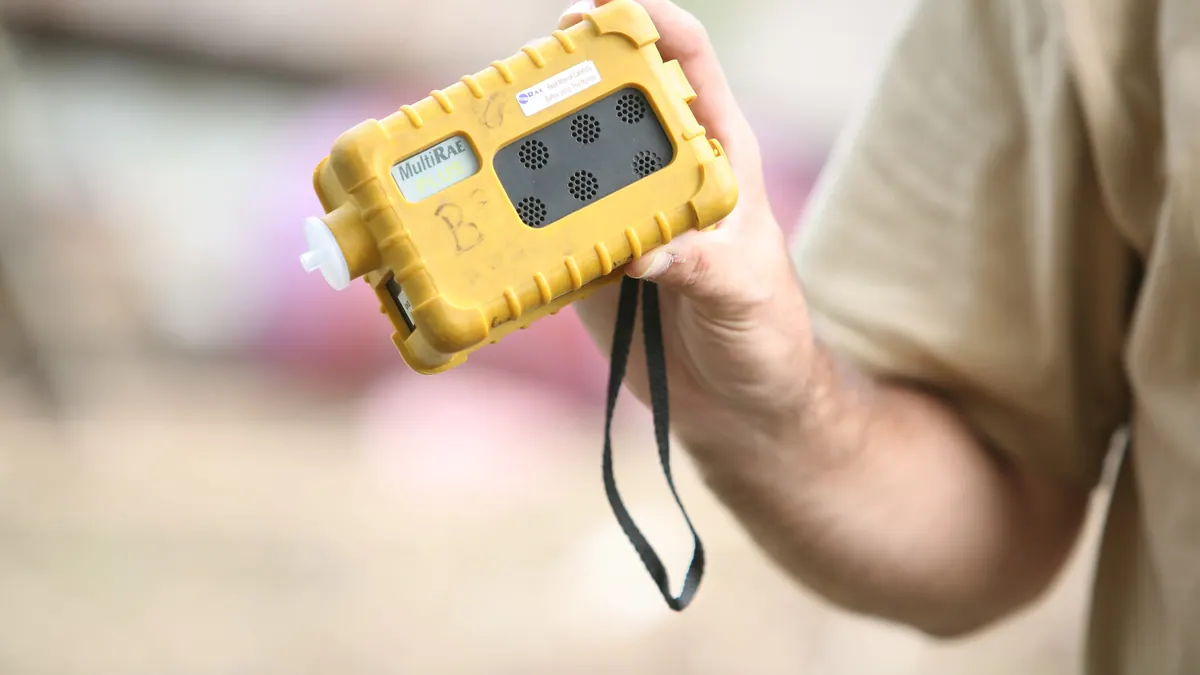
- Portable personal detectors worn during work in the field, preferably multi-parameter (H₂S, CH₄, O₂, CO).
- Alarm thresholds: a pre-alarm at a level close to the MAC (NDS) and a main alarm at a higher one, set in the safety instructions.
- Calibration and functional test before and after every shift, recorded in a log.
Work procedures
| Situation | Rules |
|---|---|
| Work at an open tank/manhole | personal detector, ban on working alone, safety backup from outside |
| Entry into a confined space | work permit, atmosphere measurement, ventilation, escape apparatus (a separate article); for work inside a tank — breathing apparatus independent of the ambient atmosphere |
| H₂S alarm | leave the zone upwind and uphill, call for help, no "blind" rescue |
| Replacing the desulphuriser packing | ventilation, respiratory protection, observing the rules for working with a pyrophoric material (spent packing can self-heat) |
First aid
An injured person may be carried out only in protective apparatus; a casual rescuer without protection often becomes a second victim. After being carried out into fresh air: call the emergency services (112), administration of oxygen by a trained rescuer, resuscitation if breathing has stopped. Every team should have a rehearsed procedure.
Limiting the source
Reducing the H₂S content of biogas (dosing iron salts, biological desulphurisation, filters) reduces the hazard, but does not eliminate it from digestate and the spaces of tanks. Personal protection and procedures must be applied regardless of the concentration in the gas.
Training
Every employee and subcontractor should know the hazard, how the detectors work, the evacuation routes and the rules of conduct in the event of an alarm. It is worth organising drills with the participation of the local fire brigade. Record training and equipment inspections; this is part of the documentation that supervisory services expect.
Example of calculating the concentration in a room
Illustrative assumptions: a room with a volume of 60 m³, a leak releases 0.5 m³/h of biogas with 2,000 ppm H₂S, no ventilation. H₂S inflow: 0.5 × 0.002 = 0.001 m³/h. After one hour the concentration rises by 0.001/60 ≈ 16.7 ppm, after six hours to about 100 ppm. This shows how dangerous slow accumulation of gas in an enclosed place without ventilation can be; that is why fixed detectors and ventilation are necessary even with small leaks.
Clothing and equipment
Escape breathing apparatus available at the entrances to risky rooms is recommended, and for work in tanks — breathing apparatus independent of the ambient atmosphere. Gas filters do not replace them in an atmosphere of unknown composition or oxygen deficiency. The equipment must be inspected and people trained in its use.
Checklist for the shift supervisor
- Are all fixed detectors working and calibrated?
- Does every employee in the field have a personal detector?
- Do planned works in tanks have a permit and safety backup?
- Are the escape breathing apparatuses in place and checked?
- Does the crew know the evacuation route and the assembly point?
- Did the last training take place within the past 12 months?
Sources
Related articles