Technology and operationExplainer
ATEX at a biogas plant: directives, obligations and the explosion protection document
Two ATEX directives: one for equipment manufacturers, the other for employers. What this means for the biogas plant operator, how the explosion protection document works and what to check.
Other language versions: polski.
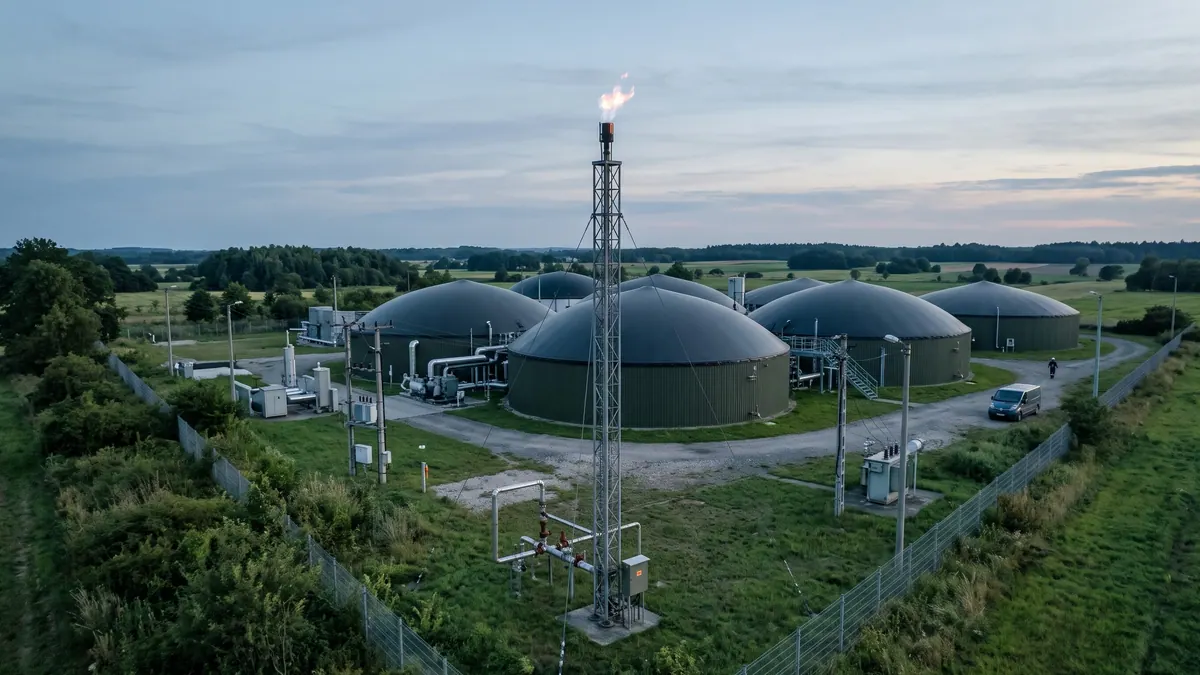
ATEX (from the French ATmosphères EXplosibles) is the colloquial name for two EU directives that together regulate explosion hazards. Directive 2014/34/EU is addressed to manufacturers of equipment and protective systems intended for use in explosive atmospheres, and Directive 1999/92/EC — to employers, who must assess the explosion risk, designate zones and prepare an explosion protection document. At a biogas plant both sets of requirements apply to the gas system, biogas tanks, technical rooms and places with combustible dust.
Where the risk comes from
Biogas contains methane (usually 50–65% by vol.), whose mixture with air is explosive in the range of approximately 5–15% by vol. CH₄ (for biogas the range is somewhat narrower because of CO₂). An explosion requires three elements: fuel, oxygen and a source of ignition. In a digester with a gas-tight roof the space above the liquid contains gas with too high a CH₄ concentration and a small amount of oxygen, so the mixture is not explosive; transitional situations are dangerous — start-up, emptying, leaks, ingress of air, repair work.
Division of responsibilities
| Party | Document | Main obligations |
|---|---|---|
| Equipment manufacturer | Directive 2014/34/EU | conformity assessment, CE and Ex marking, instructions, declaration of conformity |
| Employer/operator | Directive 1999/92/EC implemented into national law | risk assessment, zone classification, equipment selection, training, explosion protection document, marking of zones |
| Designer and contractor | construction law and standards | design consistent with the zone classification |
In Poland the employer directive was implemented by a regulation of the minister responsible for the economy; when implementing, check the current text and amendments, because changes to the names of ministries and to the numbering of the Journal of Laws are frequent.
The explosion protection document
In practice the document covers:
- an explosion risk assessment: which combustible substances are present, where, in what quantities and under what disturbances,
- zone classification (a separate article),
- a list of equipment and installations in the zones together with confirmation of conformity,
- prevention and protection measures (ventilation, detection, earthing system, explosion relief systems, instructions),
- work organisation: procedures, permits for hazardous work, training,
- a schedule of inspections and updates (after every technological change).
The document must be up to date and available to supervisory services.
Equipment in the zones
The Ex marking includes, among other things, the equipment group, the category (which determines approval for a given zone), the type of atmosphere (G — gases, D — dusts), the type of protection (e.g. increased safety, flameproof enclosure, intrinsic safety), the explosion group and the temperature class. Equipment of a lower category than that required for the zone may not be used in it. When purchasing, demand certificates and instructions, and when servicing use only parts consistent with the declaration.
Most common gaps
- no update of the document after an extension or change of technology,
- "ordinary" equipment in a zone (e.g. torches, telephones, tools),
- damaged or dismantled earthing,
- no marking of zones,
- untrained external crews (service companies),
- no hot work procedure and permits.
Operator checklist
- Is there a current explosion protection document?
- Are the zones marked on site and on drawings?
- Does all equipment in the zones have conformity documents?
- Does methane detection work, with an alarm and associated actions?
- Have employees and subcontractors been trained?
- Are inspections of the electrical installation and earthing carried out on time?
- Are evacuation and response drills held?
ATEX is not a one-off formality at commissioning: it is a system that must be maintained with every change to the plant.
What changes in practice after the document is drawn up
The document is not an end in itself. It should lead to specific changes: replacing equipment unsuitable for the zones, adding methane detection, repairing earthing, instructions for hazardous work, restricting access for outsiders. Good practice is to include in it a "hazard – measure – person responsible – deadline" table, so that the recipient can use it as an action plan.
Cooperation with service providers and contractors
External companies (CHP service, electricians, welders) should receive an extract from the document before work begins and confirm they have read it with a signature. Before work in a zone the atmosphere is checked, non-sparking tools are used and hot work permits are issued. After finishing work the contractor reports changes to the plant that may affect zone classification. With every modification of the plant ask yourself: has a new possible leak point or a new ignition source appeared, or has the ventilation changed?
Combustible dust — easy to overlook
At an agricultural biogas plant few people think about dust, yet it is a source of risk in digestate dryers, when pouring dry additives, in grain stores and in straw size-reduction installations. Organic dust in a cloud can explode, and its layers on equipment can smoulder. The risk assessment should cover both gas and dust; preventive measures include dust extraction, regular cleaning with wet methods or with an industrial vacuum cleaner in Ex design, control of surface temperatures and earthing of conveyors.
Sources
Questions and answers
Who is responsible for ATEX at a biogas plant?
The operator as employer: assesses the risk, classifies the zones, selects the equipment and maintains the explosion protection document. The manufacturer is responsible for the conformity of the equipment with the requirements of Directive 2014/34/EU.