Technology and operationExplainer
Will a heating cable protect the system from frost?
A heating cable protects the system from frost only if it is matched to the conditions, insulated, powered and monitored. When it fails and how to check.
Other language versions: polski.
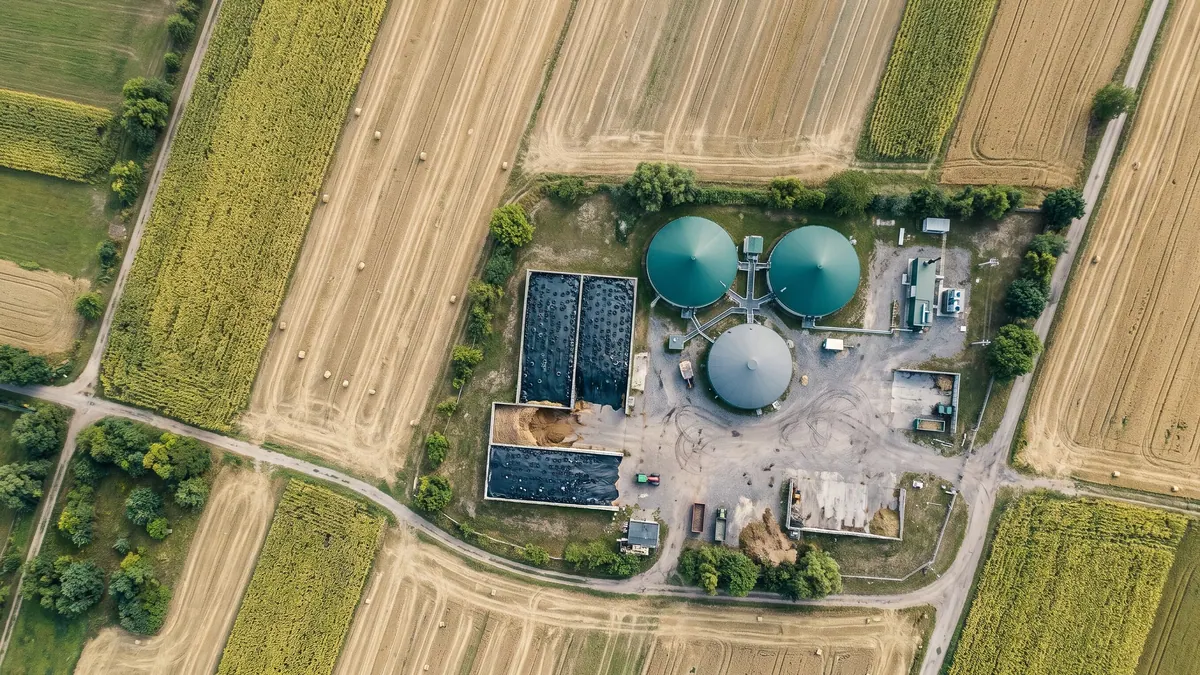
A heating cable will protect the system from frost only on condition that it is selected for the lowest design temperature, fits tightly to the protected element, is insulated, has a reliable power supply and is monitored. Installed as a mere "add-on" on a pipe or vessel without insulation, it often fails exactly when frost and wind are at their worst. This text concerns freezing in the auxiliary installations of a biogas plant, such as drains, condensate siphons, dosing lines or liquid seals; the criteria for selecting heating for pressure relief protection are discussed separately in the article How to select anti-freeze heating for a pressure relief device.
How a heating cable works
The cable produces heat with a power not lower than the heat loss of the protected element at the lowest anticipated temperature. It does not heat the liquid "in advance": it keeps the temperature above freezing point if the power is greater than the losses. Losses depend on pipe diameter, the thickness and quality of insulation, wind and the temperature difference. There are two types found in practice: self-regulating (output rises as it gets colder) and constant-wattage, usually with a thermostat.
When a heating cable fails
| Cause | What happens |
|---|---|
| No insulation, or wet insulation | Losses exceed the cable's output |
| The cable does not cover the whole system (fittings, flanges, stubs, sensors) | Ice forms at the missed point |
| Poor contact with the pipe | Heat does not reach the medium |
| Design temperature in the calculations too low | Output is sufficient only for mild frosts |
| Power failure or blown fuse | The system loses protection without any signal |
| Thermostat with the sensor in a warm place | The cable does not switch on |
| Mechanical damage or overheating of the cable | Heating along part of the section only |
| Components without certification in an Ex zone | Risk of ignition and invalid documentation |
Checking effectiveness
It is not enough to see that the cable is installed. A practical inspection includes: measuring the current draw (whether the cable is actually working), measuring the temperature at the coldest point of the system, checking the condition of the insulation and covers, and verifying that the alarm from the control room works. It is best carried out before the season and after every power failure.
Particular caution in Ex zones
If the cable or accessories are located in an explosion hazard zone, they should comply with the requirements for equipment in potentially explosive atmospheres (Directive 2014/34/EU), have a temperature class consistent with the explosion protection document, and be installed by an authorised person. "Do-it-yourself" modifications (e.g. an additional length of cable on a biogas installation) are unacceptable without a risk assessment. The ATEX rules at a biogas plant are described in the article ATEX at a biogas plant.
How to choose the power and type of cable
Power is determined from a heat-loss balance: for the lowest design temperature, pipe diameter, the thickness and thermal conductivity of the insulation, and an allowance for wind and ageing. Cable manufacturers give the output per metre (W/m) as a function of temperature, as well as the maximum circuit length for a given protection. The self-regulating type is convenient on sections with varying conditions, because it limits its own power draw in warmer places; the constant-wattage type requires a good thermostat. For fittings, flanges and valves, additional cable length should be provided, because these components lose heat faster than a straight pipe.
What else reduces the risk of freezing
Heating is the last line of defence. Earlier it is worth ensuring that liquid does not stand at all in places exposed to frost: proper pipeline gradients, no water "pockets", shortening external sections, placing drain points in heated enclosures and burying lines below the frost line where possible. In some systems antifreeze fluids are used, although their use requires checking compatibility with the system and the effect on the operation of the protection devices.
Example pre-season checklist
- Does every point in the system where water may stand have planned protection?
- Is the insulation dry, continuous and protected by a cover against rain?
- Does the cable's current draw fall within the range given by the manufacturer?
- Is the temperature sensor at the coldest point, and does the alarm reach the control room?
- Has the operation of the heating circuits been checked after the last power failure?
- Is the documentation (diagram, outputs, inspection dates) up to date?
Summary
A heating cable is a good element of frost protection, but as part of a system: insulation, covering all points, a proper thermostat, power supply, monitoring and documentation. Without these elements it gives a false sense of security. A broader view of heat at the site is given in the article Heat balance of a biogas plant in winter.
Sources
Questions and answers
Can a heating cable replace insulation?
No. The cable supplies heat equal to the losses, and without insulation the losses are several times greater, so the required power rises and in strong wind may turn out to be insufficient.
Related articles