Process biology and start-upAnalysis
Biogas plant heat balance in winter: how much heat the process uses and where to get it
In winter the heat the process needs rises several-fold compared with summer. How to calculate substrate heating, losses through the walls and the heat reserve from cogeneration.
Other language versions: polski.
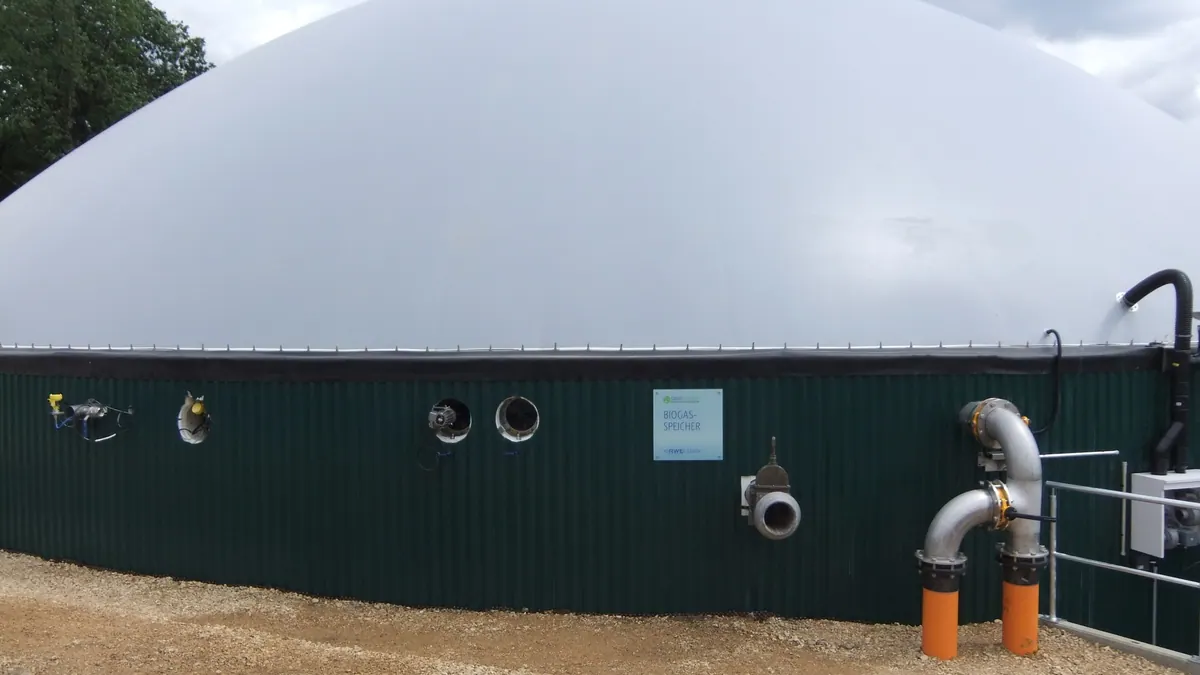

A biogas plant's heat balance in winter consists of a few simple items: heat for warming the fed substrate, losses through the envelope of tanks and pipelines, heat needed for any hygienisation, and external consumers. On the supply side there is mainly heat from the cogeneration unit (CHP) and possibly a boiler. In winter both of the main demand items rise, while the sources' ability to cover them does not rise at all. That is why the balance must be drawn up for the coldest typical week, not for the annual average.
What heat demand consists of
1. Substrate heating. The substrate enters the digester at ambient temperature (silage, cooled stillage, slurry from an external tank), while a mesophilic process is usually run at around 38–42 °C. The energy is calculated from the formula Q = m · c · ΔT. For substrates with a high water content the specific heat is close to that of water, i.e. about 4.2 kJ/(kg·K); at a higher dry matter content it is slightly lower.
An illustrative example for a specific heat of 4.18 kJ/(kg·K) (1 kWh = 3.6 MJ):
| Temperature difference | Energy per 1 t of substrate |
|---|---|
| 20 K (e.g. from 20 to 40 °C) | about 23 kWh |
| 30 K | about 35 kWh |
| 40 K (e.g. from 0 to 40 °C) | about 46 kWh |
At a feed of 50 t per day and ΔT = 40 K this gives about 2.3 MWh per day, i.e. on average about 96 kW of thermal power. In winter the same mass of substrate therefore requires many times more energy than in summer, when the substrate is warm. The value is indicative: the actual one depends on the composition of the mixture, the share of recirculate and whether the substrate is stored warm.
2. Losses through the envelope. The heat flow through the wall, roof and floor of the tank is Q = U · A · ΔT, where U is the heat transfer coefficient, A is the area and ΔT is the temperature difference between inside and outside. By way of illustration: 1000 m² of surface with U = 0.3 W/(m²·K) at ΔT = 40 K gives about 12 kW. In reality there are also the effects of wind, thermal bridges, the condition of the insulation (damp insulation loses its properties) and other thermal conditions of the ground under the base. Membrane roofs and low-mass elements behave differently from concrete walls, because they store heat poorly.
3. Hygienisation and treatment. If the plant processes materials requiring hygienisation, the heat needed to warm the whole stream to the temperature required by regulations and keep it there for the required time is a large, short-lived item. The requirements for animal by-products are set out in Regulation (EU) No 142/2011 (including time and temperature parameters for the individual categories). Heat recovery from the hygienised stream (a regenerative heat exchanger) significantly reduces heat consumption.
4. External consumers. Heating of buildings, dryers, an external heating plant. In winter they compete with the process for the same heat; in the balance the process should have priority, because chilling the digester costs weeks of production, not hours.
On the heat supply side
The CHP engine converts the energy of the fuel into electricity and heat; the electrical and thermal efficiencies of typical units are discussed in the text on CHP engine efficiency. Heat goes into the engine's cooling water circuit (jacket and oil) and into the exhaust gases. Not all of the heat is useful: temperature and availability depend on the heat exchanger arrangement and on whether the engine is running. The seasonality and structure of the heat balance from cogeneration are described in the article on waste heat from CHP.
Three situations in particular spoil the winter balance:
- Engine running at reduced load (output limited by the grid operator, less biogas after a drop in production): less heat, while demand is unchanged.
- Engine stoppage (failure, servicing, gas quality too low): heat has to be produced in the boiler, and when there is none, the digester temperature falls.
- Return water temperature too low or no consumer in the opposite season, which reverses in winter: there is heat, but the heat exchangers are undersized for high output at a small temperature difference.
How to build your own balance
- Establish the coldest typical week for the site and the temperature of the substrates at that time (silage from the clamp, slurry from the tank, stillage).
- Calculate the average daily feed mass and the heating energy (table above).
- Add the envelope losses: separately for tanks, pipelines, heat exchangers, pumps and the technical building.
- Add hygienisation and external consumers.
- Compare the total with the thermal output actually available from the CHP at the load expected in winter and with the output of the reserve boiler.
- Check the failure scenario of one source: whether the reserve will hold the process temperature for the duration of a typical repair.
What improves the balance without new sources
- Heating the substrate gradually, e.g. in a pre-tank heated with low-temperature heat, and feeding more often in smaller portions (a more stable temperature in the digester).
- Repairing the insulation, wind shields and reducing thermal bridges in the most exposed places.
- Recovering heat from the outgoing stream (a digestate heat exchanger for heating the substrate), if technically and hygienically feasible.
- Keeping substrates warm where this is cost-effective (e.g. covered storage areas), instead of heating them only in the digester.
- Switching off external consumers at the peak of the frost in line with a previously agreed priority.
The heat reserve should be verified by measurements: a heat meter on the digester circuit and a meter on the external consumers show the actual split and allow it to be compared with the design balance. The process parameters, including the effects of temperature fluctuations, are discussed in the text on digester start-up.
Typical errors in heat balances
- Assuming the substrate temperature is constant throughout the year: silage from the clamp and slurry from an external tank in winter usually have a temperature close to ambient.
- Ignoring losses in pipelines, heat exchangers and pumps, which in winter can be as significant as tank losses.
- Calculating the available CHP heat from rated output, not from the actual load at the given time of year.
- Failing to take into account the repair time of a heat source: the reserve must last for the time in which the process cannot be allowed to cool.
- Treating low-temperature heat as equivalent to high-temperature heat; the heat exchanger requires a suitable temperature difference.
How to supplement the balance with measurements
The best supplement to the calculations is heat meters and temperature sensors at several points: at the inlet and outlet of the digester heat exchanger, on the CHP circuit, on external consumers, and the temperature in the digester itself. Comparing winter readings with the calculations shows whether losses are greater than assumed (e.g. because of damp insulation) and whether the available output really matches the design. The conclusions are worth recording and repeating every season, because as the substrate recipe changes, so does the heat demand.
Sources
Questions and answers
In winter, is heat from the CHP engine enough to sustain the process?
In a typical agricultural plant running at full power, CHP heat is generally sufficient for the process, but the margin may be small if part of the heat goes to buildings, a dryer or hygienisation. At low engine load or when it is shut down, a backup source is needed, most often a boiler.
Is insulation of the digester tank more important than pipework insulation?
The tank has the largest surface area, so overall it loses the most, but short, uninsulated sections of pipework, heat exchangers and pumps can cause large local losses and a risk of freezing. Both groups are worth assessing.
Related articles