Technology and operationAnalysis
Dryers using biogas plant heat: wood, grain and digestate — what pays off
Drying is a way of using surplus CHP heat seasonally. We compare drying wood, grain and the solid fraction of digestate: heat demand and risks.
Other language versions: polski.
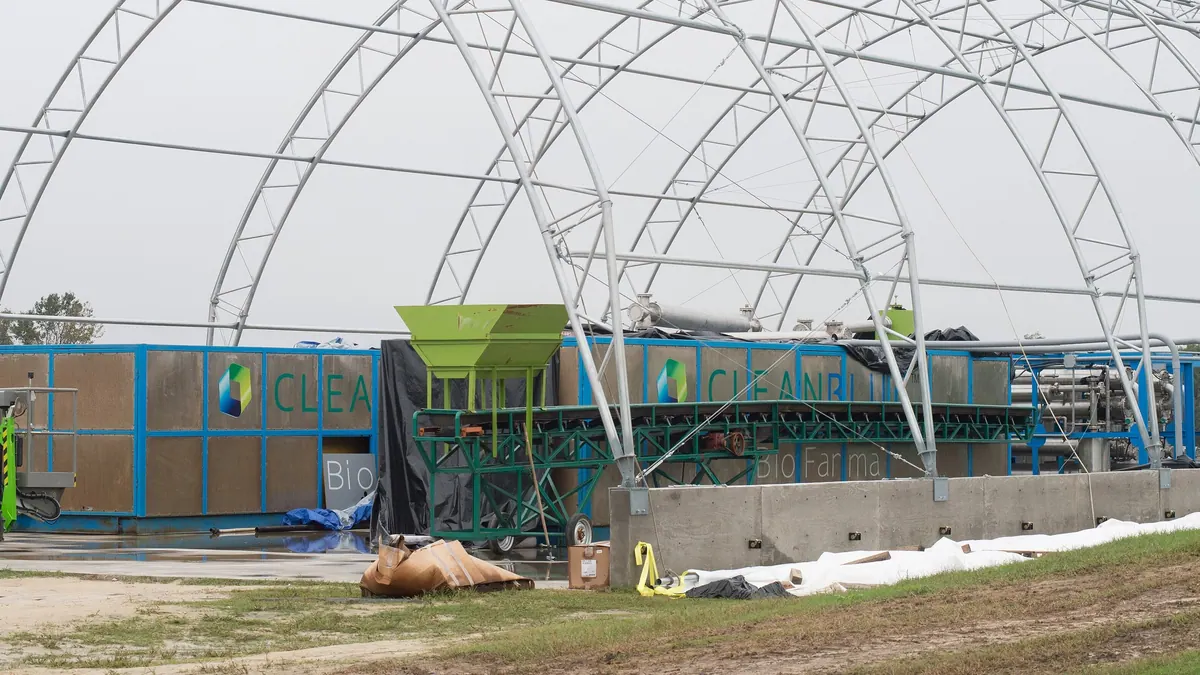

A dryer supplied with heat from cogeneration makes it possible to use the surplus heat that in the summer season usually remains unused. Evaporating 1 kg of water requires in practice about 0.8–1.2 kWh of heat, so a module with a thermal capacity of 300 kW can evaporate of the order of 250–375 kg of water per hour. The choice of material — wood, grain or the solid fraction of digestate — determines the seasonal profile, revenues and risks.
How much heat is needed — a calculation
The enthalpy of vaporisation of water is about 2,257 kJ/kg (about 0.63 kWh/kg), to which are added heating of the material and air and losses. Effective consumption in dryers is usually 0.8–1.2 kWh/kg of water evaporated, depending on design and heat recovery.
An example with explicit assumptions: surplus 300 kW, specific heat consumption 1.0 kWh/kg of water evaporated, operation 6,000 h/year.
- water evaporated: 300 kWh/h / 1.0 = 300 kg/h,
- annually: 300 × 6,000 = 1,800 t of water.
- Drying grain from 20% to 14% moisture (removing about 70 kg of water from 1 t of wet grain), with a harvest campaign lasting about 1,000 h (300 t of water), about 4 thousand t of grain would be dried; over a whole year of operation (1,800 t of water) the calculation would give about 25 thousand t, but grain is practically dried only in the harvest season.
Comparison of materials
| Feature | Wood (chips, sawn timber) | Grain and seeds | Solid fraction of digestate |
|---|---|---|---|
| Season | mainly all year, more in autumn and winter | campaign, August–October | all year |
| Initial moisture | approx. 40–55% (chips) | approx. 18–25% | approx. 65–75% |
| Target moisture | 15–25% (chips), lower for sawn timber | approx. 14–15% | approx. 10–15% (granules) |
| Quantity of water to evaporate | depending on the batch | small per tonne | large per tonne |
| Market | fuels, sawn timber | farmers, grain buyers | fertiliser, growing media — requires arrangements |
| Risks | fire, dust, quality requirements | grain quality, dust | NH₃, odour, dust, regulations |
Drying wood
Chamber dryers for sawn timber and chips use hot water or air. Advantages: stable heat demand in the heating season and a good fit with the CHP profile. Care must be taken over fire protection, ventilation and temperature control. The added value depends on quality (target moisture, certification) and access to customers.
Drying grain
Grain dryers work mainly in the harvest campaign. The heat demand is large but short, which requires high thermal capacity for a few weeks. The biogas plant can usually provide only part of the capacity needed, and the rest must be covered by a boiler. Profitability improves when the biogas plant cooperates with a grain buyer or the farms around it.
Drying digestate
Drying the solid fraction (after separation) reduces mass, eases transport and storage, and produces granules or pellets for fertiliser use. Challenges:
- Ammonia — a rise in temperature promotes the volatilisation of NH₃, which means a loss of nitrogen and an emission; acid scrubbers are used (e.g. ammonium sulphate).
- Dust and odour — filtration and a closed system are required.
- Condensate — the evaporated water contains ammonia and volatile compounds; it requires management.
- Legal status of the product — organic fertiliser, a fertiliser with specified parameters, waste — this depends on the regulations and composition; before investing, the current requirements and registration procedures must be verified.
- Market — demand for dried digestate is often local and seasonal.
Economics — how to calculate
Components of the calculation: the investment cost of the dryer, the cost of auxiliary energy (fans, belts, granulator), labour, servicing, revenue from selling the product or savings on transport costs, the value of heat that would otherwise be lost. The value of heat is key: since in summer the heat has no alternative use, its marginal cost is close to zero. Product and energy prices change, so use your own data and scenarios (optimistic/pessimistic).
Selection criteria
- continuity of demand throughout the year vs a campaign,
- availability of raw material and of a market,
- environmental protection and fire safety requirements,
- compliance with permits (change in the use of the installation, emissions),
- the possibility of recovering heat from the humid vapours.
Mistakes
- oversizing the dryer relative to the available heat,
- underestimating the costs of dust and noise,
- no contracts for taking the product,
- overlooking fire risk.
A well-designed dryer increases the use of heat, but the decision must be based on the actual heat profile and the market for the product, not on the mere assumption "since we have heat, we will dry something".
Checklist before investing
- Measure the actual surplus heat hourly for at least a year (heat meter).
- Identify buyers of the product and sign letters of intent or contracts.
- Check the formal requirements: environmental permits, waste/by-products, fire safety.
- Analyse emissions: dust, odour, ammonia, noise.
- Consider a pilot with a smaller container dryer before a large investment.
Seasonality in practice
A good system combines two or three materials with complementary seasons, e.g. wood in winter and spring, grain during the harvest, digestate in the transitional months. This way the thermal capacity is used for most of the year, and the individual market risk is reduced.
Sources
Related articles