Technology and operationExplainer
The CHP engine at a biogas plant: electrical and thermal efficiency and part-load operation
What efficiency a biogas cogeneration unit has, what it depends on and how to calculate the energy from a m³ of biogas. The effect of part load, methane and temperature.
Other language versions: polski.


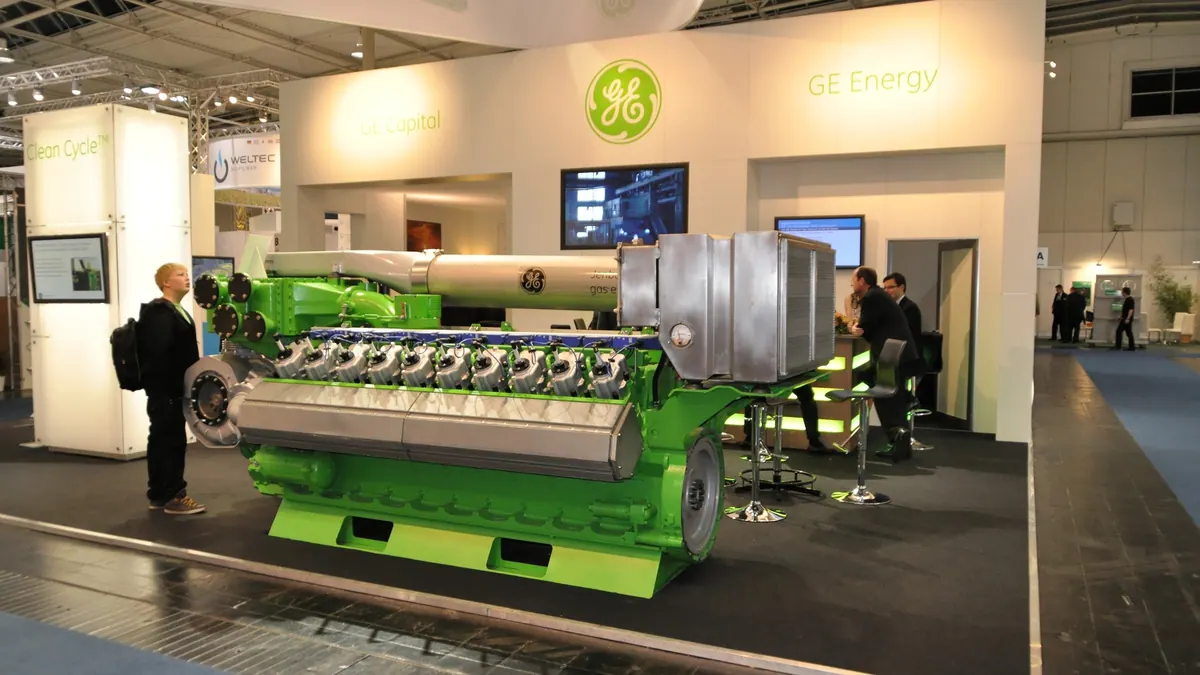
A piston engine fuelled with biogas in a cogeneration unit (CHP) converts usually 36–44% of the fuel's chemical energy into electricity, and recovers a further 40–50% as heat from the cooling water, exhaust gas and oil. Total efficiency therefore reaches about 85–90%, but only if someone actually uses the heat. Electrical efficiency falls when operating at part load, at a low methane share and with incorrect engine settings.
What the energy balance consists of
The energy supplied in the fuel is divided into four streams: electrical power at the generator terminals, heat from the jacket and oil cooling, exhaust heat and losses (radiation, unrecovered exhaust heat, friction, generator losses). Manufacturers state efficiency for rated conditions, with a fixed gas composition and air temperature. Operating values are often a few percentage points lower.
| Stream | Typical share of fuel energy |
|---|---|
| Electricity | approx. 36–44% |
| Heat from engine and oil cooling | approx. 20–25% |
| Heat from exhaust gas (down to approx. 120 °C) | approx. 15–25% |
| Losses | a few per cent |
The ranges given are indicative and depend on the unit's capacity: larger engines usually have higher electrical efficiency.
How to calculate the energy from biogas
The calorific value of methane is about 35.8–35.9 MJ/m³ under normal conditions (0 °C), i.e. about 9.95–9.97 kWh/m³; in the examples we use 9.97 kWh/m³, and in rough calculations it is rounded to 10 kWh/m³. For biogas with a CH₄ content of 52% this gives about 5.2 kWh/m³ (neglecting the contribution of trace components).
An example with explicit assumptions: biogas stream 250 m³/h, CH₄ content 52%, electrical efficiency 40%, thermal efficiency 44%.
- fuel power: 250 × 0.52 × 9.97 ≈ 1,296 kW,
- electrical power: 1,296 × 0.40 ≈ 518 kW (a unit with a rated capacity of about 500–530 kW is the right choice),
- thermal power: 1,296 × 0.44 ≈ 570 kW,
- after deducting the plant's own heat consumption for heating the digesters (e.g. 150–250 kW in winter, less in summer), the remainder is left to be used.
Part load
The electrical efficiency of a gas engine is highest at a load close to 100%. At 75% of capacity the drop is usually about 1–2 percentage points, and at 50% — a few points or more, depending on design. In addition, operation at low load promotes carbon build-up and fouling of the spark plugs. Therefore, if the installation has two units, it is better to run one at full power than two at half. When designing, it is sensible to match the capacity to average gas production, not to the peak.
Effect of gas quality
| Factor | Consequence |
|---|---|
| Fall in CH₄ content | lower fuel power; the engine has to take a larger gas stream, increasing the risk of a drop in output |
| CH₄ variability | need to correct the mixture, risk of knocking or incomplete combustion |
| H₂S | corrosion, faster wear of oil and valves |
| Siloxanes | silica deposits on pistons and valves (mainly with gas from landfills and treatment plants) |
| Moisture and gas temperature | condensate in the lines, a fall in combustion quality |
| Gas pressure | unstable pressure disrupts regulation |
Temperature and ambient conditions
High air temperature and altitude lower engine output (so-called derating, i.e. a reduction in power). Most manufacturers give derating curves. At locations in Poland a typical summer does not cause a drastic loss, but poor ventilation of the engine room can make it worse.
How to assess your unit
- Measure the electricity from the cogeneration meter, as well as the quantity of gas (flow meter) and the CH₄ content — calculate the efficiency over a period of, say, a month.
- Measure the heat delivered (heat meter) and compare it with the thermal efficiency.
- Compare with the catalogue values: a deviation of more than 2–3 percentage points usually indicates a problem (gas quality, regulation, wear).
- Check the operating time and the number of starts; frequent starts worsen the balance.
Errors in assessment
- comparing electrical efficiency with total efficiency,
- counting the heat "produced", not "used",
- omitting the biogas plant's own electricity consumption (agitators, pumps, blowers), which lowers net efficiency,
- no correction for the calorific value of the gas when the methane content changes.
A sound energy balance is the basis for a decision on modernisation: sometimes improving the use of heat gives more than replacing the engine with a model that is 1–2 percentage points more efficient.
Checklist when buying or upgrading a unit
- Ask for the electrical efficiency at 100%, 75% and 50% load, not just the rated one.
- Check the requirements for the gas: minimum CH₄ content, maximum H₂S, relative humidity, pressure range.
- Ask about guaranteed availability (in % per year) and the warranty conditions, including limits on gas quality.
- Verify exhaust emissions (NOₓ, CO) and the need for a catalyst or afterburning, if the permits require it.
- Compare total life-cycle costs: purchase price, servicing per kWh, overhauls, oil consumption.
Why it is worth calculating net efficiency
A biogas plant uses its own electricity for agitators, pumps, blowers, feeders and automation — usually a few to a dozen or so per cent of production. Net electrical efficiency is therefore lower than the efficiency of the unit. When comparing installations, always state whether the figure refers to the generator terminals or the grid connection point.
Sources
Questions and answers
How much electricity does 1 m³ of biogas yield?
At 52% CH₄, biogas has approx. 5.2 kWh/m³ of chemical energy; at an electrical efficiency of 40% that is approx. 2.1 kWh of electricity and a similar or larger amount of heat.
Is it better to run an engine at full power?
Usually yes. Full load gives the highest electrical efficiency; operation below about 50–60% of capacity noticeably worsens efficiency and promotes fouling of the engine.
Related articles