Technology and operationAnalysis
Waste heat from cogeneration at a biogas plant: balance, seasonality and ways of using it
How much heat a unit gives, how much the biogas plant itself uses and what to do with the surplus: heating buildings, drying, ORC, district heating networks. A balance with a calculation example.
Other language versions: polski.
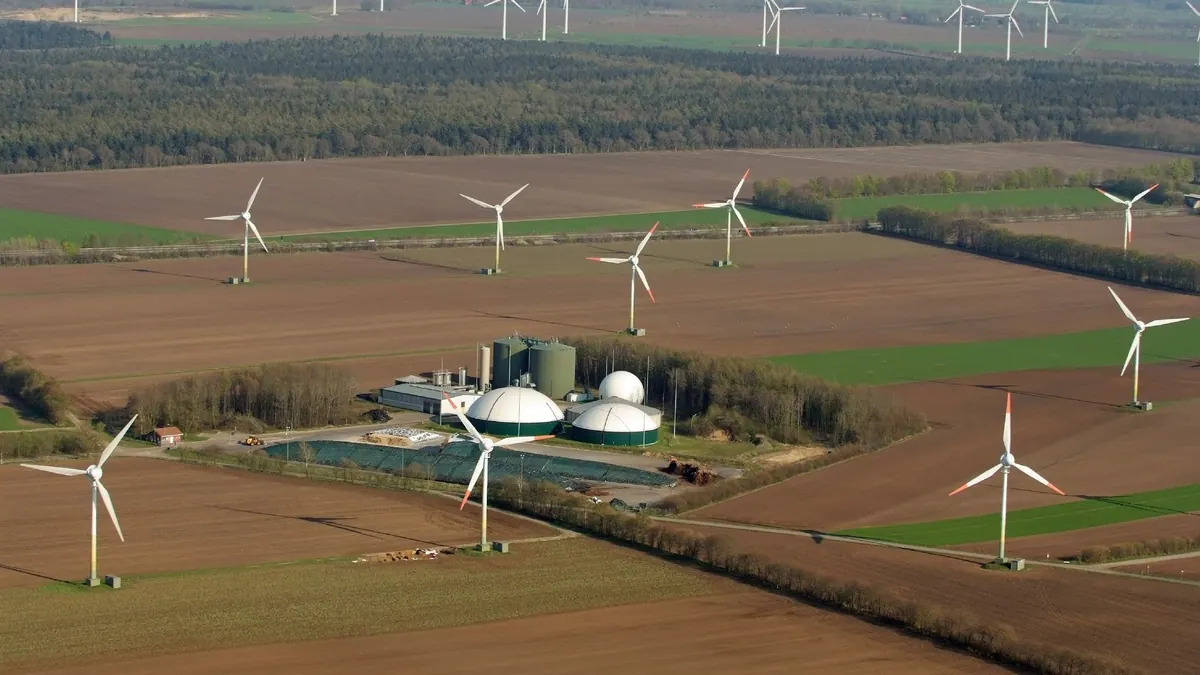

A cogeneration unit with an electrical capacity of about 500 kW simultaneously generates about 500–600 kW of thermal power, part of which the biogas plant itself uses for heating the digesters, hygienisation and buildings. The surplus is strongly seasonal — in summer most of it remains, in winter a few dozen per cent — and it is only matching the consumer to this profile that determines profitability. Using the heat raises the total efficiency of the installation from about 40% to nearly 85–90%.
Where the heat comes from
Heat is recovered from several circuits: jacket and oil cooling (water temperature 80–90 °C), the exhaust heat exchanger (up to several hundred °C at the inlet, cooled to about 120–150 °C) and, in some systems, from mixture cooling. The hydraulic system usually combines these sources into a single hot water circuit with a buffer.
The plant's own heat consumption
Heating the substrates and maintaining the temperature in the digesters depends on the ambient temperature, insulation, the size of the feed and its temperature.
A simplified example: a feed of 65 m³/d at an inlet temperature of 10 °C heated to 40 °C requires about 65,000 kg × 4.18 kJ/(kg·K) × 30 K ≈ 8.15 GJ/d, or about 2,260 kWh/d (about 94 kW on average). To this are added losses through the walls and roof of the digesters — for example 30–100 kW depending on insulation and the time of year. In total 120–200 kW in winter and about 80–120 kW in summer. In systems with hygienisation (70 °C for 1 h) there is an additional demand, reduced by recuperation.
Seasonal balance
Assumptions: a 500 kW el. unit, thermal capacity 560 kW, availability 8,000 h/year.
| Period | Heat produced [kW] | Own consumption [kW] | Surplus [kW] |
|---|---|---|---|
| Winter | 560 | approx. 200 | approx. 360 |
| Transitional | 560 | approx. 150 | approx. 410 |
| Summer | 560 | approx. 100 | approx. 460 |
The annual surplus is about 3.3 GWh of heat (on average about 410 kW × 8,000 h; the seasonal range of 360–460 kW gives 2.9–3.7 GWh). The consumer must therefore take several hundred kW throughout the year in order to use the potential.
Utilisation options
| Option | Advantages | Limitations |
|---|---|---|
| Heating farm buildings, greenhouses, hatcheries | simple, short network | seasonal demand, only in winter |
| Local district heating network | large winter offtake | cost of the pipeline, losses, need for contracts |
| Drying (wood, grain, feed, digestate) | summer and autumn demand complements winter | requires investment and a market for the product |
| ORC (generating additional electricity) | independent of the consumer | low efficiency (a dozen or so %), high cost |
| Absorption cooling | summer demand (cold stores, plants) | niche, costly |
| Evaporation/concentration of digestate | reduction of transport cost | requires an ammonia recovery system |
Project assessment criteria
- The consumer's heat offtake profile over the year (hourly, if possible).
- Distance and transmission cost: an indicative formula — network losses depend on insulation, diameter and temperature.
- The required offtake temperature: a higher one makes it harder to use heat from engine cooling.
- The consumer's readiness for a multi-year contract.
- Legal and formal aspects (licences, tariffs, permits) — check the current regulations for your own case.
- A simple payback period: annual heat revenue vs investment outlay.
Good technical practice
- A heat buffer (accumulation tank) evens out peaks and allows the engine to run in a constant mode.
- Emergency coolers (dry coolers) protect against overheating when the consumer is not taking heat, but they are only a safety measure, not a way of using the heat.
- Heat meters on both sides make it possible to document efficiency.
- Keep the exhaust heat exchangers clean: deposits worsen recovery and increase the risk of low-temperature corrosion.
Typical mistakes
- designing for maximum capacity instead of average demand,
- failing to include the plant's own heat in the balance,
- contracts without a minimum offtake clause,
- neglecting pipeline insulation,
- counting only revenue, without the costs of maintaining the network.
The best projects have one or two stable year-round consumers (e.g. a processing plant, a dryer, a greenhouse) and treat winter heat from a local network as a supplement. The use of heat is worth verifying by actual measurement, not by the design assumption.
Example assessment of a heat sales project
Let us assume a consumer (e.g. a processing plant) taking a constant 250 kW for 8,000 hours a year, i.e. 2,000 MWh. A pipeline 600 m long costs (hypothetically) several hundred thousand zlotys, and heat losses in the network are a few per cent. If the heat price in the contract is X PLN/MWh, the annual revenue is 2,000·X. For X = PLN 150/MWh this gives PLN 300 thousand a year. The payback period results from comparing the outlay with revenue reduced by maintenance costs — this simple arithmetic quickly shows whether the project makes sense. The value of X and the pipeline costs should be replaced with your own quotations.
The role of buffers and control
A buffer tank with a capacity of several dozen m³ makes it possible to even out changes in offtake and avoid frequent switching on of the emergency coolers. Well-configured control directs the heat first to process needs, then to external consumers, and only the surplus to the coolers.
Sources
Related articles