BiomethaneExplainer
Biomethane odorisation: THT, mercaptans and grid operator requirements
Gas in the grid must smell so that a leak can be detected. We explain what biomethane is odorised with, where, and in what dose, and how the odorant affects sulphur measurement.
Other language versions: polski.
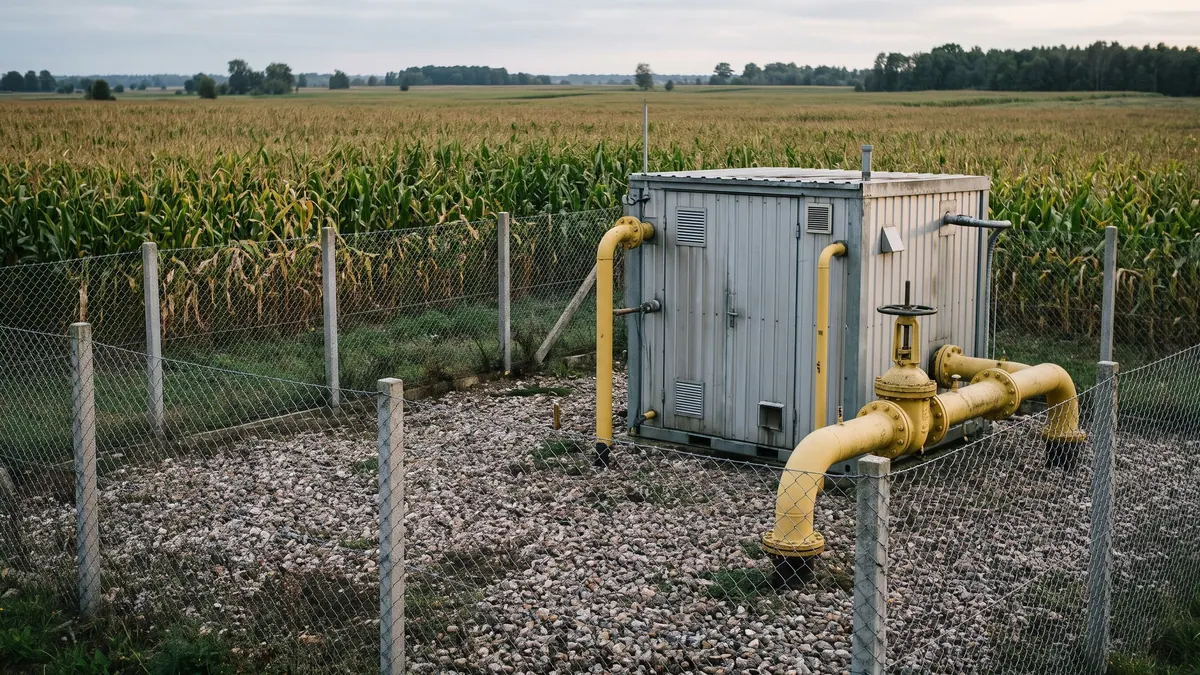
Odorisation is the addition to gas of a compound with an intense, characteristic smell so that every leak can be detected before the gas concentration in a room reaches a dangerous level. Purified biomethane is practically odourless, like natural gas, so it is odorised before being passed to customers. In Europe, tetrahydrothiophene (THT) or mixtures of mercaptans are most often used; the choice depends on the operator's practice. Gas fed into a distribution grid must be odorised in accordance with the requirements of its operator.
Why it is required
Methane is a flammable gas, and mixtures with air in the range of about 4.4–17% by volume are explosive (lower explosive limit about 4.4%, upper about 17%). Technical regulations require gas distributed to customers to be detectable by smell at a concentration well below the lower explosive limit (usually formulated as detectability at a fraction of the LEL). The odorant dose is therefore selected so that the smell is distinct before the gas becomes dangerous.
What we odorise with
| Substance | Characteristics |
|---|---|
| THT (tetrahydrothiophene) | stable, with a characteristic "gassy" smell; widely used in many European countries |
| Mercaptans (e.g. tert-butyl mercaptan) | strong smell, used in mixtures; may react with impurities and metals |
| Sulphur-free mixtures | under development, but rare; require separate approvals |
The choice of compound belongs to the system operator, because the smell must be uniform throughout the grid. A biomethane producer should not change the odorant on its own.
Who odorises and where
Odorisation can take place:
- at the producer's injection station (as instructed by the operator), after quality measurement;
- at the entry point to the distribution grid by the operator (when the grid is already odorised);
- at the end of the grid, if the biomethane goes into a transmission grid in which gas is not odorised (in some systems odorisation is carried out at distribution custody-transfer stations).
In practice a producer injecting into an odorised grid usually does not have to odorise additionally, but for new grids or injection into an isolated local grid odorisation is the producer's task. The operator decides this in the connection conditions.
Dosing
The dose is specified in mg of odorant per m³ of gas (of the order of a dozen or so mg THT/m³; the specific value follows from the operator's requirements). The dosing unit operates in proportion to the flow: a signal from the gas meter controls the dosing pump. The important elements are:
- Odorant tank – leak-tight, in an explosion hazard zone, with spill protection.
- Dosing pump – precise, with redundancy.
- Concentration control – an analyser or periodic laboratory measurements.
- Underdosing alarm – no dose or too small a dose is a safety hazard.
Effect of odorisation on gas quality
The odorant contains sulphur. In gas quality specifications the total sulphur limit usually applies to sulphur without the odorant, and separate rules apply to sulphur with the odorant. For the producer it is important that the sulphur measurement in the gas before odorisation confirms compliance with the requirements, and after odorisation – compliance with the operator's specification. Odorised gas must not be returned to an upgrading installation with membranes or a carbon bed without a plan, because THT contaminates adsorbents.
Example: odorant consumption
Assumptions: a 500 m³/h biomethane installation, a dose of 15 mg THT/m³ (an illustrative assumption), 8000 h/year. Consumption: 500 × 15 mg = 7.5 g/h; over a year 7.5 × 8000 = 60 kg THT. This is a small quantity, but at a price of several dozen zlotys per kilogram (an assumption) it shows that the material cost is small and the key factor is the reliability of dosing.
Occupational safety
THT and mercaptans are compounds with a strong smell, but the smell is detectable at very low concentrations; when working with the odorant, respiratory protection, transfer procedures and training are required. Tanks and dosing units should be fitted with appropriate safeguards and emergency procedures. A spill of odorant in an enclosed space can trigger false alarms, so staff must know the rules of conduct.
Questions for the operator
Before designing the station, ask the operator: whether the gas at the connection point is already odorised; with what compound and in what dose the grid is odorised; who is responsible for odorisation and for controlling the concentration; what the procedure is when a check shows underdosing. The answers affect not only the investment cost (dosing unit, tank, Ex zone) but also legal risk: improper odorisation is usually the responsibility of the entity that feeds the gas into the grid under the conditions specified in the agreement.
Summary
Odorisation is technically simple but critical for safety. The biomethane producer should agree with the operator whether and where to odorise, with what compound, in what dose, and how correct dosing is confirmed.
Sources
Related articles