BiomethaneExplainer
Injection into the transmission grid versus the distribution grid: pressure levels and reverse compression
The distribution grid has limited absorption capacity, especially in summer, so biomethane is sometimes injected into a higher-pressure grid or via reverse compression. We explain pressure levels, the choice of injection point and the criteria.
Other language versions: polski.
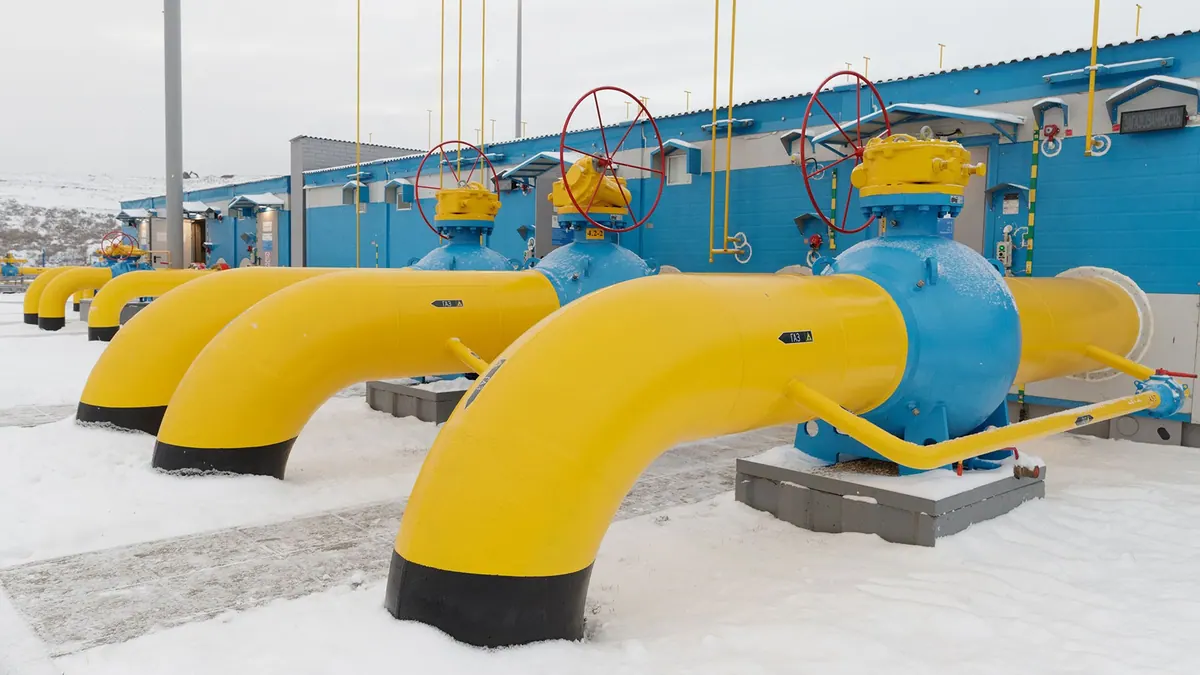

The gas grid is divided into pressure levels and into the transmission and distribution systems, and which of them biomethane can be injected into depends primarily on the grid's absorption capacity, that is, its ability to accept gas even when local offtake is low. In low- and medium-pressure grids, which supply housing estates and businesses, summer gas consumption can be lower than the output of a biomethane plant. The solution is injection into a higher-pressure grid, reverse compression or a connection to the transmission system, which can accept gas at the scale of the whole country.
Pressure levels in Poland
In accordance with the technical regulations for gas pipelines, nominal pressure is classified indicatively as follows:
| Level | Pressure | Typical use |
|---|---|---|
| Low | up to 10 kPa | distribution networks in built-up areas, individual customers |
| Medium | 10 kPa – 0.5 MPa | networks in towns and villages, businesses |
| Elevated medium | 0.5 – 1.6 MPa | local trunk lines |
| High | above 1.6 MPa | high-pressure networks, including transmission |
The transmission system belongs to the transmission system operator (GAZ-SYSTEM), and the distribution system to distribution system operators, including Polska Spółka Gazownictwa. Technical requirements, procedures and tariffs differ between these systems.
What absorption capacity is
Grid absorption capacity is the largest gas flow that can be injected into it without exceeding the permissible pressure and without breaching operating conditions. In summer, gas consumption falls (no heating), so on a given section fewer customers remain to consume the biomethane. If production exceeds local consumption, pressure rises and injection has to be curtailed. For this reason a connection analysis is based on summer and hourly flows.
Options when capacity is too low
- Connection to a higher-pressure grid. A longer or more expensive connection, but greater capacity.
- Reverse compression (reverse flow). A station with compressors transfers surplus biomethane from a lower-pressure grid to a higher-pressure one, where the gas is distributed more widely. This solution can be carried out by the operator or co-financed by producers.
- Capacity limitation to a level corresponding to summer flows.
- Local storage or buffer (e.g. a tank, a grid with a large volume).
- Alternative offtake – bioCNG/bioLNG or direct supply to a large consumer.
- Grouping several producers at one connection point, which shares the compression costs.
Transmission grid
Injection directly into the transmission grid gives the greatest capacity, but requires: higher pressure (compression to several MPa), stricter quality requirements, an extensive metering system and separate connection procedures. It is usually cost-effective for large projects or clusters of biomethane plants, and the costs of a compressor station rise with pressure and flow.
Example: compression energy
Assumptions: biomethane 500 m³/h, isothermal compression from 1.5 to 8 bar(a) and to 40 bar(a) (for comparison). Theoretical isothermal compression power P = p₁·V̇₁·ln(p₂/p₁): V̇₁ = 500 m³/h at 1.013 bar → at 1.5 bar the volume ≈ 338 m³/h = 0.094 m³/s; p₁·V̇₁ ≈ 150,000 Pa × 0.094 ≈ 14.1 kW; ln(8/1.5) = 1.67 → 23.5 kW; ln(40/1.5) = 3.28 → 46.3 kW. After taking efficiency and cooling into account, the actual power is about 1.5–2 times higher. The difference between 8 and 40 bar is about 35–45 kW after taking efficiency into account, i.e. in the order of 270–360 MWh per year (assuming about 8000 hours of operation per year), which at PLN 600/MWh gives about PLN 160–220 thousand of additional energy cost.
Criteria for choosing the point
- distance and cost of the connection,
- summer capacity,
- pressure and the need for compression,
- the operator's quality requirements,
- the prospect of connecting further installations,
- the operator's grid development plan.
Who pays for reverse compression
The rules for sharing the costs of grid expansion and reverse compression depend on regulations and connection conditions; in practice, various models are used, from cover by the producer to financing from the operator's funds taking the tariff into account. For this reason, in the very first conversation with the operator you should ask which solutions it is considering for a given area and whether it plans investments that could increase capacity. Coordinated action by several producers in one region can make it easier to justify such an investment.
Summary
The pressure level and the grid's absorption capacity decide whether a biomethane plant can be connected economically. It is worth commissioning an analysis of summer flows and discussing all variants with the operator, including reverse compression and a connection to a higher grid level.
Sources
Related articles