Technology and operationExplainer
Hygienisation at 70 °C for 1 hour: animal by-products (ABP) in a biogas plant step by step
What the requirement of 70 °C/60 min and particles up to 12 mm means for animal by-products, when to apply it and how a hygienisation tank is designed.
Other language versions: polski.
Category 3 animal by-products (ABP; in Polish UPPZ), e.g. slaughter waste from meat fit for human consumption, used food of animal origin or some food waste, may go to a biogas plant after treatment, which in the standard variant comprises heating to at least 70 °C for at least 60 minutes, with a particle size of no more than 12 mm. These requirements arise from Regulation (EC) No 1069/2009 and Implementing Regulation (EU) No 142/2011; the veterinary authority may approve alternative parameters if the operator demonstrates an equivalent reduction of hazards.
Division into categories
| Category | Examples | Admission to a biogas plant |
|---|---|---|
| 1 | risk material (e.g. TSE), diseased animals | in principle no, apart from exceptions and after sterilisation approved by the authority |
| 2 | manure and slurry (as ABP), digestive tract content, dead farm animals | in principle after pressure sterilisation (method 1: core temperature > 133 °C for min. 20 min, pressure min. 3 bar, particles up to 50 mm); manure, digestive tract content and milk may be processed without prior treatment if the authority agrees |
| 3 | slaughter waste fit for consumption, milk, used food | after pasteurisation/hygienisation 70 °C/60 min/≤12 mm or according to approved alternative parameters |
Detailed conditions, exceptions and required documents are in Annex V to Regulation 142/2011; before the design, the current wording and the requirements of the national authority should be verified.
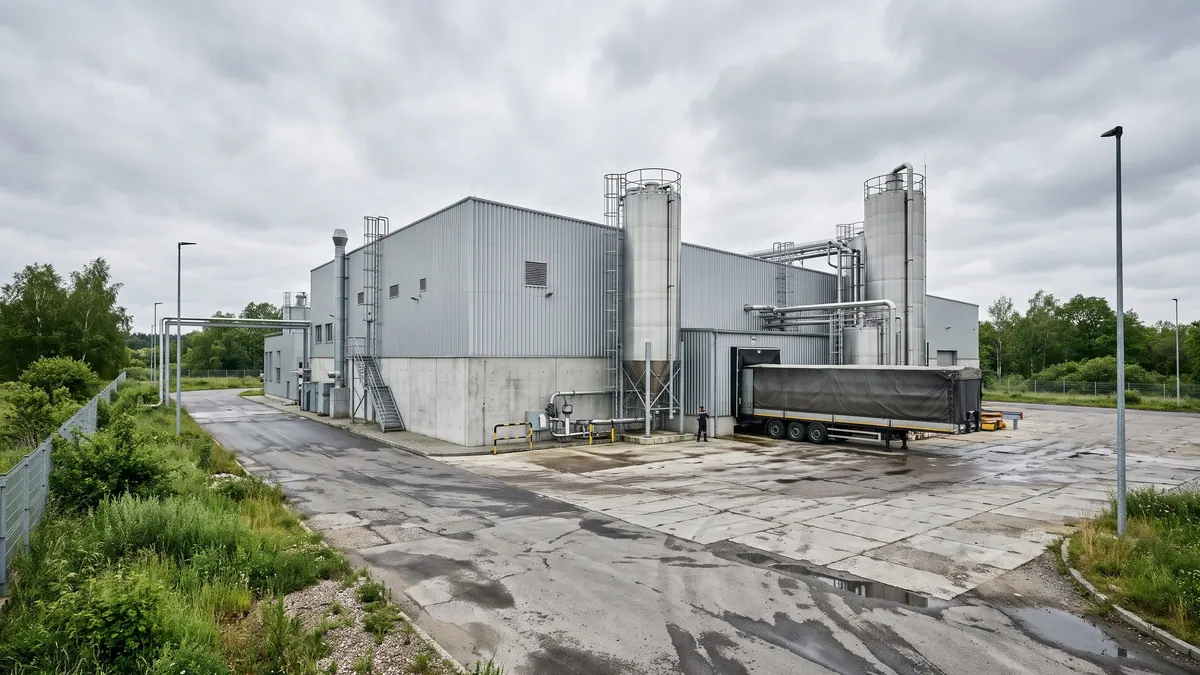
What the hygienisation arrangement looks like
- Reception and initial size reduction — the shredder ensures particles ≤12 mm, checking of screens or openings.
- Buffer tank — accumulates material before the batch.
- Hygienisation tank — heating with steam, a heat exchanger or hot water; mixing; temperature sensors at several points.
- Recording — automatic recording of temperature and time; an alarm on deviation.
- Cooling and heat exchange — heat recovery from outgoing material to incoming material.
- Dosing to the digester — only after the cycle has ended.
The arrangement can work in batches or continuously; the key is to rule out a bypass and the mixing of unhygienised material with hygienised.
Heat balance example
Assumptions: 20 t/d of category 3 ABP at a temperature of 10 °C, heating to 70 °C, specific heat approx. 3.5 kJ/(kg·K) (a water-rich mixture). Energy: 20,000 kg × 3.5 kJ/(kg·K) × 60 K = 4.2 GJ/d, that is approx. 1,170 kWh/d (approx. 49 kW of continuous power). Heat recovery from outgoing material (e.g. 60–70%) reduces the net demand to a dozen or so kW. In addition, tank losses and reheating after cooling to the digester temperature must be added.
Validation and control
- temperature recorders with periodic calibration,
- records for each batch (time, temperature),
- procedures in case of deviations — the material is returned to treatment,
- microbiological control of the end product according to requirements (e.g. indicators Escherichia coli or Enterococcaceae and Salmonella — in line with the annex to the regulation),
- staff training and separation of clean and dirty zones.
Administrative requirements
A biogas plant processing ABP is subject to approval by the veterinary authority (in Poland the District Veterinary Officer, powiatowy lekarz weterynarii), with an assessment of the technological arrangement, safeguards and documentation. In practice the following are needed: a description of the process, diagrams, HACCP instructions, records of materials received, commercial documents, a plan for cleaning and disinfecting vehicles. The conditions and scope of approval are set by the authority; changes to the arrangement require agreement.
The most common mistakes
- no size reduction to ≤12 mm or an unchecked particle size,
- bypassing the tank during a failure,
- no calibration of sensors,
- mixing category streams and no clear marking,
- underestimating the heat demand in winter.
Hygienisation is a cost item, but it opens access to substrates with a high methane potential and often additional income from gate fees. It is worth planning from the concept stage, not adding it after the fact.
What about slurry and manure
Manure and slurry do not usually require pressure sterilisation or separate hygienisation like category 3 material, but in EU law they belong to category 2 by-products, and their status and the scope of the plant approval required depend on national regulations and the decision of the veterinary authority, and on the Nitrates Directive. If slaughter waste, residues from meat plants, milk or used cooking oil of animal origin go into the mix, the requirement of approval and hygienisation becomes in practice unavoidable. In every case, check the interpretation with the veterinary authority before signing a substrate contract.
Digestate from ABP
Digestate resulting from the processing of category 3 material, once the parameters are met, may be used as a fertiliser or soil improver, but is subject to additional conditions, including microbiological control and, in some cases, restrictions on grazing after application. The details, including waiting periods, must be read from the current regulations and the decision of the authority.
Sources
Questions and answers
Does thermophilic fermentation replace hygienisation?
Not automatically. The regulation requires specific parameters for every batch of material and an approved system. Running fermentation at 52–55 °C alone is usually not enough to demonstrate compliance without additional arrangements with the veterinary authority.
Related articles