Implementing OGI at a plant: purchase, rental or external service
How to implement OGI: when to buy a camera, when to rent one and when to commission an inspection — and what follows from Regulation (EU) 2024/1787, what the good practices for biogas plants are and how to choose a supplier.
Other language versions: polski.
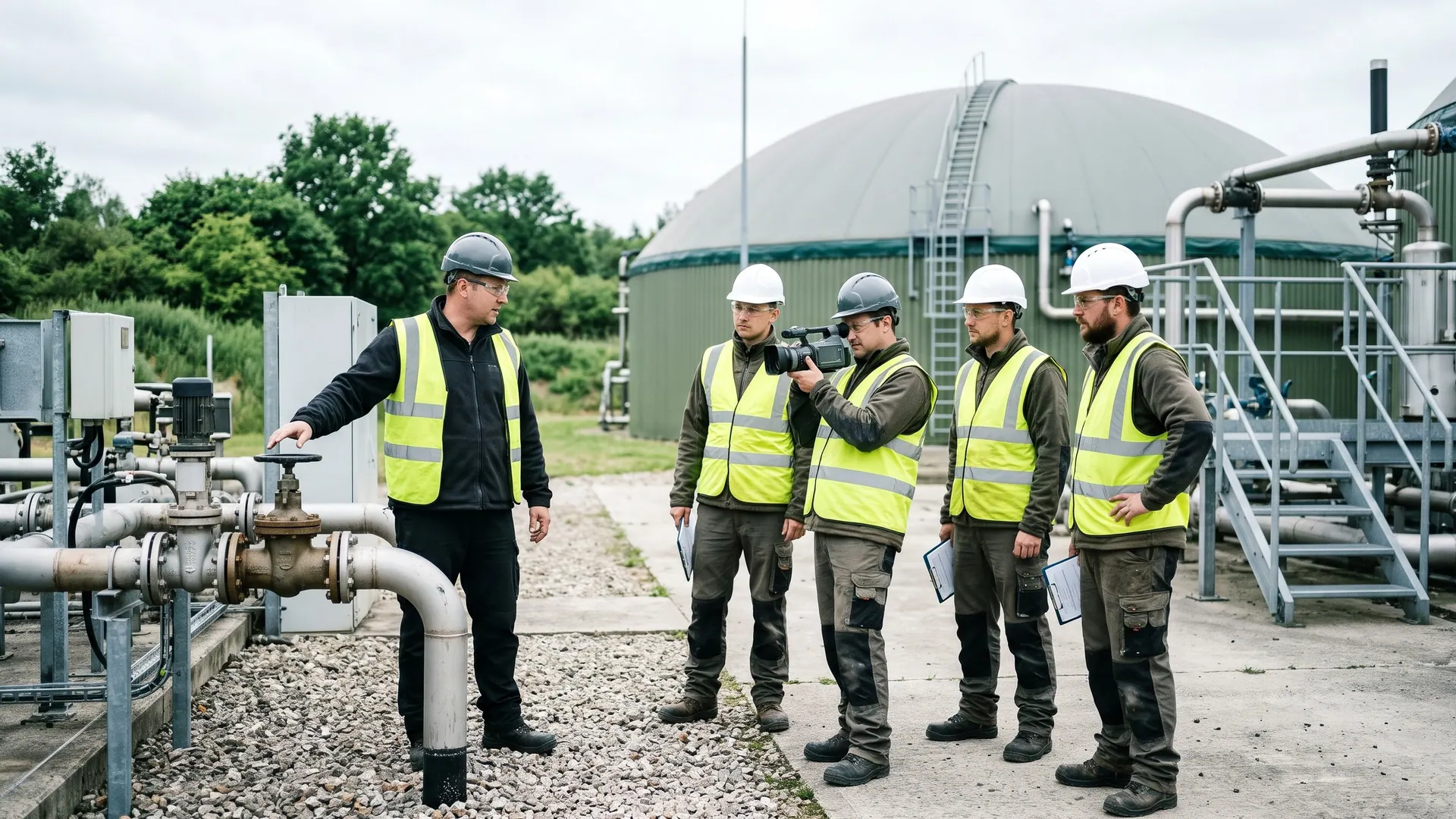
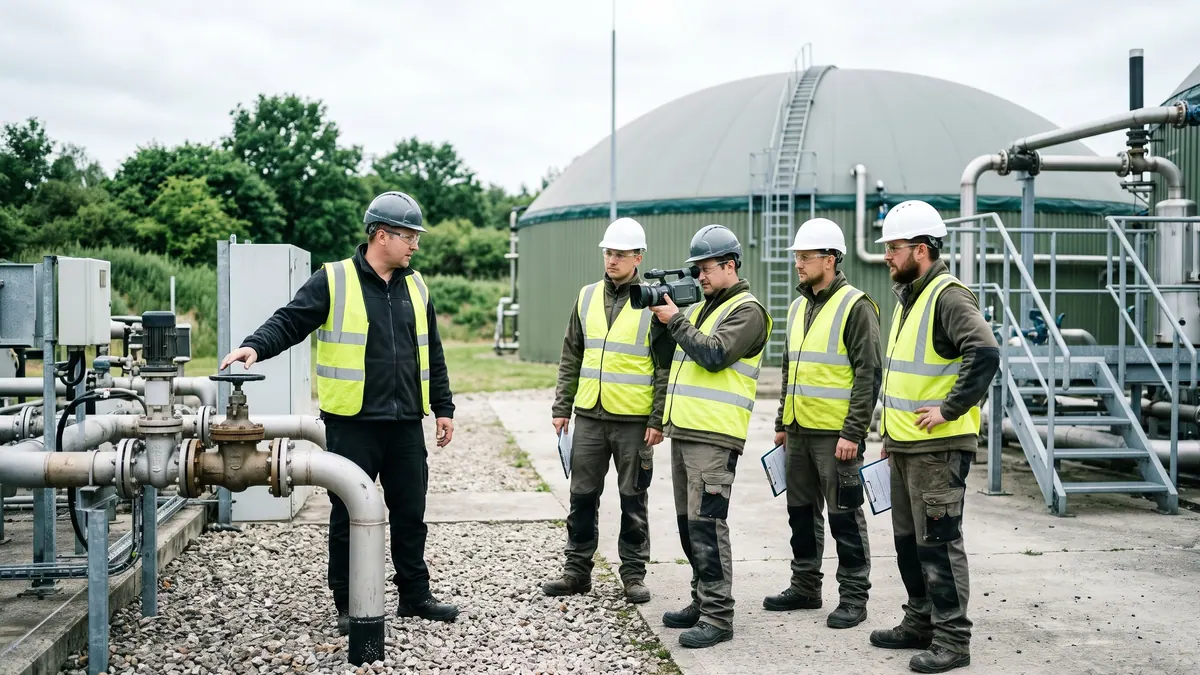
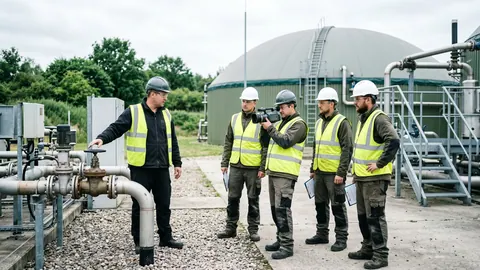 Szkolenie operatorów OGI w terenie: instruktor wskazuje armaturę, kursanci w ŚOI, jeden obserwuje przez kamerę ręczną. Illustrative image (AI) — FeedstockData, Google Gemini
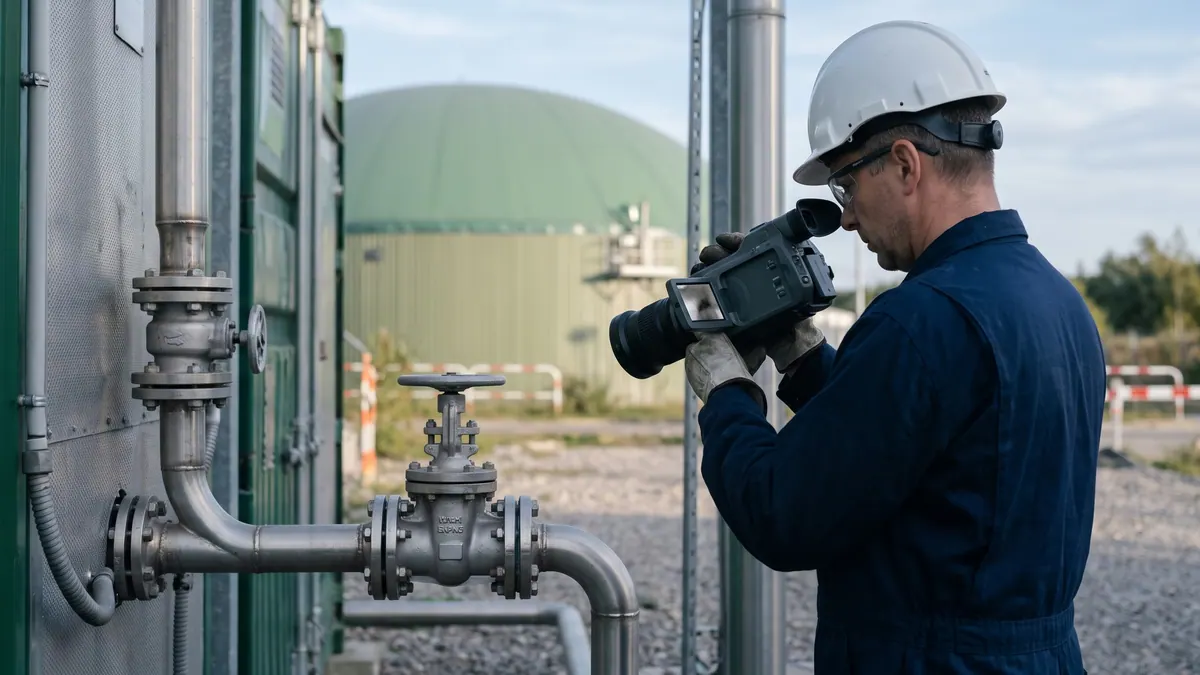
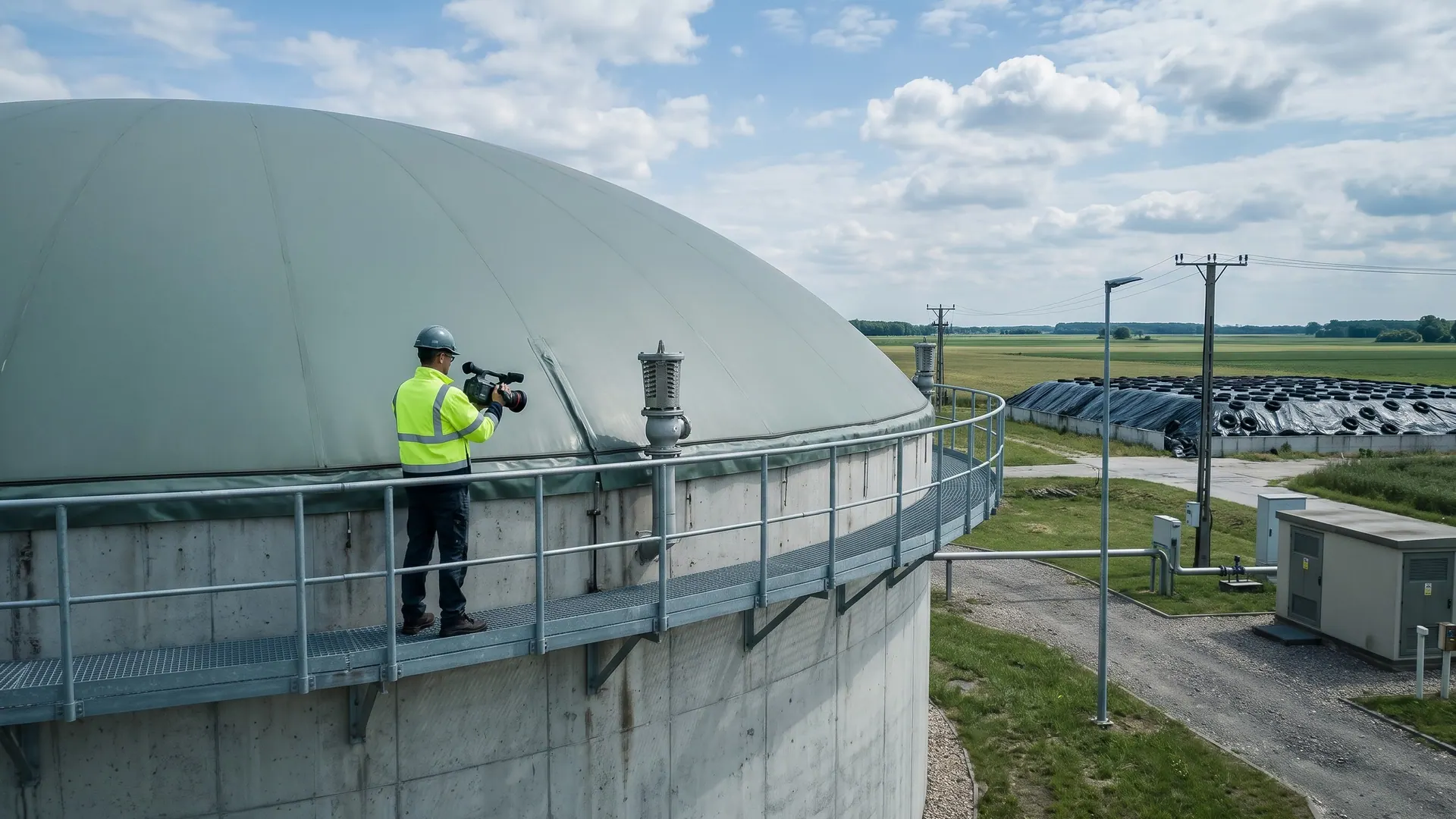
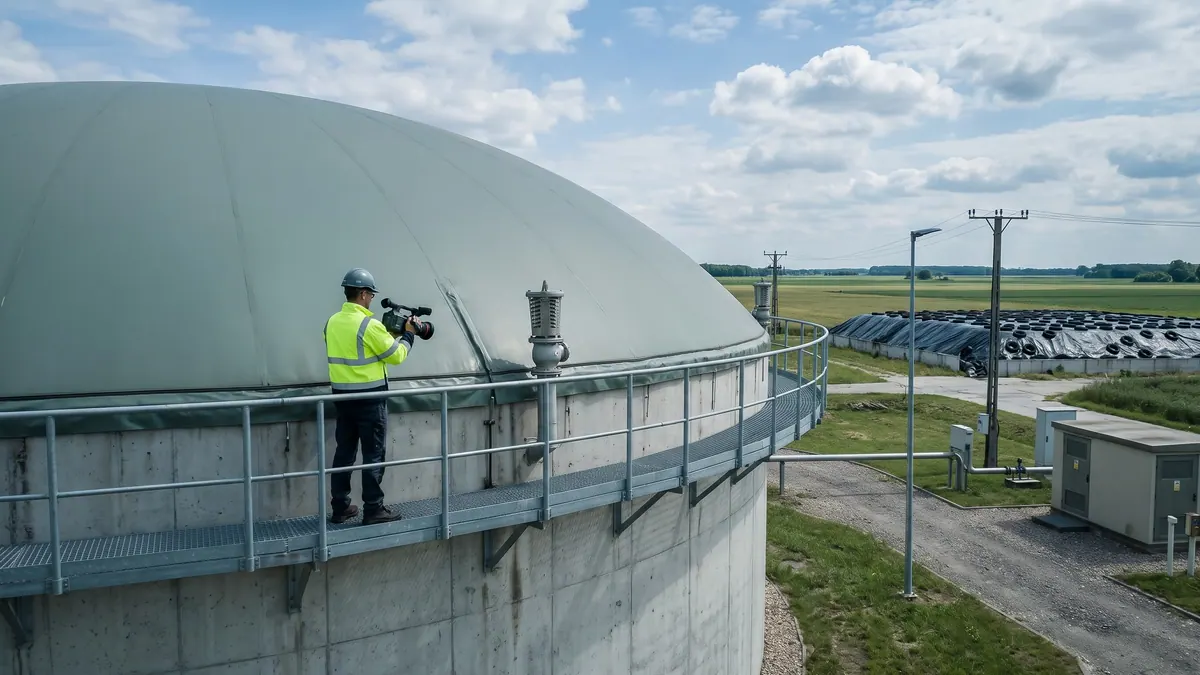
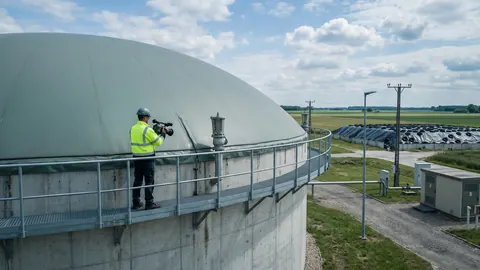 Inspektor z kamerą OGI na pomoście zbiornika fermentacyjnego z dachem dwumembranowym, sprawdza zawór nad- i podciśnieniowy i obrzeże membrany. Illustrative image (AI) — FeedstockData, Google Gemini
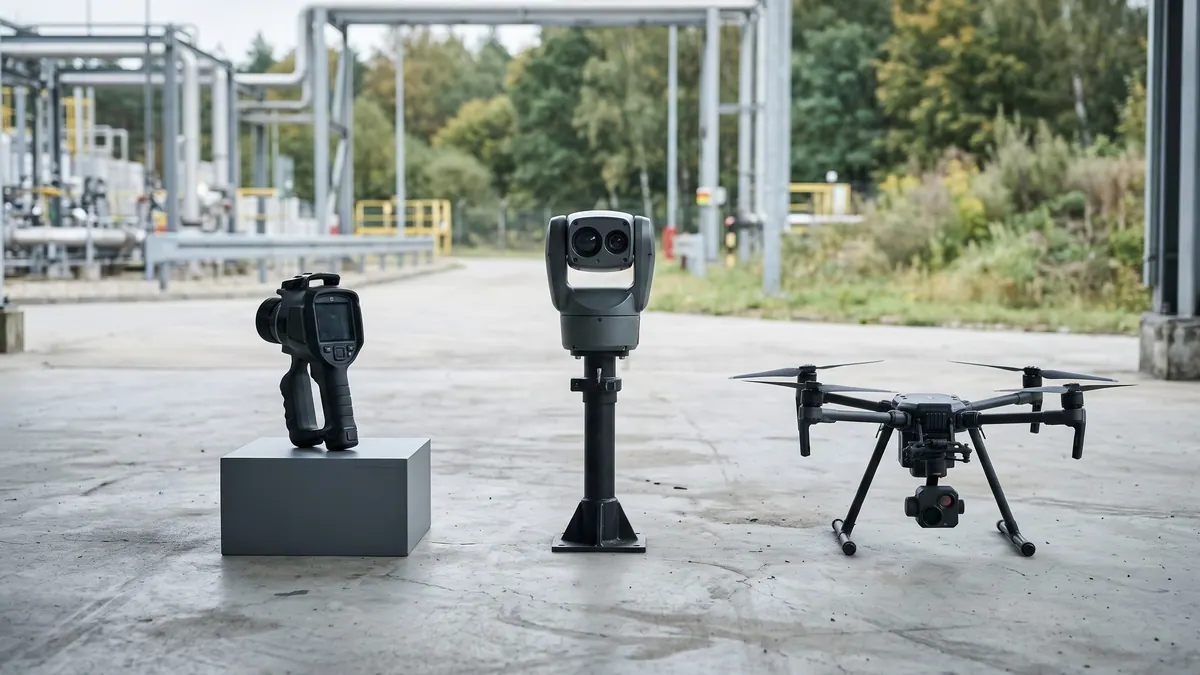
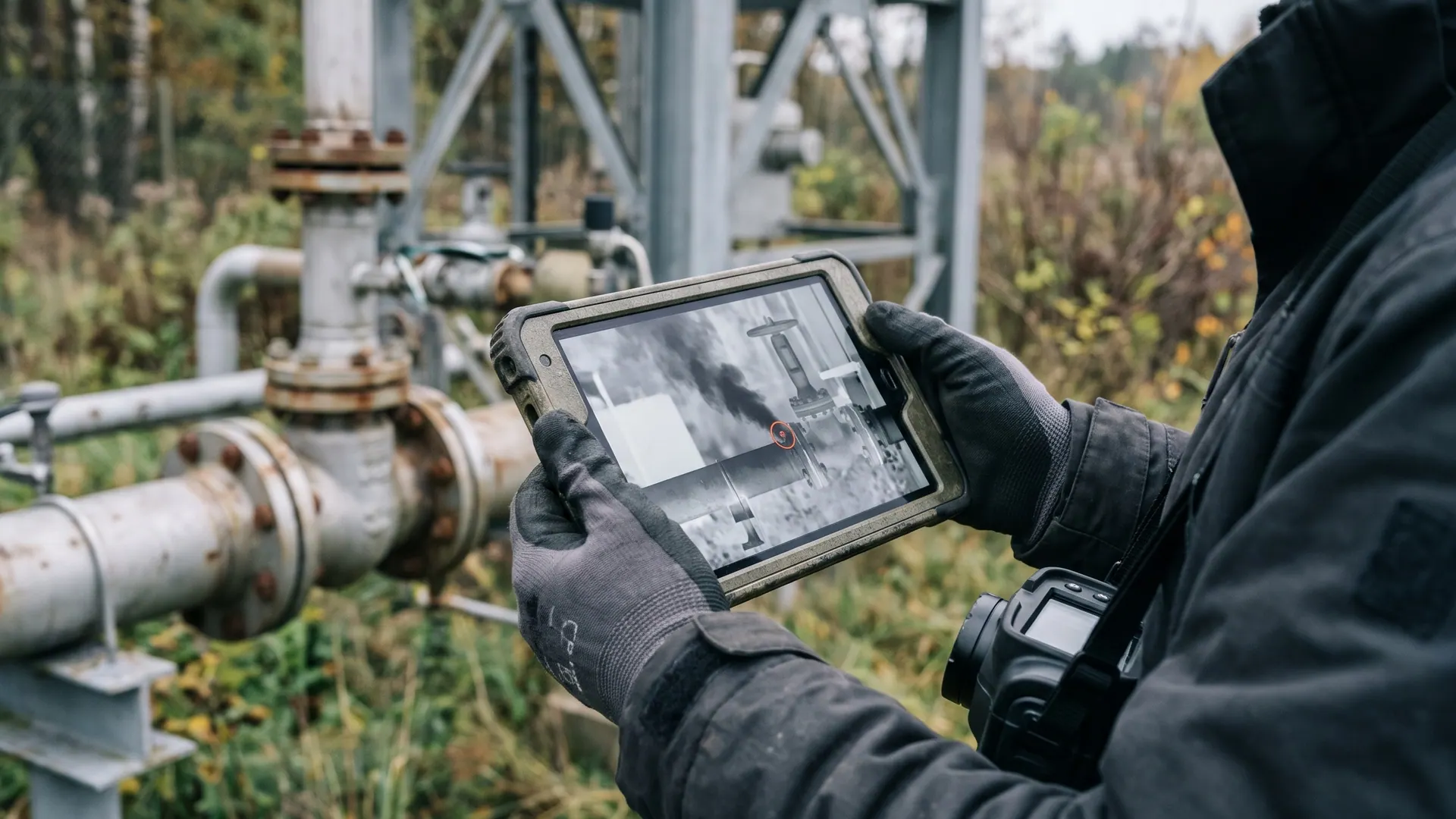
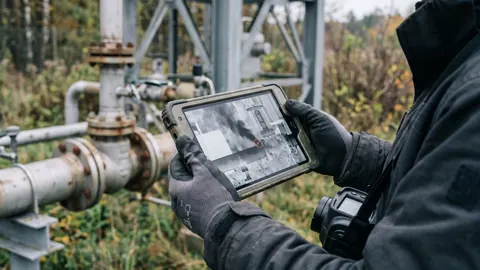 Technik w rękawicach dokumentuje wyciek na tablecie: na ekranie obraz OGI z zaznaczonym punktem nieszczelności. Illustrative image (AI) — FeedstockData, Google Gemini
The choice between buying an OGI camera, renting it and commissioning an external company to carry out inspections depends on the number of installations, the frequency of surveys and the competence of your own team — not on the price of the camera itself. For a single biogas plant surveyed a few times a year, a service model or rental usually pays off; for a group of plants with surveys every few weeks, purchase becomes justified. This guide describes the criteria, the legal requirements (together with what they do not cover), the survey procedure, training, documentation and typical mistakes. The basics of OGI are explained in the compendium, the types of solutions in the technology overview, and the companies operating in Poland in the market overview.
Editorial overview. This article does not name companies or products; the criteria are neutral and serve to compare any suppliers. As of the publication date (7/10/2026) we have no commercial cooperation with the companies in this industry described in our OGI series. This is not legal advice. Please send comments and corrections to biuro@substraty.pl.
Purchase, rental or service — criteria
| Criterion | Purchase | Rental | External service |
|---|---|---|---|
| Number of installations | many | a few or periodic campaigns | one or a few |
| Frequency of surveys | high (e.g. cyclical walk-rounds) | periodic | rare or quarterly |
| Competence in the team | necessary (operator + analyst) | necessary during the rental | on the contractor's side |
| Costs | device, training, service, software | fee for the period + training | fee per survey and report |
| Flexibility | full | limited by dates | depends on the contract |
| Risk | equipment becoming obsolete, failure | availability in the season | quality of the contractor |
| Documentation | own | own | contractor's report |
Rule of thumb: if you plan fewer than a few surveys a year and have no trained operator, start with a service or rental with support; if surveys are frequent and cover many sites, balance the cost of purchase against the cost of services over a horizon of several years. Remember the hidden costs: operator time, training, calibration, servicing of the cooler in cooled cameras, software licences.
Requirements and obligations
Regulation (EU) 2024/1787
The regulation entered into force on 4/08/2024. Art. 1(2) covers: the extraction and processing of oil and fossil gas, inactive and closed wells, the transmission and distribution of natural gas (excluding installations at end customers), underground storage, LNG facilities and coal mines. The text we checked does not contain the words "biogas" or "biomethane", and an "operator" is an entity running assets in these sectors.
Obligations under Article 14 for the operators covered (status as of 7/10/2026):
- an LDAR programme for existing sites by 5/05/2025, and for new ones within 6 months of the start of operation;
- the first type 2 survey of all components by 5/08/2025 (for new sites within 9 months);
- repair thresholds: for type 2 — 500 ppmv or 1 g/h of methane (above-ground components), for type 1 — 7000 ppmv or 17 g/h;
- repair or replacement immediately; if impossible, an attempt within 5 days and completion within 30 days, with exceptions requiring notification;
- a register of all detected leaks kept for at least 10 years and an annual report to the competent authority;
- the possibility of delegating tasks to contractors, without relieving the operator of responsibility (Art. 14(15));
- an obligation on Member States to provide certification, accreditation or qualification schemes for LDAR service providers and operators (Art. 14(16)) — in the sources we checked we did not find a Polish scheme, so for now it is worth requiring evidence of competence from the contractor.
The regulation does not name OGI; it requires devices that make it possible to locate a leak as close to the source as possible, and "advanced technologies" require the consent of the competent authority. The technical details (including minimum detection limits) are to be specified by a Commission implementing act; we did not confirm its publication in the Official Journal of the EU as of 7/10/2026, so before planning a purchase check the current status in EUR-Lex.
EN 17628
EN 17628:2022 ("Fugitive and diffuse emissions of common concern to industry sectors — Standard method to determine diffuse emissions of volatile organic compounds into the atmosphere") sets out a framework for selecting and applying methods for detecting, identifying and quantifying diffuse emissions of volatile organic compounds into the air from industrial plants; it covers five methods: OGI, DIAL, SOF, tracer correlation (TC) and reverse dispersion modelling (RDM). It supplements EN 15446, which concerns the detection and quantification of individual leaks from equipment and pipelines in LDAR programmes. According to descriptions of the standard, it has been validated for non-methane VOCs, although its approach should in principle also apply to methane. We did not confirm the existence of a Polish edition (PN-EN 17628) in the sources available — its status in the PKN catalogue should be checked independently. It matters for plants that include OGI in an emissions monitoring programme, especially where a permit requires it.
Biogas plants and biomethane plants
Since the regulation does not expressly cover biogas, regular OGI surveys at a biogas plant are good practice: they reduce methane losses (that is, revenue), improve safety and make it easier to meet the requirements of an insurer, a bank or an offtaker. Typical inspection points: tank covers and membranes, pressure-vacuum relief valves, penetrations, heat exchangers and the upgrading system, compressors, the metering and injection station. For installations in explosive atmosphere zones, explosion protection requirements apply, so equipment approved for work in the given zone or a work permit procedure is needed.
Roles and responsibilities
Whatever the model, establish who is responsible for what. The process owner (usually the technical or environmental manager) approves the scope, schedule and budget. The OGI operator carries out the survey and documents the results. The maintenance team repairs leaks and confirms completion. The health and safety department approves the rules for entering hazardous zones. With an external service, responsibility for repairs and compliance remains with the plant; Regulation 2024/1787 expressly states that delegating tasks does not relieve the operator of responsibility (Art. 14(15)). The contract with the contractor should therefore specify the report deadline, the data format, the rules for re-inspection and insurance.
Operator training
The operator should understand the principle of operation, the limitations (wind, background, temperature difference), operation of the device and documentation. Manufacturers and sellers offer training: FLIR describes in a Polish brochure a three-day OGI certification course at the ITC, and some companies run free webinars. Require the trainer to show evidence of competence and field practice; a manufacturer's certificate confirms the ability to operate the equipment and is not a state qualification certificate.
Survey procedure
- Preparation: scope (list of components), map and route, permits, weather conditions, checking the equipment and its charge.
- Survey: a walk-round with the camera from different angles, observation in two planes, recording detected leaks, describing the location and conditions.
- Confirmation and estimation: an FID analyser (or another methane analyser) or a quantitative function where the procedure requires it.
- Repair: a work order, deadline, prioritisation of larger leaks.
- Post-repair check: a repeat survey of the component.
- Report: results, videos, conclusions.
Documentation
A leak register (location, date, size, status), recordings, a survey report, a record of repairs and post-repair checks, data on the equipment and the operator, the procedure version. Keep the data in a format that can be exported and passed to an auditor. Plants covered by the regulation must keep the register for at least 10 years; for the others we recommend a similar period.
How to calculate the total cost
When comparing the options, put the costs over the same horizon (e.g. five years): for purchase — the device, lenses, accessories, training, software, calibration and service (including the cooler in cooled cameras), operator working time, a replacement in the event of failure; for rental — fees for periods, transport, training, working time of your own team; for a service — fees for surveys, reports and re-inspections after repairs. Also take into account the value of the gas lost: the greater the flows, the faster more frequent surveys pay back. We do not give prices, because they are not public; ask for quotations for an identical scope and compare them in a spreadsheet.
The first 90 days of implementation
In the first month, define the scope (list of components, route, Ex zones), designate the responsible persons and choose the delivery model. In the second, carry out training and a pilot survey on part of the installation, and record the results in the register. In the third, improve the procedure on the basis of the pilot, set a schedule of cyclical surveys and the rules for reporting to management. Only then scale up to the remaining sites.
Typical implementation mistakes
- choosing equipment without checking whether it sees the gas in the plant's conditions,
- no procedure and register — a survey without continuity,
- an operator without practice or trained only in theory,
- ignoring conditions (wind, no temperature difference, background),
- treating a QOGI estimate as a certain measurement,
- no check after repair,
- ignoring Ex requirements,
- choosing a contractor solely on price.
Supplier selection checklist
Equipment - Do the spectral range and lens match the gas to be detected? - What sensitivity data was given, and under what conditions? - Is there an Ex version for your zone (certificate number)? - What are the weight, start-up time and battery run time? - Is a field trial possible?
Service and support - Where and within what time is service carried out (including the cooler)? - Are calibration, replacement rental and training available? - Does the supplier confirm its status towards the manufacturer (authorisation) and the warranty?
Data and reporting - Can the results be exported in open formats? - Does the report contain video, location and repair status? - What are the rules for data storage and ownership?
Service - Experience in plants similar to yours, references. - Operators' qualifications and insurance. - Scope of liability, report and re-inspection deadlines. - Compliance with the plant's safety procedures.
It is good practice to ask at least two suppliers for the same scope and compare the offers using the same list.
Corrections. Companies and readers may submit corrections to biuro@substraty.pl. The order of companies in the series is always alphabetical, and the list may be incomplete.
Sources
- Rozporządzenie (UE) 2024/1787 w sprawie redukcji emisji metanu w sektorze energetycznym — EUR-Lex
- EN 17628:2022 — Standardowa metoda wyznaczania emisji rozproszonych LZO (opis normy)
- Przegląd zastosowań EN 17628:2022 (Sensors 2025, 25(5), 1561; PubMed Central)
- Teledyne FLIR — broszura OGI w języku polskim (kurs ITC)
Questions and answers
Does a biogas plant need an LDAR programme?
This does not follow directly from Regulation (EU) 2024/1787: Article 1(2) covers the extraction and processing of oil and fossil gas, drilling, transmission and distribution of natural gas, storage, LNG installations and coal mines, and the text does not mention biogas or biomethane. Any obligations may arise from other sources (permits, insurance, contracts). The interpretation in a specific situation should be confirmed with the authority or a legal adviser.
From when do the LDAR deadlines apply in the Methane Regulation?
The Regulation entered into force on the twentieth day after publication on 15/07/2024, that is 4/08/2024. Article 14 requires an LDAR programme by 5/05/2025 (existing sites) and the first type 2 survey by 5/08/2025; new sites are subject to shorter deadlines from the start of operation. This applies to operators within the scope of the Regulation.
How long should inspection records be kept?
Regulation 2024/1787 requires the operators it covers to keep a register of detected leaks for at least 10 years (Article 14(13)). For other plants, it is good practice to adopt a similar period.
How much time do I have to repair a detected leak?
Under Article 14(9) of Regulation 2024/1787: repair immediately after detection, and if that is not possible, an attempt no later than within 5 days and completion within 30 days, with exceptions and a reporting obligation. For installations outside the scope of the Regulation, it is good practice to set your own deadlines in the procedure.
Is an OGI camera enough to meet LDAR requirements?
The regulation does not name OGI: it requires devices that make it possible to identify a leak as close to the source as possible and refers to thresholds in ppmv and g/h. The operator must provide the authority with information about the device (Annex I, Part 2). OGI alone is usually supplemented with quantitative measurement, and “advanced technologies” (a term from the regulation) require the consent of the competent authority.
Related articles