Technology and operationAnalysis
OGI solutions: handheld, fixed and drone cameras and QOGI — an overview
An overview of OGI solution categories: cooled and uncooled cameras, fixed, drone-mounted, quantitative (QOGI), software and Ex versions — and the parameters that actually differentiate the devices.
Other language versions: polski.
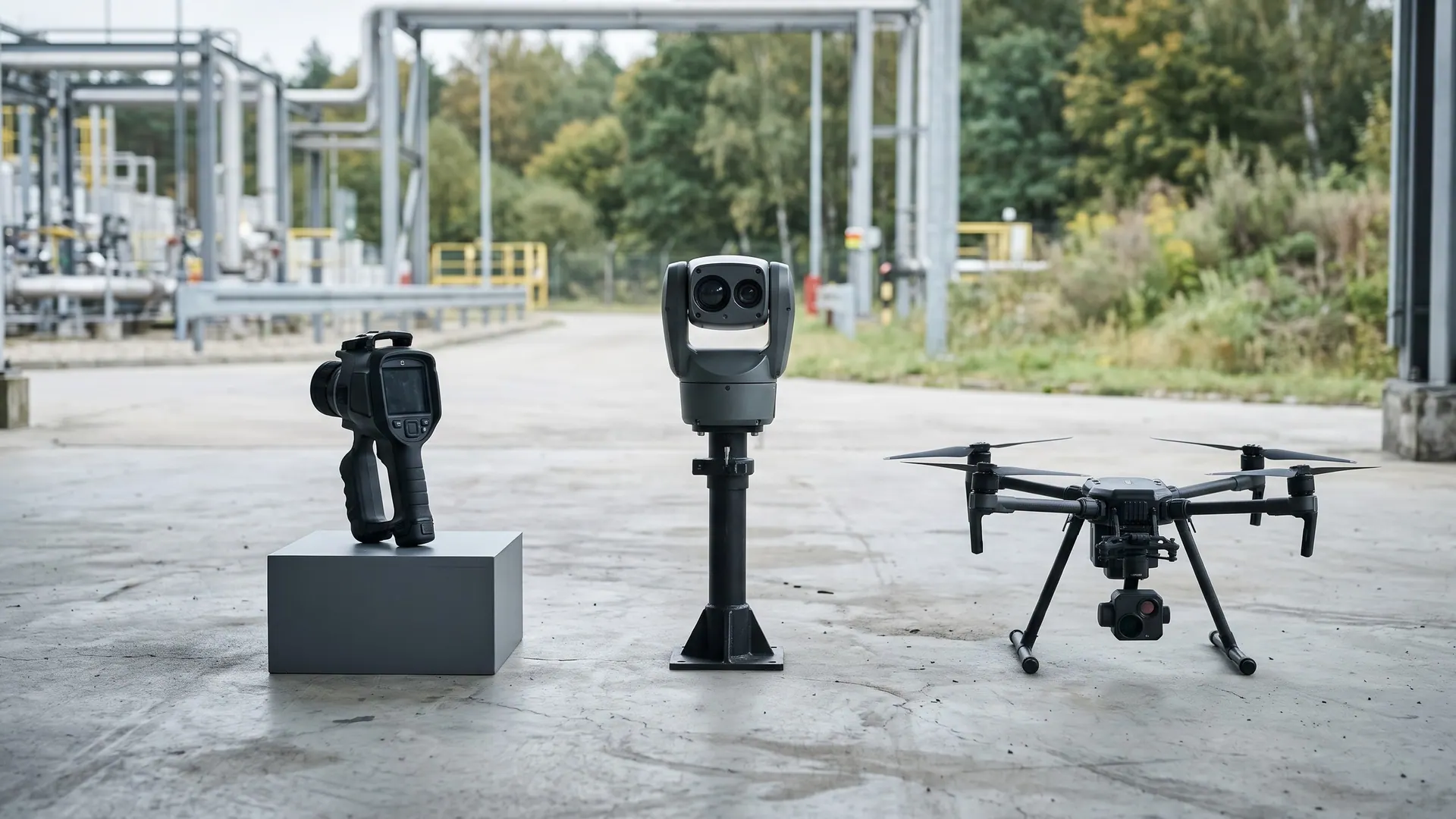
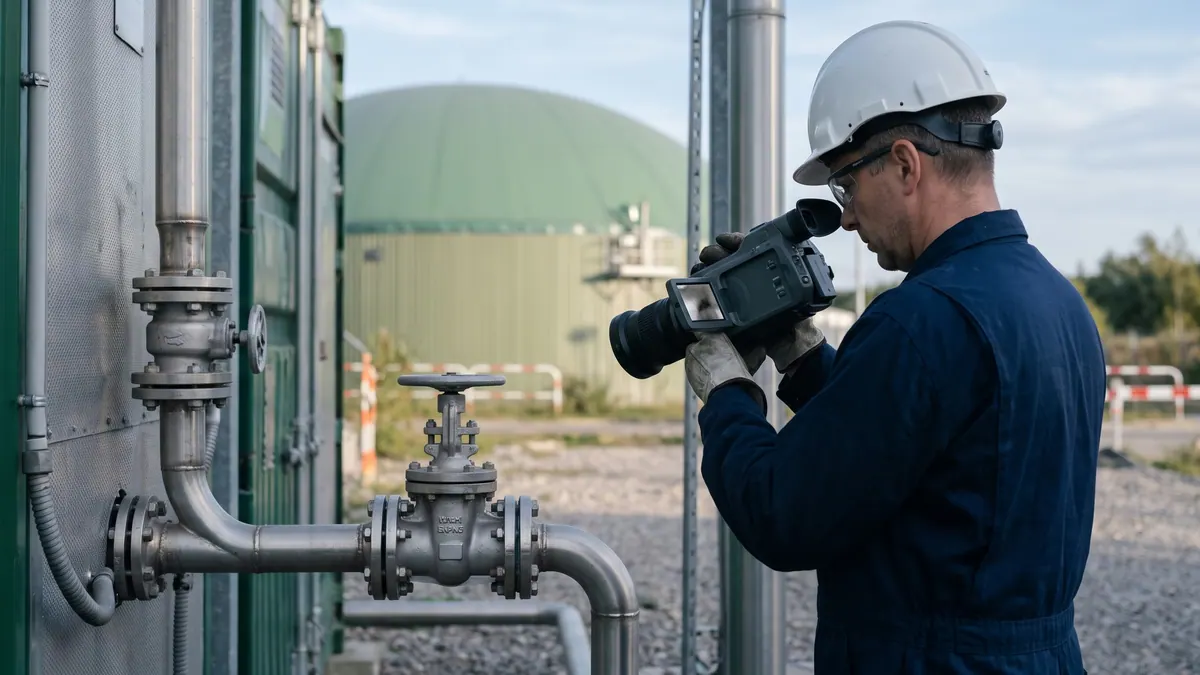
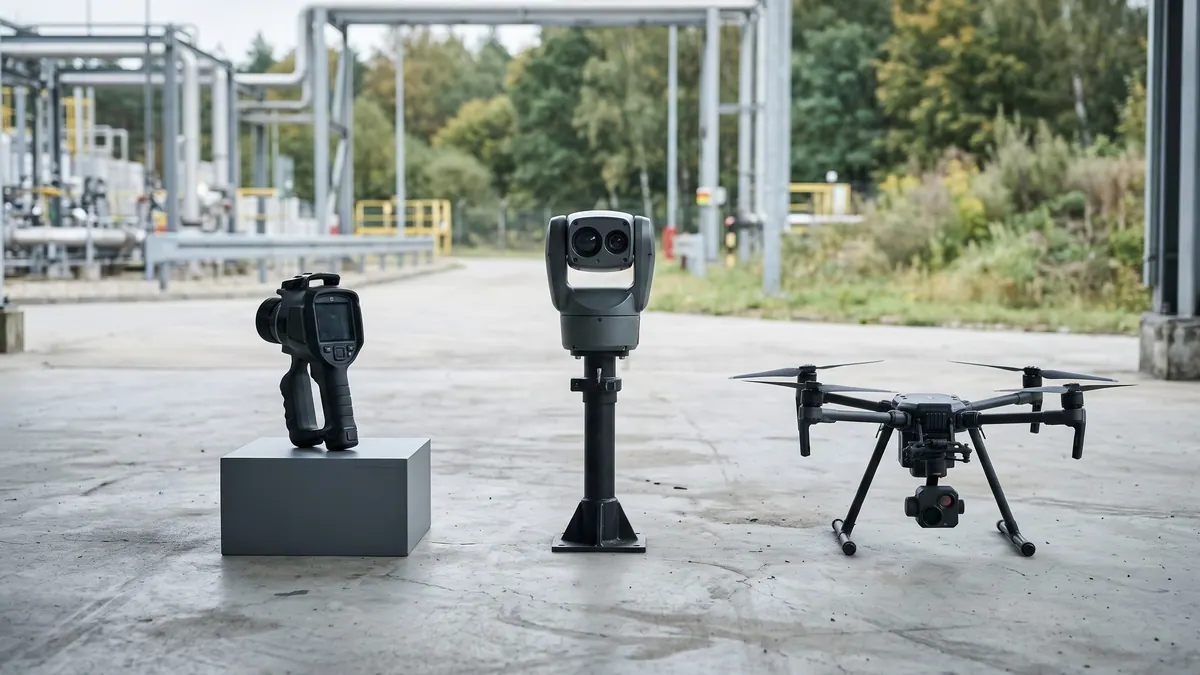
 Trzy typy sprzętu OGI obok siebie: kamera ręczna, stacjonarna kamera monitoringu ciągłego i dron z kamerą w gimbalu. Illustrative image (AI) — FeedstockData, Google Gemini
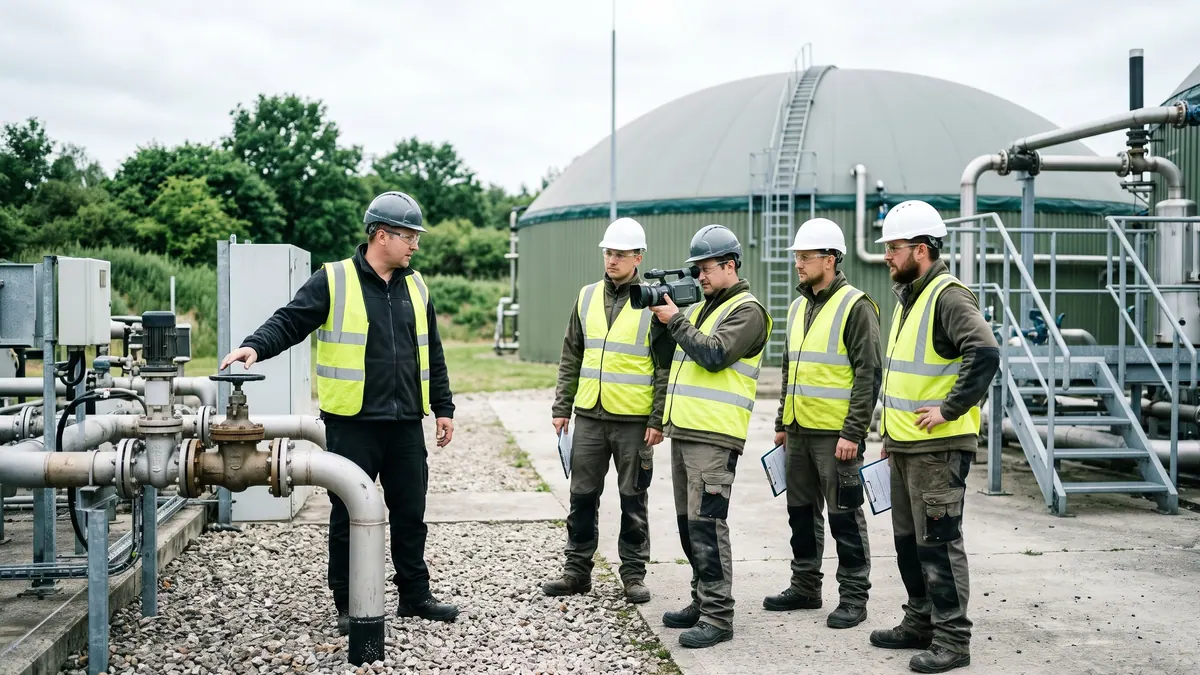
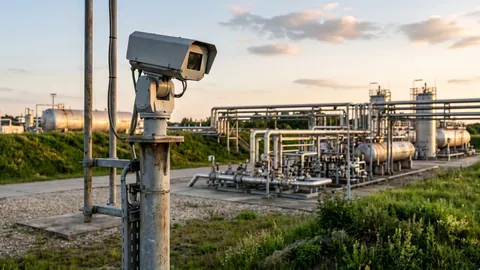 Stacjonarna kamera OGI w obudowie na maszcie z głowicą obrotową, obserwująca instalację do monitoringu ciągłego. Illustrative image (AI) — FeedstockData, Google Gemini
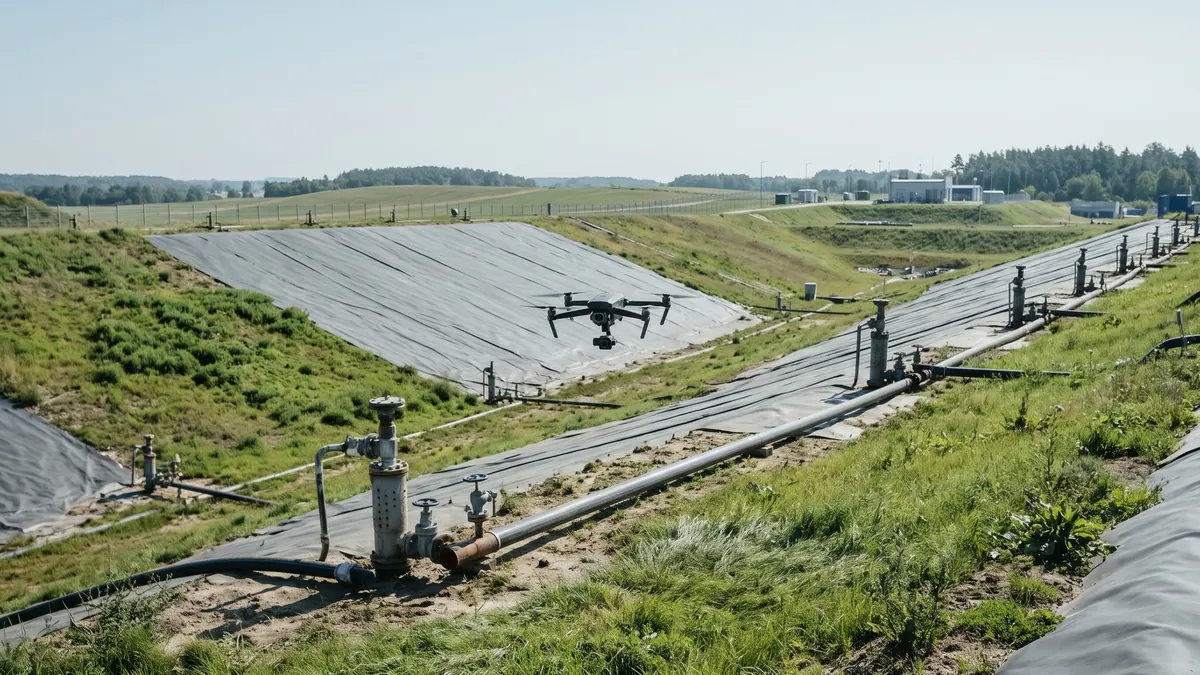
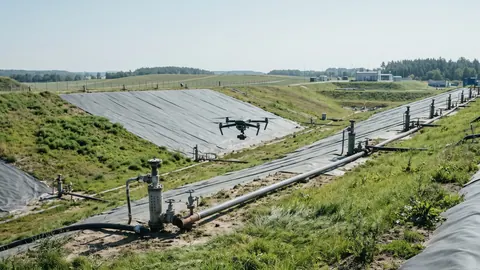 Dron z kamerą w gimbalu nisko nad kwaterą składowiska odpadów z systemem odgazowania: studnie, rury zbiorcze i geomembrana. Illustrative image (AI) — FeedstockData, Google Gemini
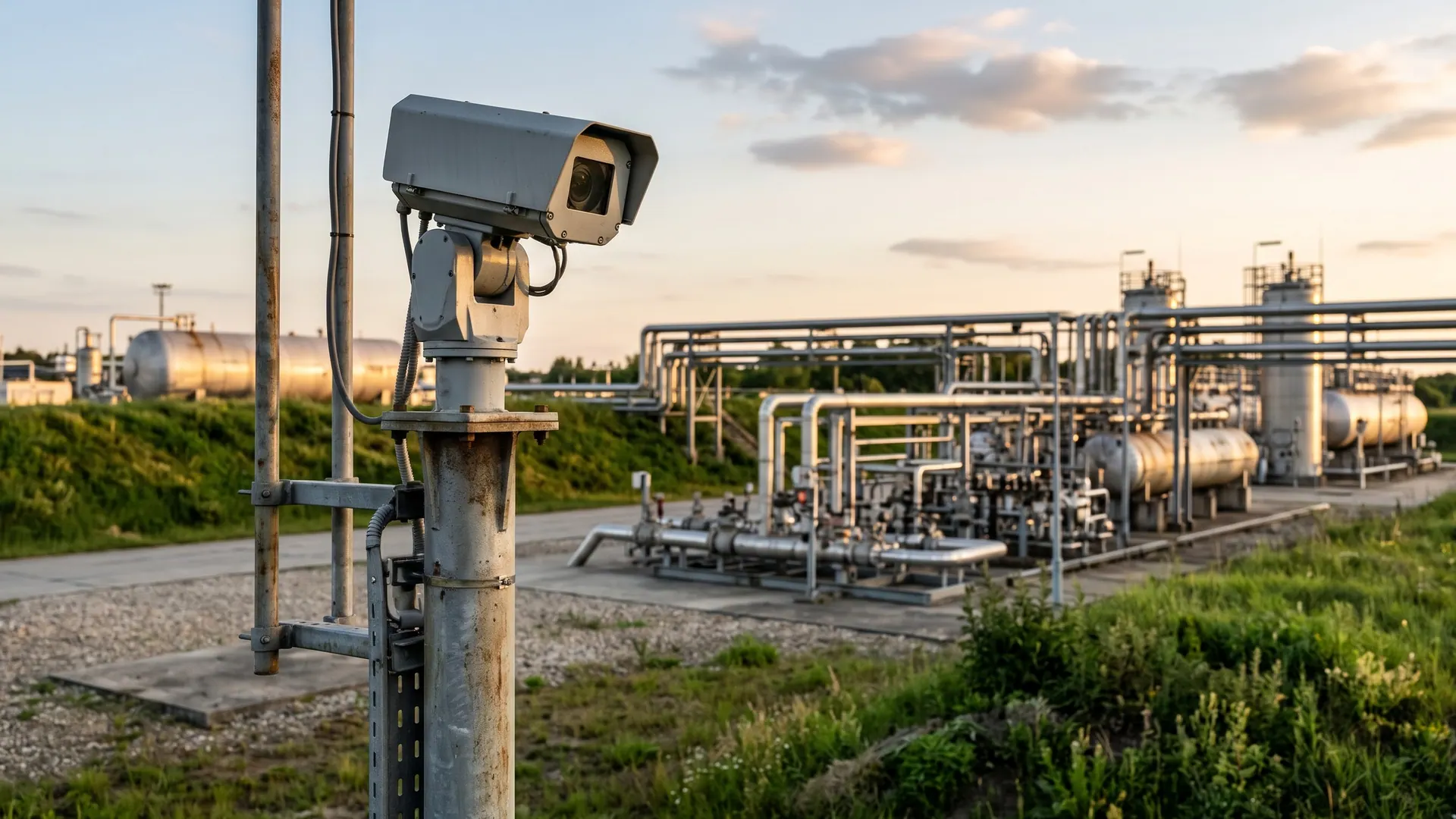
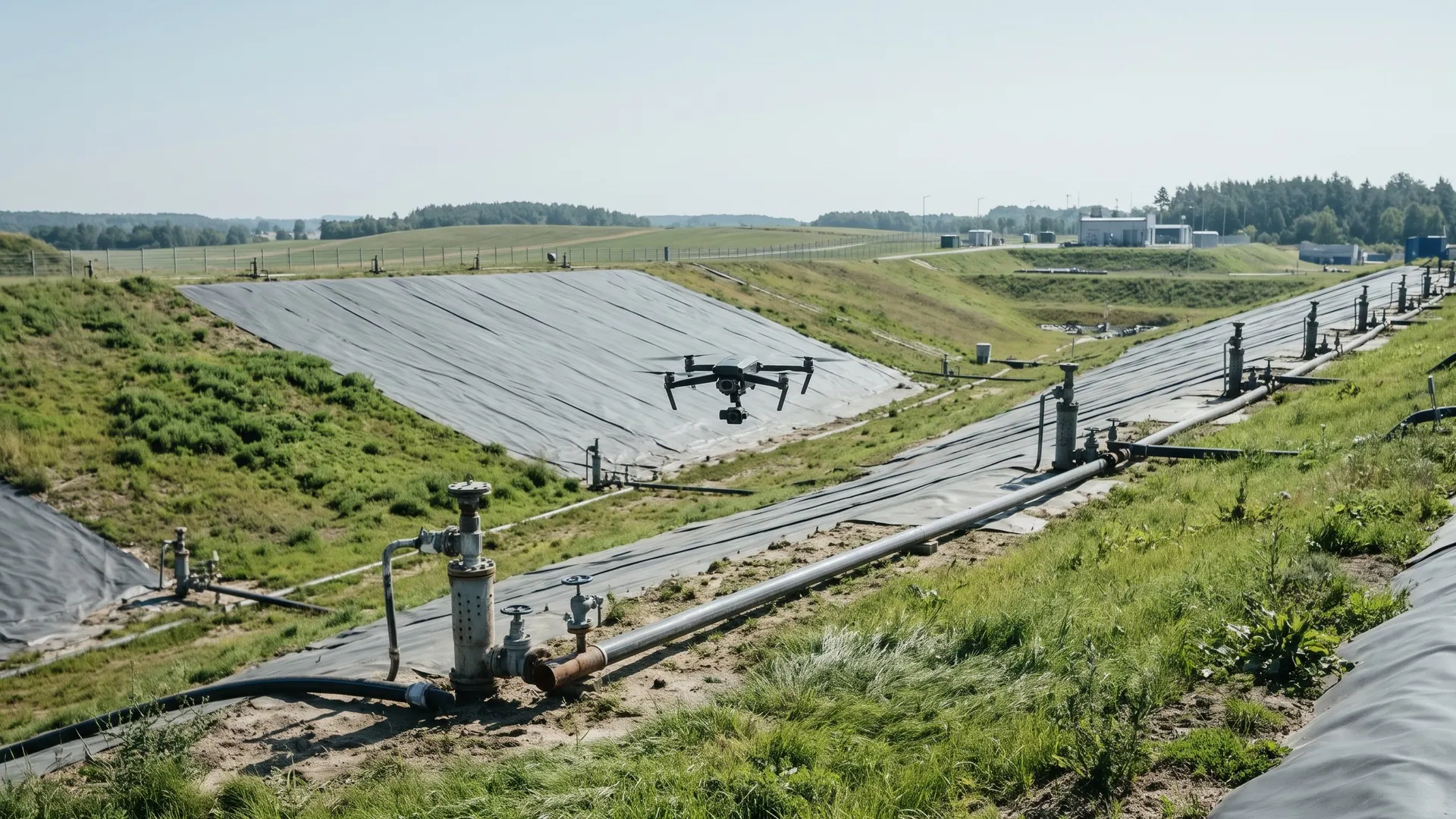
Optical gas imaging (OGI) solutions today come in five main varieties: handheld cooled cameras (usually MWIR, aimed at methane and other hydrocarbons), handheld uncooled cameras (usually LWIR, described for, among others, SF₆, ammonia and refrigerants, and in some models also for methane), fixed cameras for continuous monitoring, drone payloads and quantitative systems (QOGI) together with software. This overview organises them and points to the parameters that genuinely differentiate the devices. It is part of the OGI series; the principle of operation is described in the OGI compendium, and the market of manufacturers and companies in Poland in a separate article.
Editorial principle. The overview is neutral: we do not compare manufacturers, create rankings or point to the "best" models. Product family names appear solely as examples of categories, in the alphabetical order of manufacturers. Technical data comes from manufacturers' websites (status as of 12/08/2026) and consists of manufacturers' declarations, not the results of independent tests. We quote numerical values (sensitivity, weight, certificates) where the manufacturer publishes them on a website that we were able to open; the fact that the numerical examples concern some of the manufacturers is not an assessment of any of them. The list may be incomplete; please send corrections to biuro@substraty.pl.
A reminder in three sentences
Gases such as methane absorb infrared radiation in narrow bands. An OGI camera has a filter matched to such a band, so the gas is visible as a moving "smoke" against the background — provided there is a temperature difference between the gas and the background. The details of the physics and the limitations are in the compendium.
Overview of categories
| Category | Typical spectral range | Typical gases (per manufacturers' descriptions) | Typical use |
|---|---|---|---|
| Handheld cooled camera | MWIR, e.g. 3.2–3.4 µm | methane and other hydrocarbons, VOCs; in other bands CO₂, CO | LDAR surveys, plant walk-rounds |
| Handheld uncooled camera | LWIR, e.g. 7–8.5 µm or 9.5–12 µm | SF₆, ammonia, refrigerants, ethylene; in some models methane, propane | switchgear, refrigeration, quick surveys |
| Fixed camera | MWIR or LWIR | depending on the version | continuous monitoring of stations, compressors, tanks |
| Drone payload | most often MWIR | methane, hydrocarbons, VOCs | extensive sites, landfills, pipelines |
| QOGI (quantitative) | as the base camera + module/algorithm | assessment of the leak flow | documentation of emission size |
| Software | — | — | records, video, reports, walk-round routes |
The ranges in the table are examples from product cards, not a rule: e.g. Sensia gives a 3.2–3.4 µm band for the Mileva 33 (per cards on the DirectIndustry site), Teledyne FLIR a 3.2–3.4 µm band for the G series, and for the GF77 two lens variants (7–8.5 µm and 9.5–12 µm).
Handheld cooled and uncooled cameras
Cooled. The detector (e.g. InSb or another material working in the MWIR) is cooled by a cooler, usually of the Stirling type, and the camera has a narrow-band filter. The result is high thermal sensitivity: Teledyne FLIR gives for the Gx320 model (G series) a thermal sensitivity below 10 mK at 30°C. The price is weight, energy consumption, the cool-down time after switching on, and the need for periodic servicing of the cooler. Manufacturers associate with cooled cameras (InSb or another MWIR detector), among others, the PV400 (Guide Sensmart; according to the manufacturer with a cooled detector, for methane and VOCs), the GMP03 (Konica Minolta; according to its press release a cooled camera), the handheld EyeCGas Multi family (Opgal; we list it as an example of the category — the type of detector should be checked in its card), the Mileva 33 (Sensia), the G series (Teledyne FLIR) and the GIS-320 (Workswell; according to its website with a cooled FLIR detector).
Uncooled. A microbolometer works without a cooler, so the camera switches on faster, is lighter and is simpler to maintain. Manufacturers describe such cameras for, among others, SF₆, ammonia, ethylene and refrigerants. Opgal lists the uncooled EyeCGas Mini family, Sensia describes the Caroline X model as uncooled (SF₆, refrigerants, methanol, ammonia; per cards on the DirectIndustry site), and Teledyne FLIR gives for the GF77 a weight of 1.54 to 2.05 kg (depending on the lenses), NETD below 25 mK for the 25° lens and below 40 mK for the 6° one, and, with the 7–8.5 µm lens, detection also of methane, nitrous oxide, propane, SO₂ and the refrigerants R-134a and R-152a. A difference in sensitivity relative to cooled cameras does exist, so for small methane leaks a trial under target conditions decides.
Fixed cameras
Permanently mounted cameras observe a selected part of an installation and report leaks automatically. The offers include cooled versions (e.g. for hydrocarbons) and uncooled ones. Examples of families (alphabetical order of manufacturers): SENTINUUM24 (Opgal; according to the manufacturer a 24/7 monitoring system) and ADGiLE (Teledyne FLIR; according to the manufacturer automatic, continuous gas monitoring). The choice depends on whether the risk of a leak is concentrated (a pressure reduction station, compressors, a biogas upgrading unit) and whether a periodic survey is sufficient.
Drones and mobile platforms
OGI payloads for drones are usually miniaturised MWIR cameras. Examples (alphabetical order of manufacturers): EyeCGas Fly (Opgal), the Mileva 33 in the On-Board version (Sensia), the Ventus OGI OEM core (Sierra-Olympic Technologies, 580 g with a lens, for integration in fixed systems and on unmanned platforms) and the GIS-320 (Workswell; according to its website the exclusive global distributor is FLIR). A drone shortens the time needed to walk round large sites, but it requires compliance with aviation regulations and an assessment of whether a flight over the installation is permissible, especially in explosive atmosphere zones.
QOGI and software
QOGI means cameras or modules that estimate the size of a leak, usually after entering the distance, the conditions and the gas type. Examples (alphabetical order): the GMP03 (Konica Minolta, a camera described as quantitative), EyeQGas and EyeCSite QOGI (Opgal), the QL320 module (Providence Photonics) working with Teledyne FLIR cameras, and the Caroline Y and Mileva 45 (Sensia). A QOGI estimate is the result of a model and of the measurement conditions, so it does not replace measurement with an analyser where the procedure requires it.
Software covers leak records, video, walk-round routes and reports. Names encountered: Opgal Connect (Opgal), RedLook (Sensia) and Thermal Studio and Route Creator (Teledyne FLIR). In selection, what counts is data export in open formats and the ability to pass the data to an auditor.
Accessories and Ex versions
Interchangeable lenses change the field of view (Teledyne FLIR gives fields of view of 14.5° and 24° for the G series, and 25° and 6° lenses for the GF77), and mounts, tripods and housings make work in the field easier. Ex/ATEX versions exist at some manufacturers. On the G series page, Teledyne FLIR gives for all variants (Gx320, Gx620, G620) the marking "ATEX/IECEx, Ex ic nC op is IIC T4 Gc II 3 G" (zone 2) and Class I Div. 2, and in the description indicates the Gx320 and Gx620 models as ATEX-compliant — for the G620 the scope should be confirmed with the manufacturer. The GF77 product page does not mention ATEX, and the enclosure protection rating is IP54. Guide Sensmart gives the marking "Ex ic IIC T6 Gc" for the PV400. We did not check the Ex certificates of the other manufacturers — they must be confirmed in the cards and declarations of conformity. Always verify the certificate for a specific model and lens, because the marking applies to the set, not to the brand.
Matching to the gas: where to start
Start with the list of gases, not with the camera type. For methane and other hydrocarbons, manufacturers point to cooled cameras in the 3.2–3.4 µm band, and some also to uncooled LWIR cameras with a suitable lens (e.g. the GF77 with the 7–8.5 µm lens according to Teledyne FLIR). For SF₆, ammonia and ethylene, manufacturers describe separate lenses or uncooled models in the LWIR bands (e.g. the 9.5–12 µm lens in the GF77; the Caroline X according to Sensia). For refrigerants and for CO₂ and CO there are separate configurations with narrower bands — offered by at least Opgal (EyeCGas CO2 and CO), Sensia (Mileva 45 for CO₂) and Teledyne FLIR (single-gas models); check the specific bands and models in the manufacturers' cards. At biogas plants, methane is essentially what counts, but at refrigeration stations and switchgear on the same site other gases may be present. A multi-gas camera is convenient, but it is not necessarily the best answer — if the task covers one gas, selecting for that gas simplifies operation.
Remember that OGI sees only gases that absorb radiation in the camera's band, and the image depends on conditions. Also check whether the manufacturer describes a given gas for a specific lens: in the case of the GF77, the same camera handles different gases depending on the optics fitted.
Parameters that actually differentiate devices
| Parameter | Why it matters | How to ask |
|---|---|---|
| Spectral range | must cover the gas's absorption band | "which gas and with which lens?" |
| NETD / NECL | thermal sensitivity and sensitivity to concentration; NETD is not directly comparable between bands | "how was it measured and under what conditions?" |
| Minimum detectable leak | depends on distance, wind, background and temperature difference | "what test was the value based on?" |
| Resolution | affects detail, but less than the band and sensitivity | "the IR sensor, not the video" |
| Cooling, start-up time | affects how the survey is organised | "how long does cool-down take and what is the service?" |
| Ex | a condition for work in a hazardous area | "certificate number and scope" |
| Weight, ergonomics | many hours of work with the camera in hand | "a field trial" |
| Recording, radiometry | documentation and analysis | "format, GPS, markers" |
| QOGI | assessment of leak size | "model and uncertainty" |
Camera sensitivity is not a single number. For example, Teledyne FLIR (and Workswell for the GIS-320) refer in their materials to the US EPA sensitivity requirement (the OOOOa rule); test conditions and values vary between manufacturers, so compare them only under the same conditions.
Prices, maintenance, rental
Prices. The websites of manufacturers and sellers that we checked do not give OGI camera prices, and ranges from unverifiable compilations do not meet the site's rules. That is why we do not give prices — you have to ask suppliers for a quotation.
Maintenance costs. They consist of: the device, lenses, operator training, periodic calibration and manufacturer inspection, servicing of the cooler in cooled cameras, and software and licences. With uncooled cameras the cooler servicing item disappears, but the others remain. It is worth asking about the availability of service in Poland and the repair time.
Rental. The website of one of the sellers (EC TEST Systems) contains an enquiry form for renting FLIR cameras; the other websites checked do not describe the rental of OGI cameras. For infrequent surveys, rental or an external service may be more sensible than purchase — the criteria are described in the article Implementing OGI: purchase, rental or service.
How to read product cards
Compare only data from the manufacturer's cards, with the date and measurement conditions. Note whether the stated sensitivity applies to a specific lens, which gas has been declared, whether the Ex certificate covers the whole set, and whether the manufacturer indicates service in Poland. In selecting, do not be swayed by the number of functions — check whether the camera sees your gas in your conditions and whether the results can be documented.
Sources
- Teledyne FLIR — Optical Gas Imaging (przegląd kategorii)
- Teledyne FLIR — karta produktu GF77 (dane techniczne, stan na 12.08.2026)
- Teledyne FLIR — seria G (dane techniczne, certyfikaty, stan na 12.08.2026)
- Konica Minolta — kamera QOGI (GMP03, GMP02)
- Konica Minolta — komunikat o kamerze GMP03 (2025)
- Opgal — rodziny produktów OGI (stan na 12.08.2026)
- Sensia — opis oferty na stronie firmy CORONA (strona producenta niedostępna automatycznie)
- Sierra-Olympic Technologies — Ventus OGI (rdzeń OEM)
- Workswell — GIS-320, ładunek OGI dla dronów
Questions and answers
How does a cooled OGI camera differ from an uncooled one?
Cooled cameras have a detector chilled to a low temperature and work in a narrow MWIR band; in manufacturers' offerings these are usually solutions for methane and other hydrocarbons. Uncooled cameras use a microbolometer in the LWIR band and are lighter, but have lower sensitivity; manufacturers describe them for, among others, SF₆, ammonia and refrigerants, and some models also for methane. The specific gases and sensitivity must be checked in the datasheet of the given camera.
Do you give prices of OGI cameras?
No. The manufacturers and sellers whose websites we checked do not publish OGI camera prices. Instead of approximations, we give a list of cost components worth asking about: the device, lenses, training, cooler servicing, calibration, software.
Is an OGI camera enough to meet LDAR requirements?
The regulation does not name OGI: it requires devices that make it possible to identify a leak as close to the source as possible and refers to thresholds in ppmv and g/h. The operator must provide the authority with information about the device (Annex I, Part 2). OGI alone is usually supplemented with quantitative measurement, and “advanced technologies” (a term from the regulation) require the consent of the competent authority.
Why does an OGI camera need an Ex version?
For work in explosive atmosphere zones, and the areas around biogas tanks and upgrading installations can be such a zone. The Ex version is certified for a specific category and gas group; the scope of certification differs between models, so the marking on the nameplate and in the declaration of conformity must always be checked.
Will an uncooled camera detect methane?
Some manufacturers describe such models: for example, FLIR states that the GF77 with a lens in the 7–8.5 µm band detects, among others, methane and propane. The sensitivity of such cameras is, however, different from that of cooled cameras, so suitability for a given task (e.g. small leaks at a biogas plant) should be checked in the technical data and, ideally, in a field trial.