Methane losses and fugitive emissions at a biogas plant: detection and reduction
Methane escapes through roof valves, leaks, digestate stores, upgrading and unburned gas in the CHP. How to detect, measure and reduce it, and what the EU Methane Regulation means.
Other language versions: polski.

Methane escapes from a biogas plant from several sources: leaks in the gas installation, safety valves of membrane roofs, poorly covered digestate stores, unburned methane in the CHP exhaust (so-called methane slip), losses in upgrading, and failures and servicing operations. Every per cent of methane lost is lost energy and an emission of a gas whose warming potential over a horizon of several decades is many times greater than that of CO₂. The best strategy is a leak detection and repair programme, orderly operation and closing the digestate.
Sources of emissions
| Source | Mechanism | Main measures |
|---|---|---|
| Leaks from pipelines, flanges, valves | ageing of seals, vibration, corrosion | periodic inspection, replacing seals |
| Roof overpressure valves | opening when there is excess gas, foam, poor adjustment | gas store management, flare, valve checks |
| Roof membranes | cracks, leaking joints | inspections, replacement |
| Digestate in storage | residual methane potential | gas-tight tank, longer HRT, gas recovery |
| CHP (methane slip) | incomplete combustion, especially at low load | proper adjustment, an oxidation catalyst in justified cases, servicing |
| Upgrading | methane in waste CO₂ or off-gas | choice of technology, oxidation of off-gas |
| Vents, sampling, servicing | release during work | procedures, recovery, flare |
| Failures and downtime | no gas offtake | a flare that is operational and available |
Detection
- Visual and sensory inspections — by sight, hearing and smell (methane is odourless, but other gases accompany it).
- Portable gas detectors for checking connections; leak detection fluid as a simple method.
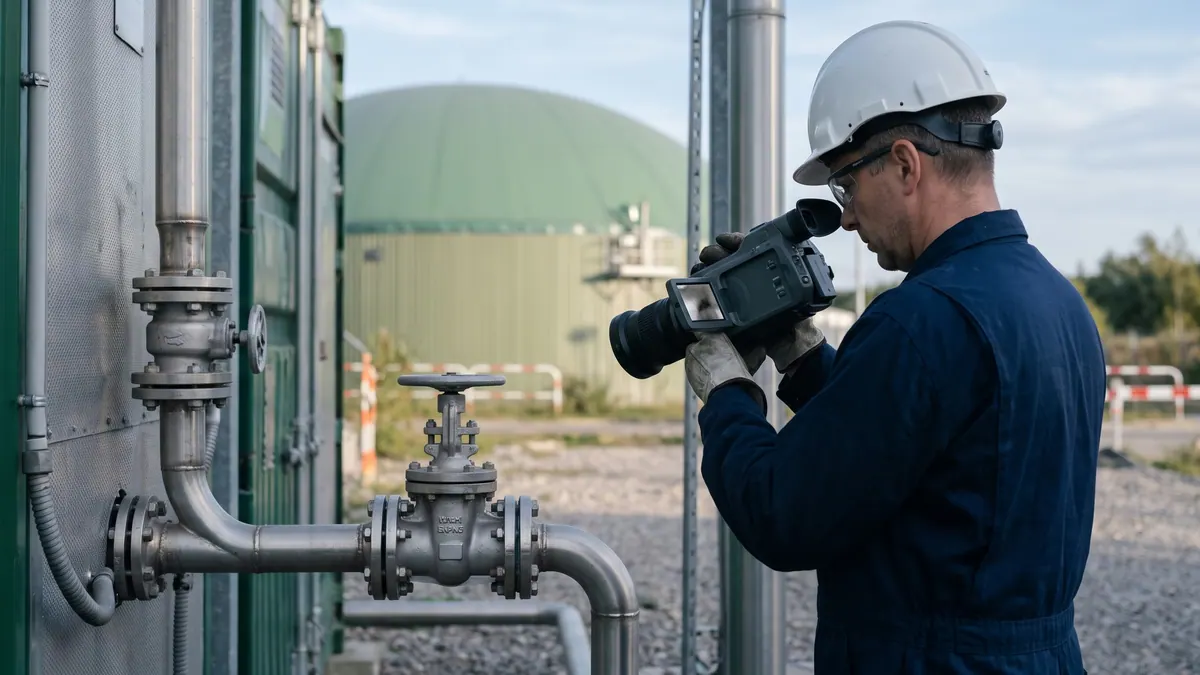
- Gas imaging infrared cameras (OGI) make it possible to see methane leaks from a distance and are used in LDAR programmes.
- Quantitative measurements (e.g. remote, by drone or using suitable analysers) to estimate the size of emissions from the whole site.
- Gas balance — comparing production with the potential of the substrates and with consumption; constant, unexplained shortfalls may indicate losses.
An LDAR programme in practice
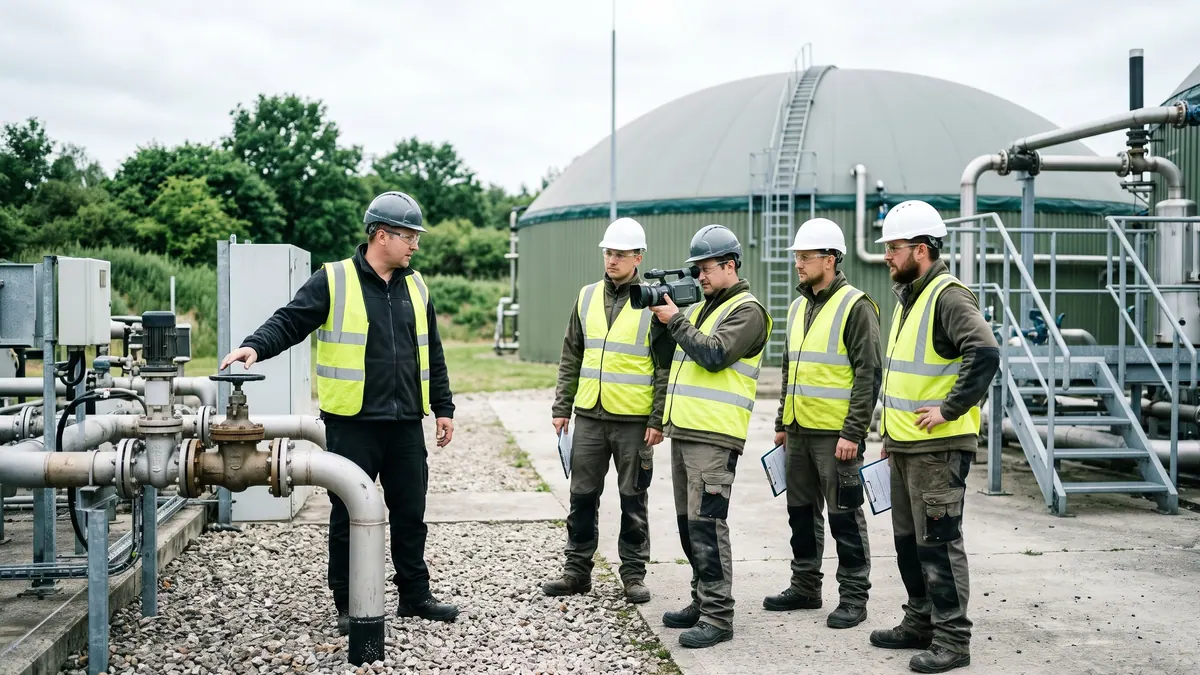
A leak detection and repair programme includes an inventory of points (flanges, valves, penetrations), setting the inspection frequency, the threshold for treating something as a leak, the repair time and documentation. For biogas installations it makes sense to scan the whole site at least once a year and to inspect after every major service job. Inspection records also make it easier to demonstrate good practice to the insurer and the authorities.
Example of estimating the value of losses
Illustrative assumptions: the installation produces 2.9 million m³ CH₄ per year. A loss of 1% means 29,000 m³ CH₄, i.e. energy of around 289 MWh (at 9.97 kWh/m³). If one cumulative leak consumes 2 m³ CH₄/h, over a year that gives 17,520 m³ (0.6% of production). Such calculations show that detecting and repairing a few larger leaks pays off not only environmentally but also financially; you will work out the specific value by substituting your own energy price.
Reduction
- A flare that is operational and ready — it is better to burn excess gas than to release it through a valve.
- Gas store management — keeping the fill level with a margin, avoiding foam in the valves.
- Closing the digestate — gas-tight tanks with recovery or at least a cover; optimisation of HRT.
- CHP servicing — correct adjustment of the mixture, cleanliness, emission control; where necessary, catalytic oxidation of the exhaust.
- Servicing procedures — limiting releases during overhauls (emptying to the flare, not to the atmosphere).
- Continuous monitoring — sensors at critical points, alarms.
The EU Methane Regulation — what to know about it
Regulation (EU) 2024/1787 sets out requirements for the measurement, reporting and verification of methane emissions and for LDAR programmes in the energy sector, mainly with regard to oil, natural gas and coal, including requirements for imports. It is not an act aimed directly at agricultural biogas plants, but it affects the gas market and increases the emphasis on limiting methane losses across the whole chain. The scope of obligations concerning biomethane and gas infrastructure and the implementation deadlines should be checked in the current text of the act and in national implementing regulations.
Checklist
- Do we have an up-to-date inventory of points of potential leaks?
- Was a scan (OGI or equivalent) carried out in the last 12 months?
- Were the roof valves and membranes inspected?
- Is the digestate stored in a tank with emission control?
- Does CHP servicing include a check of emissions and load?
- Is the flare operational and available?
- Is the gas balance kept and analysed?
Reducing methane losses is a rare case in which the interests of the environment, safety and economics coincide.
Work organisation and responsibility
Appoint a person responsible for the loss reduction programme, set targets (e.g. the maximum permissible level of loss relative to production) and report results quarterly. Effectiveness depends on whether the crew reports minor leaks immediately, rather than only at the annual inspection. A simple reporting system (a card, an app) and quick repairs build a culture of care for tightness.
Safety and methane
Leak detection is also an element of explosion safety: every leak that is located reduces the risk of an explosive atmosphere forming. During inspections use equipment rated appropriately for the zones and do not enter rooms where a large leak is suspected without ventilation and detection.
Sources
Questions and answers
How much methane does a typical biogas plant lose?
Values in the literature vary widely, from a fraction of a per cent to several per cent of production, depending on the design, the covering of the digestate and the quality of operation. The best answer is a measurement at your own plant.