Law and regulationAnalysis
Liability and penalties: what a biogas plant risks for breaching regulations
A biogas plant is liable administratively, civilly and criminally: for waste, emissions, the register of agricultural biogas producers, water and construction. We review the main penalty regimes and how to defend yourself.
Other language versions: polski.
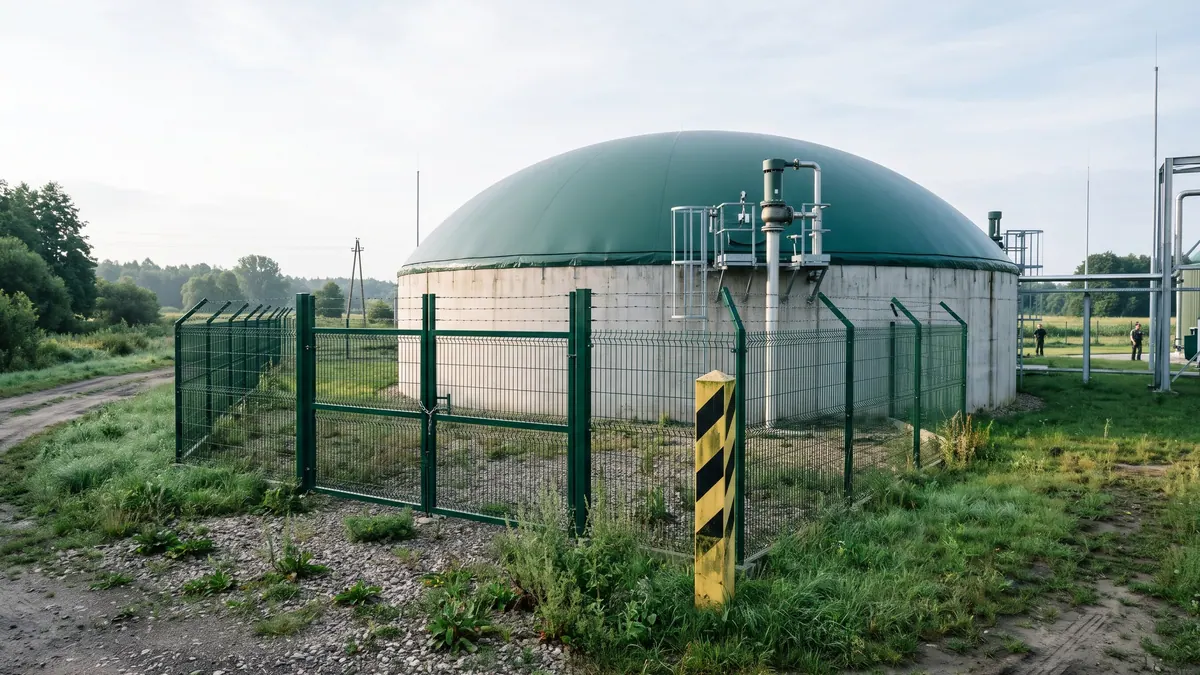
A biogas plant bears liability in several regimes at the same time: administrative (fines, halting of operations, orders), civil (damage to neighbours) and criminal (towards natural persons). There is no single "tariff of penalties" – the type of sanction is determined by the provision that was breached and the authority that found the breach. Below is an overview of only those regimes that are confirmed by the text of the acts in force.
A map of penalties and authorities
| Area | Basis | Typical breach | Authority |
|---|---|---|---|
| Waste | Waste Act, Articles 194–199 | processing or collecting waste without an authorisation; storage contrary to requirements; mixing of waste | voivodeship inspector for environmental protection |
| Environment, emissions | Environmental Protection Law (including Articles 276, 362, 364) | using the environment without a permit or in excess of conditions | WIOŚ, environmental protection authority |
| Agricultural biogas | Act on Renewable Energy Sources, Article 168(20)–(24) | production without an entry in the register or contrary to the entry | Director General of KOWR |
| Special act on agricultural biogas plants | Article 8 | failure to inform KOWR of loss of the conditions | Director General of KOWR (PLN 10,000) |
| Energy | Energy Law, Article 56 | activity without a licence, breach of operator obligations | President of URE |
| Construction | Construction Law | works without a permit, use without the required documents | building supervision authorities |
| Water | Water Law | use of water or discharge of wastewater without a water-law permit | water authorities |
Waste: the greatest risk for waste-processing biogas plants
An administrative fine is imposed for, among other things, collecting or processing waste without the required authorisation (PLN 1,000 to PLN 1,000,000), for managing waste contrary to the authorisation and for storage contrary to requirements (Article 25). Transporting waste without an authorisation or an entry in the register is subject to a fine of PLN 2,000 to PLN 10,000. In setting the amount of the fine, the inspector takes into account the type of breach, the effect on life, health and the environment, duration, scale of activity, and the consequences and extent of the danger. The fine is paid within 14 days from the moment the decision became final.
Environment: increased charge, fine and halting
An entity using the environment without the required permit bears an increased charge; where the conditions of a permit are exceeded or breached, it bears the charge and an administrative fine (Article 276). The authority may impose an obligation to limit impact or to restore the environment to a proper state (Article 362), and in case of deterioration of the state of the environment on a significant scale or danger to life and health – the WIOŚ halts operations (Article 364). Using an installation without an integrated permit, where required, is also subject to a halt (Article 365).
The register of agricultural biogas producers and KOWR penalties
Producing agricultural biogas or biomethane from agricultural biogas in a renewable installation (or electricity in an installation other than a micro-installation) without an entry in the register of agricultural biogas producers, or contrary to its content, is grounds for a fine imposed by the Director General of KOWR. In determining the fine the authority takes into account the scope and repetition of breaches and the financial benefit, and may waive the fine where the breach is negligible and has been remedied. The fine is paid within 14 days of the decision becoming final, and the appeal is considered by the minister responsible for agricultural markets.
Criminal liability
The Criminal Code contains provisions on pollution of the environment (Article 182) and offences connected with waste (Article 183). Natural persons are liable – those operating the installation, managers, employees who breached their duties. The sanction may be a fine, restriction of liberty or imprisonment, depending on the scale. In addition, neighbours may pursue civil claims for damage and nuisance.
How to reduce the risk
- Keep a current register of authorisations, permits and notifications with expiry dates.
- Compare every change of substrates, capacity or technology with the scope of the permits and the entry in the KOWR register.
- Document waste: cards, records, storage in line with requirements.
- Carry out the measurements and tests required in the decisions.
- React to an inspection: cooperate, submit explanations in writing, remedy shortcomings, apply for a waiver of the fine if the breach is minor.
- Train employees in health and safety, ATEX and conduct in an emergency.
Inspections and explanations
An inspection is carried out by the authority competent for the given regime: the environmental protection inspectorate checks waste, emissions and the conditions of permits, KOWR verifies the register of agricultural biogas producers, and building supervision – the legality of facilities. Most often the documentation is verified first (authorisations, waste transfer cards, records, measurement protocols), and then the actual state on site. A dispute over the amount of a fine is usually a dispute about circumstances: the duration of the breach, its extent, the consequences and whether the entity remedied it promptly. It is therefore worth keeping an event log in which failures, departures from the technology and corrective actions taken are noted.
Civil liability and insurance
Besides public-law sanctions, neighbours and other persons may pursue civil claims for damage and excessive interference, for example odour or noise. Biogas plants usually hold property, third-party liability and business interruption insurance, but policies have exclusions, so the scope of cover (including environmental damage) has to be analysed separately.
This text is for information only and does not constitute legal advice; before an investment or formal decision, check the current wording of the legislation and consult a lawyer or the relevant authority.
Sources
Questions and answers
Can a penalty decision be appealed?
Yes. A decision of the Voivodeship Inspectorate for Environmental Protection (WIOŚ) can be appealed to the Chief Inspector for Environmental Protection, a decision of the Director General of KOWR to the minister responsible for agricultural markets, and a decision of the President of the Energy Regulatory Office (URE) to the Court of Competition and Consumer Protection.
Who imposes penalties on a biogas plant?
It depends on the infringement. For waste, emissions and use of the environment, the voivodeship environmental protection inspector imposes the penalty; for the register of agricultural biogas producers, the Director General of KOWR; for infringements in the area of energy and licences, the President of the Energy Regulatory Office (URE).
Related articles