BMP testingGuide
TS and VS in BMP testing: how to determine dry matter and measurement pitfalls
The BMP result refers to volatile solids (VS), so its determination is the foundation. How drying and ignition work, where losses of volatiles come from and how to avoid them.
Other language versions: polski.

The BMP result is usually given in NmL CH₄ per gram of volatile solids (VS), so correct determination of TS (total solids, dry matter) and VS (volatile solids) is the foundation of the entire test. TS is determined by drying the sample at about 105 °C to constant mass, and VS — by igniting the dried sample at about 550 °C and calculating the loss of mass (what has burnt off) as a fraction of TS. An error in these determinations passes directly into the BMP result.
Formulas
TS [%] = (mass after drying / fresh mass) × 100. VS [% TS] = (mass after drying − mass after ignition) / mass after drying × 100. VS [% of fresh mass] = TS × VS/100. Ash = 100% − VS (in % TS).
Calculation example
Assumptions: 50.00 g of fresh silage; after drying 16.50 g; after ignition 0.80 g of ash. TS = 16.50 / 50.00 = 33.0%. VS = (16.50 − 0.80)/16.50 = 95.2% TS. VS in fresh mass = 0.33 × 0.952 ≈ 31.4%. In the BMP test a dose of 2 g VS therefore requires 2 / 0.314 ≈ 6.4 g of fresh silage.
Pitfalls — losses of volatiles
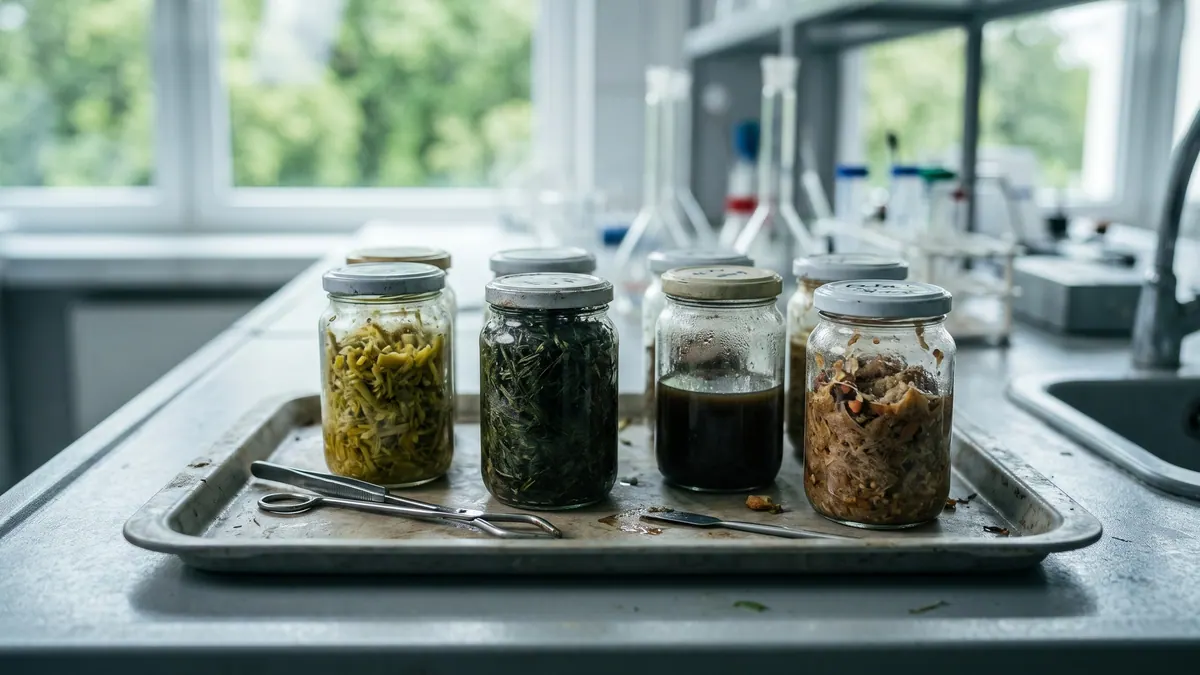
In silages, stillage, kitchen waste and slurry a significant part of the volatile compounds (volatile fatty acids, e.g. acetic and butyric, alcohols, including ethanol, esters, ammonia) evaporates at 105 °C. This means that:
- TS is understated, and VS as well, because volatiles belong to the organic matter,
- BMP expressed per "VS from drying" can be overstated, because the denominator is understated.
For ensiled silages, corrections are applied (e.g. according to methods described in the literature for silages: accounting for volatile compounds measured separately). The protocol recommends stating whether such corrections were applied.
Other sources of error
| Source | Effect | Prevention |
|---|---|---|
| Unrepresentative sample | large scatter of TS/VS | homogenisation, several replicates |
| Insufficiently dried sample | overstated water | drying to constant mass, checking 2 weighings |
| Absorption of moisture by the ash | understated VS | cooling in a desiccator |
| Ignition temperature too high | loss of carbonates (decomposition) | keep at about 550 °C |
| Content of salts and minerals | understated VS | determine the ash, consider a correction |
| Lumps / no size reduction | uneven drying | size reduction before drying |
Specifics of different materials
- Silages: losses of volatiles, as above.
- Slurry and digestate: high water content and salts — high uncertainty at low TS; more replicates.
- Kitchen waste and fats: heterogeneity, large samples required.
- Straw: low moisture, but size reduction is important.
- Inoculum: TS and VS are necessary for calculating I/S — understating them changes the ratio.
Why this matters for I/S
The inoculum-to-substrate ratio is calculated in grams of VS. If the VS of the substrate is understated by 10%, the actual I/S ratio is lower than declared, which increases the risk of overloading and acidification in the test.
Checklist
- Take a representative sample (several hundred grams, homogenisation).
- Determine TS in at least two replicates; a difference of below a few per cent relative.
- Determine VS on the dried sample; cool in a desiccator.
- Note the temperature and time of drying and ignition.
- For products with volatile compounds apply or describe a correction.
- In the report give TS, VS and uncertainty, and the BMP result in NmL/g VS.
Reliable TS and VS are the basis of comparability of results: in publications and reports, one of the most common causes of discrepancies between laboratories is different ways of converting to VS.
Example of the effect of a VS error
Let us assume that the actual volatile solids of the silage are 31.4% of fresh mass, and the laboratory understated them through losses of volatiles to 29.0%. If 6.4 g of silage was weighed in the test, the declared VS is 6.4 × 0.29 = 1.86 g, and the actual 2.01 g. The measured methane, related to the understated VS, will come out about 8% higher than the true value. An error of this size is comparable to the entire scatter between good laboratories, which is why it is worth controlling.
Documentation
In the test report record the sample batch, the number of TS/VS replicates, the initial and final masses and the method of cooling. In case of doubt, ask for the determinations to be repeated on the retained sample.
Recommendation for the client
When handing a sample to the laboratory, pack it in a gas-tight container with no free space, cool it and deliver it as quickly as possible; silages and slurry are best frozen if analysis will not take place within a day. State the type of material in the order so that the laboratory can choose the determination method and any correction for volatiles. For materials of high variability, take samples from several places of the clamp or tank and combine them into a composite sample.
Sources
Questions and answers
Why is BMP reported per VS rather than per fresh matter?
Fresh matter contains a variable amount of water and ash. VS describes the matter that can actually be broken down, which allows substrates with different moisture content to be compared.
Related articles