BMP testingGuide
Inoculum in the BMP test: where to get it, how to prepare it and how to assess activity
The inoculum determines the reliability of a BMP test. We discuss sources, degassing, control parameters (VS, pH, alkalinity, VFA, NH₄⁺) and the effect on kinetics and result.
Other language versions: polski.
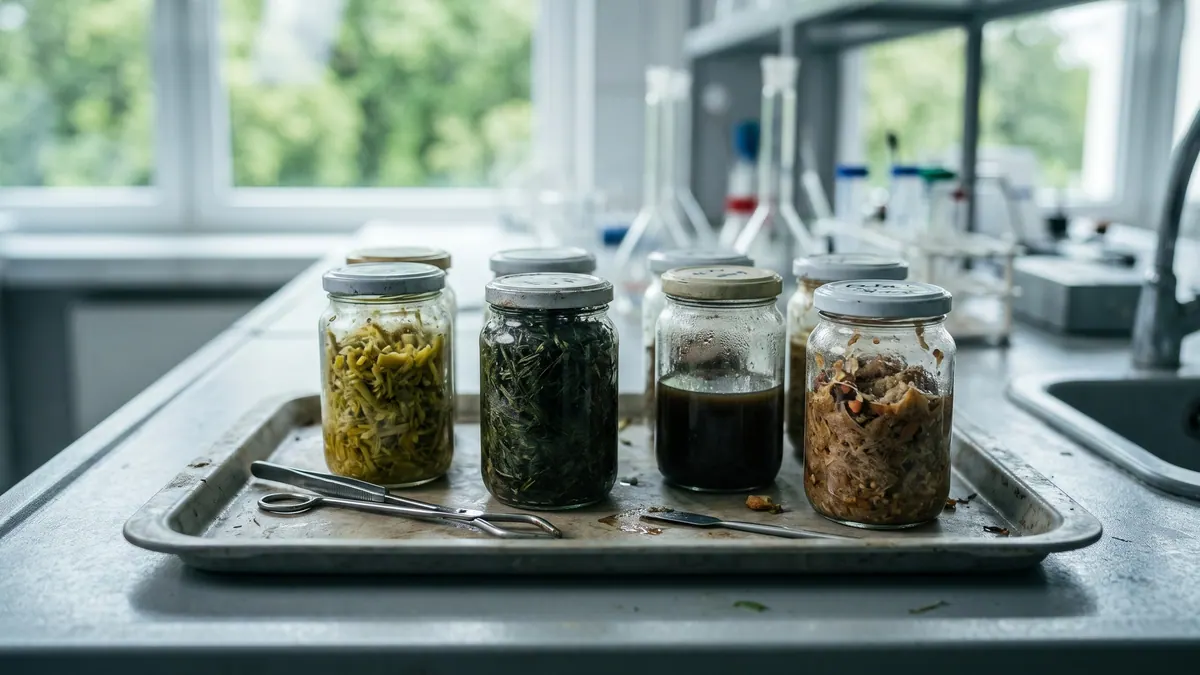
Inoculum in a BMP test is a suspension of active anaerobic microorganisms that is to break down the tested substrate and convert it into methane. It should come from a reactor operating stably, be adapted to a similar type of material, be degassed to low endogenous production and be characterised (VS, pH, alkalinity, VFA, ammonium nitrogen). The guidelines stress that the quality of the inoculum is one of the main sources of scatter in results between laboratories.
Sources of inoculum
| Source | Advantages | Disadvantages |
|---|---|---|
| Digestate from an agricultural biogas plant | adapted to agricultural substrates, readily available | variable composition, high fibre share, possibly high NH₄⁺ |
| Sludge from a treatment plant digester | stable, well described | different community, may break down lignocellulosic materials more slowly |
| Granular sludge from UASB reactors | very active, small amount of VS | specific to wastewater, limited availability |
| Mixtures from several sources | averaged properties | harder to standardise |
The choice depends on the purpose: for agricultural substrates agricultural digestate is the natural choice, for sludges and bio-waste — inoculum from a treatment plant or a bio-waste installation. Always state the source in the report.
Degassing (pre-incubation)
Fresh inoculum still contains degradable residues. To limit the background, it is kept for a few days (usually from 2–3 to a dozen or so) at the test temperature, in a closed vessel with gas venting. The effect is monitored by gas production: the guidelines recommend that endogenous production be as low as possible relative to production from the substrate, so that the error of subtracting the background does not dominate. Degassing for too long lowers activity.
Control parameters
- VS and TS — needed to calculate I/S.
- pH — usually in the neutral to slightly alkaline range (about 7.0–8.2).
- Alkalinity (TAC) and VFA — high alkalinity and low VFA indicate stability.
- Ammonium nitrogen (TAN) — high TAN may inhibit sensitive substrates or make the result dependent on adaptation.
- Methanogenic activity — optionally a test with acetate or hydrogen.
- Absence of inhibitors — heavy metals, antibiotics, detergents.
Effect of inoculum on the result
- Lag — poorly adapted inoculum will cause a longer lag phase.
- Kinetics — the rate constant k is often strongly dependent on the inoculum; comparing k between laboratories requires caution.
- Final yield — for easily degradable substrates the differences are small; for difficult ones (lignocellulosic, fats) larger.
- Background — high endogenous production increases uncertainty.
Calculation example: effect of the background
Let us assume inoculum A: endogenous production 140 NmL/bottle; inoculum B: 350 NmL/bottle. In both cases the sample with the substrate gives 600 NmL, with 1.5 g VS. BMP_A = (600 − 140) / 1.5 ≈ 307 NmL CH₄/g VS; BMP_B = (600 − 350) / 1.5 ≈ 167 NmL CH₄/g VS. The example is exaggerated, but it shows that when production reaches more than half of the signal, the uncertainty of the background is transferred to the result. This is why degassing and a proper I/S, which ensures that the substrate signal dominates, are recommended.
Good practices
- Collect inoculum from a reactor operating stably, preferably from several points for averaging.
- Transport in a tight container, maintain the temperature, avoid access of oxygen.
- Grind/sieve large particles to ensure homogeneity of the sample weights.
- Degas and characterise each batch.
- Use the same inoculum throughout a series, and if it has to be changed — carry out a cellulose control for both.
- Document the source, date of collection, parameters and degassing time.
Risks
- Inoculum from an installation operating in crisis (high VFA) will give an unreliable result.
- Inoculum stored for a long time in poor conditions loses activity.
- A high content of undegraded substrate residues raises the background.
- Changing the source during a project makes comparisons harder.
Inoculum activity test
A simple activity test consists of adding acetate or a mixture of acids to the inoculum and measuring the rate of methane production. This makes it possible to distinguish inoculum of good activity from degraded inoculum, even when the chemical parameters look correct. Laboratories keep activity control charts for successive batches, which makes it easier to catch drift.
Storage
It is best to use fresh inoculum. If it has to be stored, this is done briefly, at a low temperature or under mesophilic conditions with minimal feeding, and before the test it is reactivated and degassed again. Frozen inoculum usually loses activity and needs a longer adaptation time.
Inoculum checklist
- [ ] Source, date and place of collection recorded.
- [ ] VS, TS, pH, TAC, VFA and TAN determined.
- [ ] Degassing carried out, time recorded.
- [ ] Endogenous production assessed as low relative to the substrate signal.
- [ ] Cellulose control carried out on the same batch.
- [ ] Large particles sieved out, suspension homogenised before filling.
If any item is not met, this must be stated explicitly in the report; the reader will then assess the reliability of the result knowingly, instead of assuming that everything was within the norm.
Inoculum and the type of material tested
When testing fats, protein-rich waste or substrates with potential inhibitors, it is worth reaching for inoculum already adapted to similar materials or carrying out a longer pre-incubation. For ordinary silages and slurry, agricultural digestate is usually sufficient. Whatever the choice, reproducibility is key: the same inoculum quality in successive series makes comparisons easier.
Sources
Questions and answers
Can inoculum from a wastewater treatment plant be used to test agricultural substrates?
It can, but this must be stated. Inoculum from sewage sludge has a different microbial community and often lower activity towards lignocellulosic materials; for difficult substrates the result and kinetics may differ from a test with agricultural digestate.
Related articles