BiomethaneAnalysis
Biogas upgrading technologies: comparing membranes, PSA, scrubbers and cryogenics
Five families of technology remove CO₂ from biogas: membranes, PSA, water scrubbing, amine scrubbing and cryogenic separation. We compare the operating principle, methane losses and energy demand.
Other language versions: polski.
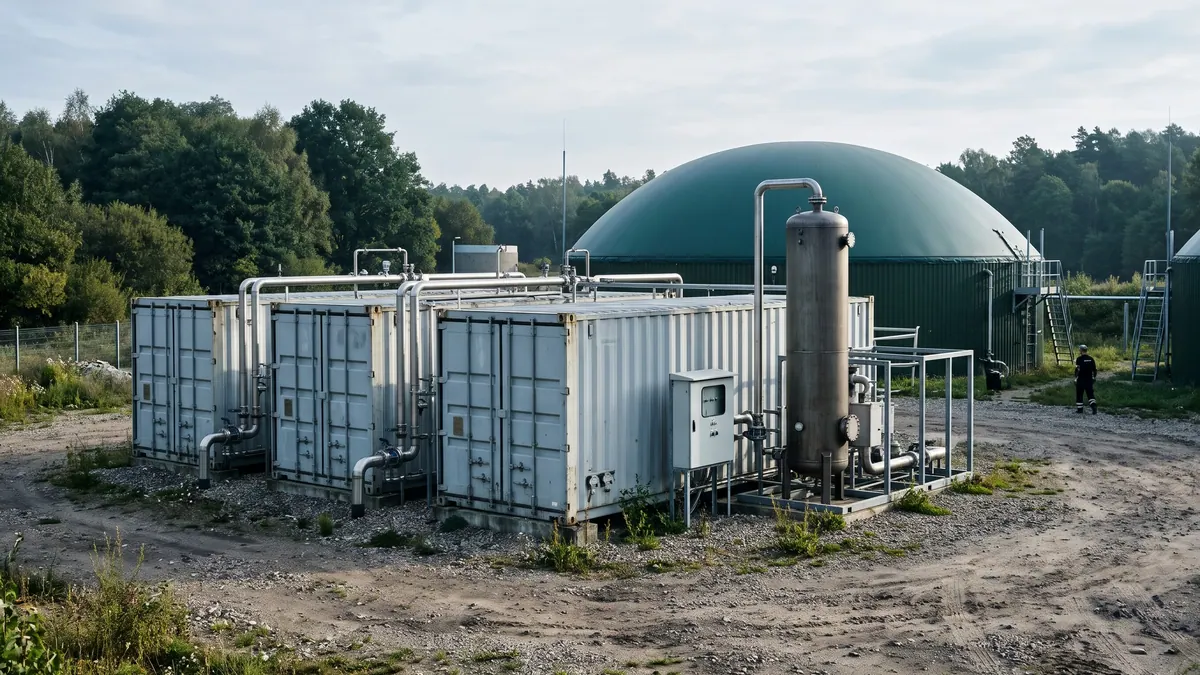
Five main families of technology are used to remove CO₂ from biogas: membrane separation, pressure swing adsorption (PSA), physical absorption in water, chemical absorption in amines and cryogenic separation. None wins on all criteria – membranes are compact and modular, amine scrubbing has the lowest methane losses, water scrubbing is simple and robust, PSA competes on price, and cryogenics yields liquid CO₂ or bioLNG at the outlet. The comparison below is indicative: exact values depend on the supplier, contractual guarantees and operating conditions.
Operating principles in a nutshell
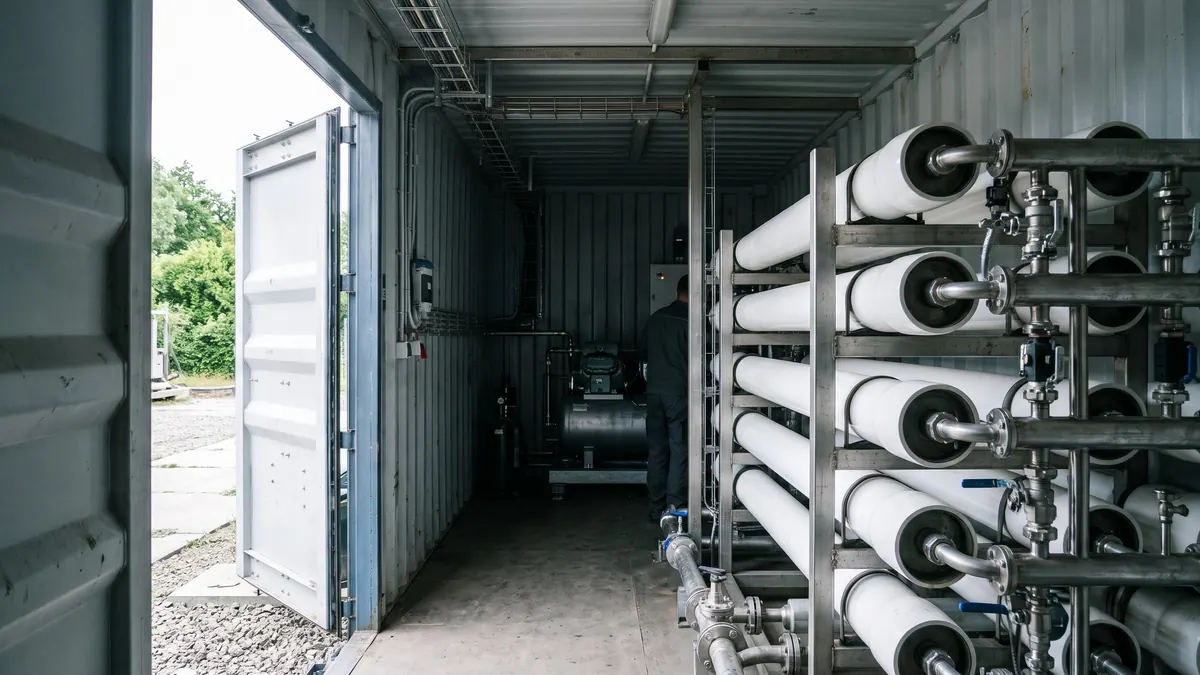
- Membranes – the gas flows through polymer fibres in which CO₂ (and water vapour) permeates faster than CH₄. The methane remains on the retentate side.
- PSA – CO₂ is adsorbed on a molecular sieve (carbon or zeolite) at elevated pressure and desorbed at reduced pressure; several columns operate cyclically.
- Water scrubbing – CO₂ dissolves in water many times better than CH₄ (of the order of 25 times at room temperature), so water in a pressurised column binds mainly CO₂.
- Amine scrubbing – CO₂ reacts chemically with an amine solution; the solvent is regenerated with heat at a temperature of approx. 110–140°C.
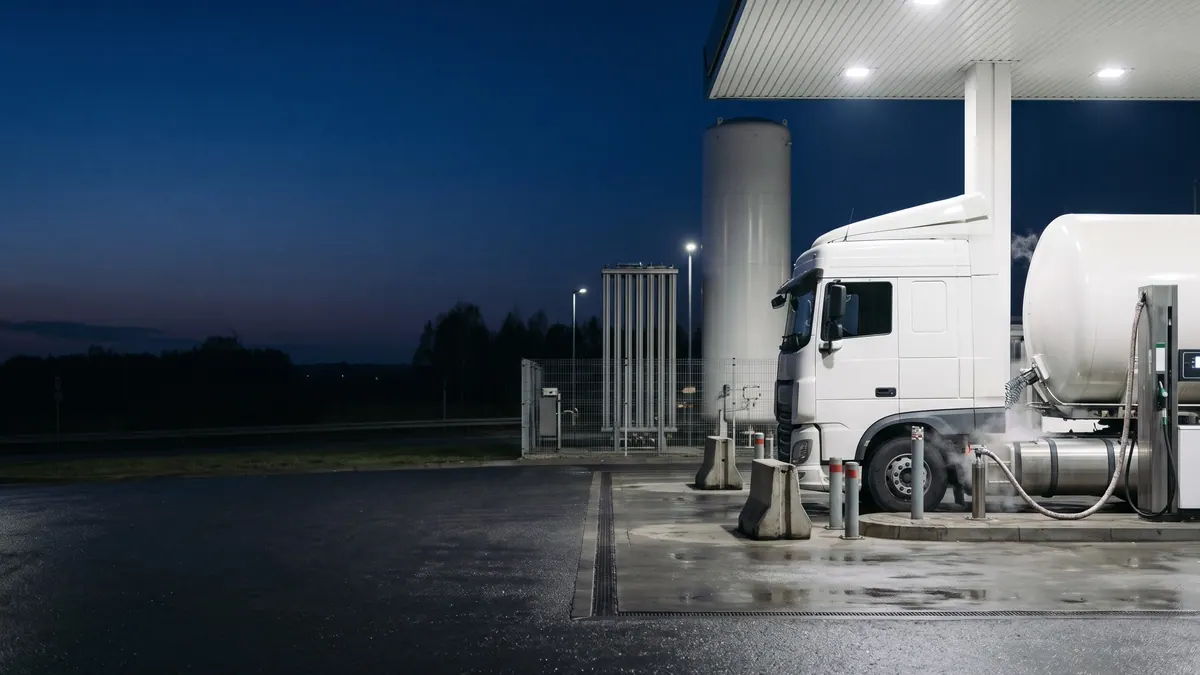
- Cryogenics – biogas compressed and cooled to low temperatures at which CO₂ condenses or desublimates and is separated from the methane.
Indicative comparison
| Criterion | Membranes | PSA | Water scrubbing | Amine scrubbing | Cryogenics |
|---|---|---|---|---|---|
| Methane losses (modern systems) | usually below approx. 1% | usually approx. 1% or less | approx. 0.5–1.5% | usually below 0.1–0.2% | low, depending on the system |
| Main energy demand | electricity | electricity | electricity | heat + little electricity | electricity (cooling) |
| Purity of the CO₂ stream | low (permeate with methane) | low | low (air stripping) | high (>99%) | high, often liquid CO₂ |
| Pretreatment requirements | drying, removal of H₂S and VOC | removal of H₂S and VOC | tolerant of H₂S | removal of H₂S | deep drying |
| Advantage | modularity, simplicity | low price | robustness, no chemicals | lowest CH₄ slip | bioLNG and liquid CO₂ |
| Disadvantage | CH₄ losses with a single stage | complex automation | water, large columns | need for heat, amine waste | complexity and CAPEX |
How the technology is chosen
- Scale. A small and medium-sized agricultural plant (a few hundred m³/h of biogas) usually chooses membranes, because they are compact and quick to install. Large installations also consider scrubbers.
- Waste heat. If cheap heat is available nearby (e.g. from an existing CHP, a biomass boiler or an industrial plant), amine scrubbing becomes attractive – its largest cost, regeneration, is then low.
- Use of the CO₂. If the CO₂ is to be sold (e.g. to the food industry), high purity is needed, which is provided by amine scrubbing or cryogenics; with the other technologies the waste stream has to be additionally purified.
- Methane losses. Every percent of slip is lost revenue and a greenhouse gas emission.
- Availability of service. It matters whether the supplier has local support and guarantees availability.
An illustrative calculation
Assumptions: a biogas stream of 1000 m³/h with 55% CH₄ (550 m³/h of methane), methane slip of 0.5% in variant A and 1.5% in variant B, 8000 operating hours per year. Methane loss in A: 550 × 0.005 × 8000 ≈ 22 thousand m³, in B: 550 × 0.015 × 8000 ≈ 66 thousand m³. The difference is approx. 44 thousand m³ of CH₄ per year, i.e. approx. 440 MWh (at approx. 10 kWh/m³). For gas valued at PLN 200/MWh this gives approx. PLN 88 thousand per year – an amount that over a horizon of more than a dozen years can justify a more expensive technology if the difference in CAPEX is small. The price of PLN 200/MWh is a calculation assumption, not a quotation.
Trends
Suppliers combine technologies, e.g. membranes with final polishing of methane from the off-gas by a thermal oxidiser or an additional separation stage, and amine scrubbing with heat recovery from compression. The importance of using biogenic CO₂ and limiting emissions from the off-gas is growing, which will affect legal requirements and the GHG balance.
What to look at in an offer
Besides the parameters from the table, compare the full scope of supply. One offer includes pretreatment, drying, a compressor, an off-gas afterburning system and an injection station, another only the separation module. Ask about guaranteed availability (as a percentage of the year), the costs of replacing consumables (membranes, sorbent, solvent, packing), delivery time and the range of operation at partial load. In practice an agricultural installation rarely operates at a constant, design flow of biogas, because production depends on feeding the digesters. A system that copes well with a load of 50–60% of nominal may be worth more than a system with slightly lower losses at the design point.
Summary
A sensible choice requires comparing total costs (CAPEX + OPEX + the value of methane losses) and taking into account local conditions – heat, water, electricity and the CO₂ market. You will find a detailed discussion of each technology in the following entries of the series.
Sources
Related articles