Digestate and fertilisersExplainer
Digestate composition: nitrogen, phosphorus, potassium, sulphur and organic matter
Digestate is an organic fertiliser of variable composition. What it contains, how this depends on the substrates, and why the form of nitrogen (ammonium vs. organic) determines its value.
Other language versions: polski.
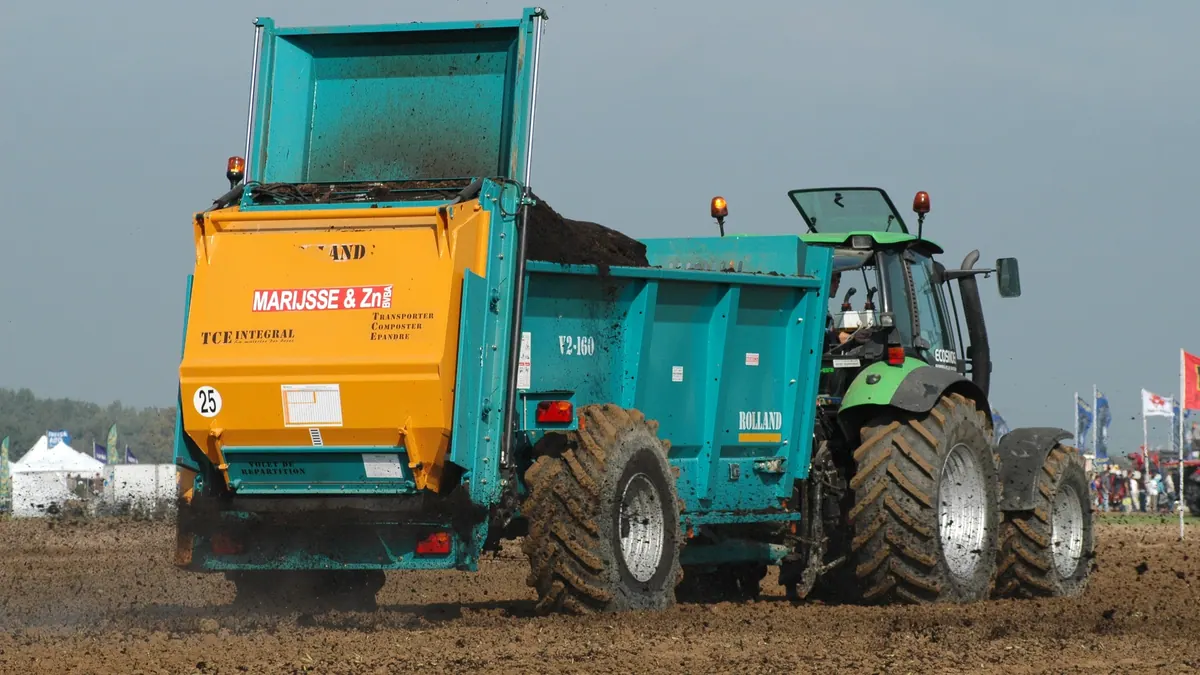

Digestate is the residue after fermentation, which retains most of the mineral components of the substrates while its organic matter is largely decomposed. Its composition depends primarily on the substrate mix: digestate from slurry and silage has a few per cent dry matter and about a few kg of total nitrogen per tonne, a considerable part of it in ammonium form. Because the scatter is large, the assessment has to be based on an analysis from your own plant.
What happens to the components in the digester
- Carbon — a large part of the organic matter is converted into CH₄ and CO₂, so organic dry matter decreases.
- Nitrogen — it does not escape with the biogas (apart from traces of NH₃); organic nitrogen from proteins is mineralised to ammonium nitrogen (N-NH₄⁺). The amount of total nitrogen is approximately conserved.
- Phosphorus — it remains; part precipitates in the form of phosphates.
- Potassium — it remains in solution; in digestate it occurs largely in dissolved form.
- Sulphur — part escapes with the gas as H₂S, part stays in the digestate as sulphides and organic sulphur.
- pH — it rises (usually 7.5–8.5), which increases susceptibility to ammonia volatilisation.
Indicative ranges
The values below are illustrative (fresh mass); actual composition may differ significantly.
| Parameter | Digestate from slurry (mainly cattle) | Digestate with silage, high share of crops | Digestate with poultry droppings/waste |
|---|---|---|---|
| Dry matter [%] | 4–8 | 6–10 | 6–12 |
| Total N [kg/t] | 2–4 | 3–5 | 5–10 |
| Share of N-NH₄ in total N | approx. 50–65% | approx. 50–70% | approx. 60–80% |
| P (as P₂O₅) [kg/t] | 1–2 | 1.5–2.5 | 2–5 |
| K (as K₂O) [kg/t] | 2–4 | 3–5 | 3–6 |
Why the form of nitrogen matters
Ammonium nitrogen acts like a mineral fertiliser: it is quickly available to plants, but when applied without rapid incorporation into the soil it volatilises as NH₃. Organic nitrogen is released slowly. The fertilisation plan should therefore take into account what part of the N is available in the year of application, and the application technique (a separate article).
Organic matter and humus
Although digestion reduces the content of easily degradable organic matter, digestate (especially the solid fraction) supplies more stable carbon to the soil. The soil-forming effect itself depends on the rates; liquid digestate contains relatively little of it per unit volume.
Contaminants and safety
- Heavy metals (Cu, Zn from feed and additives) may occur in digestate because of the substrate — analyse for them, especially with pig slurry and trace-element additives.
- Physical contaminants (plastic, glass from waste) — depend on the quality of separation at the input.
- Pathogens — reduced in the process, but hygienisation requirements depend on the type of substrates.
- Weeds — seeds are for the most part deactivated at thermophilic temperature, to a lesser extent at mesophilic.
Legal aspects
The legal status of digestate (natural fertiliser, by-product, waste, EU fertilising product) depends on the substrates and the way it is placed on the market. Regulation (EU) 2019/1009 makes it possible to place on the market fertilising products bearing the CE mark, including digestates that meet specified criteria (categories of component materials for digestate). The legal route should be determined for the specific plant — we recommend consulting an adviser or the competent authority.
Checklist of determinations
- Dry matter, organic dry matter.
- Total N, N-NH₄, pH.
- P, K, Mg, Ca, S.
- Heavy metals (Cd, Pb, Cu, Zn, Cr, Ni, Hg, As) when a sale is planned or for risk assessment.
- Repeat analyses seasonally and after a change of mix.
Knowing the composition makes it possible to plan fertilisation without excessive rates, reduce purchases of mineral fertilisers and estimate the commercial value of the product.
Example: how much nitrogen in a rate
Suppose a digestate from slurry and silage in which the analysis showed 4.0 kg of total N per tonne, including 2.6 kg of N-NH₄ (65%). A rate of 30 t/ha supplies 120 kg of total N, of which 78 kg is ammonium N. If the utilisation of ammonium nitrogen in the year of application is, say, 60–70% (depending on technique and conditions — an example value), the crop will obtain the equivalent of about 47–55 kg of mineral N from the ammonium fraction plus part of the organic nitrogen. Such a calculation shows why, without an analysis, it is easy both to overdose and to underfeed the field.
Variability over time
The composition of digestate changes with the substrate mix, the season and the degree of degradation. Take samples from several places in the tank after mixing and analyse at least once a year, and more often when the recipe changes.
Practical conclusion
The cheapest way to improve digestate management is regular analysis and keeping a nutrient balance that takes the form of nitrogen into account. This helps limit purchases of mineral fertilisers, avoid exceeding limits and show whether separation or nitrogen recovery pays off. Composition data are also the basis for talks with digestate recipients and for reporting it in farm fertilisation plans.
Sources
Questions and answers
Does digestate contain more nitrogen than raw slurry?
The amount of total nitrogen per unit of mass is similar or slightly higher (most of the nitrogen stays in the digestate, while carbon escapes as biogas), but the share of ammonium nitrogen is higher, so the nitrogen is available to plants faster and is more prone to volatilisation.
Related articles