Law and regulationGuide
Storage and application of digestate: tanks, dates, distances and good practice
How to store and apply digestate in line with the regulations: tank capacity, covering of lagoons, dates from the nitrates programme, distances from water and ways of reducing ammonia emissions.
Other language versions: polski.
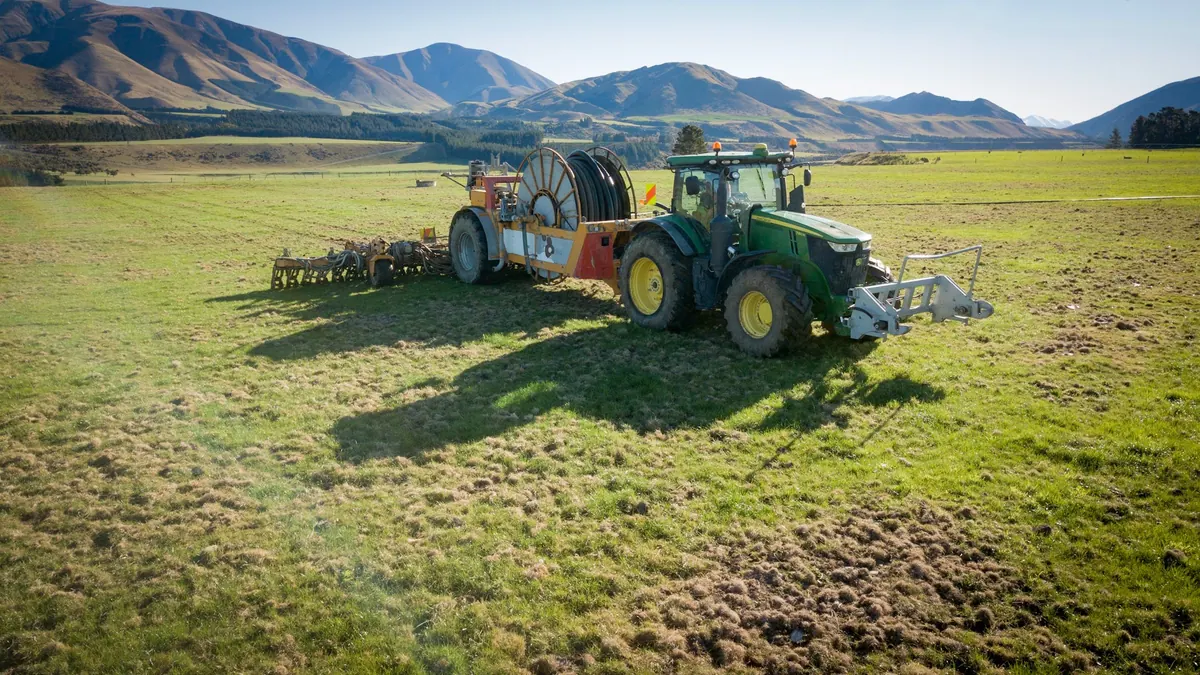

Digestate must be stored in leak-tight, covered tanks and applied on the dates and in the doses in line with the nitrates programme, maintaining distances from water. The most important tools for limiting nitrogen losses and odour nuisance are good storage capacity, injection into the soil and rapid mixing with the soil. Below are the requirements in force in August 2022.
Capacity and construction of stores
The nitrates action programme (Dz.U. 2020 item 243) requires, for liquid natural fertilisers (slurry, liquid manure), tanks with a capacity allowing production from 6 months to be stored, and for solid ones (manure, droppings) areas with a surface for 5 months. Tanks must have a leak-tight base and walls, and liquid fertilisers should be covered (e.g. with a flexible or floating cover), which reduces ammonia and odour emissions. The adaptation deadlines passed for large farms (above 210 LU) at the end of 2021, and for smaller ones expire at the end of 2024.
Digestate does not fall within the definition of "natural fertilisers" in the act on fertilisers and fertilisation (manure, liquid manure, slurry, excrement of farm animals and guano). The capacity of its tanks therefore results mainly from the conditions of environmental decisions, R10 recovery or the fertiliser permit, and the nitrates programme is rather a reference point; in case of doubt it is worth asking the authority or an adviser. The reference point is nevertheless the programme's 6-month standard, because it is meant to ensure the possibility of storing the fertiliser during periods when it may not be spread on fields.
Additional storage rules arise from the fertilisers act itself: solid organic fertilisers are stored in unit packaging or in bulk in clamps on a hardened, impermeable base, covered with waterproof material, and liquid fertilisers — in closed packaging or leak-tight tanks. Liquid fertilisers are transported in closed, leak-tight tanks or tankers.
A sizing example
A biogas plant produces 12,000 m³ of liquid digestate per year, and recipients' fields take it mainly in spring and after harvest. A 6-month store is about 6,000 m³ of working capacity, plus a reserve for rainfall and uneven spreading. When the period without the possibility of spreading is longer (winter, drought, date requirements), the capacity must be increased. This is an illustrative example: real figures result from the nitrogen balance, the recipients' acreage and the conditions of administrative decisions.
When application is permitted
Dates for arable land: mineral nitrogen fertilisers and liquid natural fertilisers from 1 March to 20 October, solid natural fertilisers from 1 March to 31 October; on permanent grassland and perennial crops the dates are longer. In some municipalities shorter autumn dates apply. Exceptions: autumn fertilising after late-harvested forecrops (up to 30 kg N/ha) and, after adverse weather, until 30 November. Application is prohibited on frozen, flooded, saturated and snow-covered soil and of liquid fertilisers during the growing period of plants intended for direct consumption.
Distances from water and slopes
Near surface waters, strips without fertilising apply: for fertilisers usually 5 m, for slurry 10 m, and from large lakes and water intakes 20 m. When a crop is growing in the field, injection into the soil or splitting the dose into at least three equal parts at intervals of at least 14 days allows these distances to be halved. On steeply sloping land the distances are increased by 5 m, and natural fertilisers must be ploughed in or mixed with the soil within 4 hours, at the latest the next day.
Good practice for limiting losses
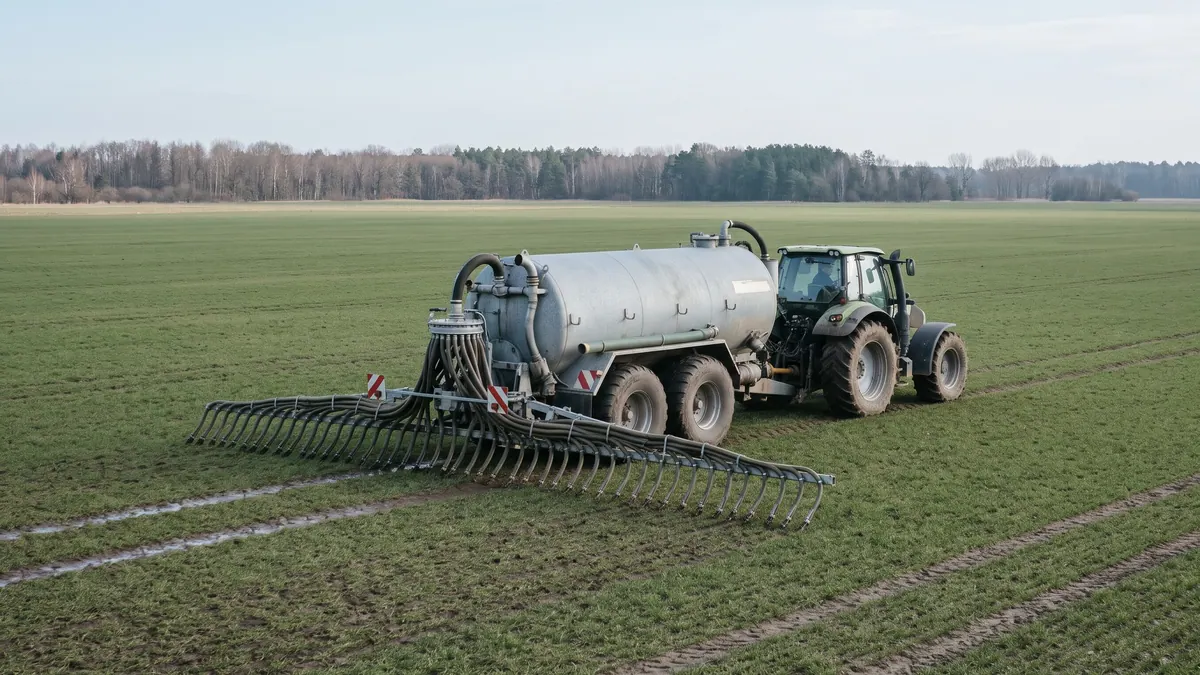
- Injection or band application instead of broadcasting "on top", especially for the liquid fraction.
- Rapid mixing with the soil (on arable land), which limits the volatilisation of ammonia.
- Choice of conditions: cooler days, no strong wind and no rainfall in the next few hours.
- Dosing according to plant needs and the N content from testing, not "by eye"; the last dose no later than the final date allows.
- Separation of digestate into a liquid and a solid fraction eases transport, storage and matching to the needs of the fields.
- Records of treatments: date, area, crop, type and dose; documents are kept for 3 years.
Typical problems in practice
- Seasonality. A biogas plant produces digestate all year round, while farmers can apply it only during the growing season and on the permitted dates. Hence the need for large tanks or intermediate stores at recipients' farms.
- Dilution. Liquid digestate has a low nutrient content per tonne, so transport over long distances is uneconomical. Separation and thickening of the solid fraction improve the economics.
- Uneven composition. The nitrogen content changes with the feedstock recipe; a fertilisation plan based on a single analysis from a year ago may be off the mark.
- Ammonia. Digestate usually has a high pH and a large part of its nitrogen in ammonium form, so uncontrolled spreading risks losses and odour nuisance.
Inspections and consequences
Compliance with the rules on fertiliser application is monitored by, among others, the Environmental Protection Inspectorate, and the nitrates programme is also enforced as part of the basic requirements in agriculture. A fee may be imposed for breaching the programme; the maximum rates are announced by the minister responsible for water management in notices. Evidence of diligence consists of the fertilisation plan, records of treatments, digestate test results and documents confirming tank capacity.
What to do first
- Test the composition of the digestate (total N, ammonium N, phosphorus, potassium, dry matter).
- Calculate the nitrogen balance for the fields that will receive the fertiliser.
- Check the tank capacity in months of production and the covering requirements.
- Prepare agreements with recipients and a spreading plan consistent with the dates.
This text is for information purposes only and does not constitute legal advice; before an investment or formal decision, check the current wording of the provisions and consult a lawyer or the competent authority.
Sources
- Rozporządzenie Rady Ministrów z 12 lutego 2020 r. — Program działań azotanowych (Dz.U. 2020 poz. 243)
- Ustawa z dnia 10 lipca 2007 r. o nawozach i nawożeniu — tekst jednolity z 2021 r. (ISAP/ELI)
- Ustawa z dnia 25 lipca 2025 r. o szczególnych rozwiązaniach w zakresie przechowywania nawozów naturalnych (Dz.U. 2025 poz. 1187) (aktualizacja)
Questions and answers
Can digestate be spread on fields in winter?
Not on frozen, flooded, water-saturated or snow-covered soils. Soil that thaws during the day, at least at the surface, is not considered frozen. The deadlines from the nitrates programme also apply.
Related articles